
1. Introduction: Pressure Is a State of Mind
We’ve all been there. That moment when your heart races, your thoughts scatter like startled birds, and the weight of expectation feels like an anvil on your chest. Maybe it’s the last-minute project deadline that just got moved up. Perhaps it’s the presentation to executives that could make or break your career. Or it could be something as seemingly routine as a team meeting where you need to defend your decisions.
Pressure isn’t just happening to you—it’s happening within you.
After spending years researching performance psychology and applying these principles in my own high-stakes career, I’ve discovered something revolutionary yet simple: pressure is fundamentally a state of mind, not an external force. Understanding this distinction changes everything about how we respond when the heat is on.
The Mindset Triangle: Your Internal Pressure System
At the core of our pressure response lies what I call the “Mindset Triangle”—a continuous feedback loop between our thoughts, emotions, and physiology. These three elements don’t just influence each other; they amplify each other, creating either an upward spiral toward optimal performance or a downward spiral into panic and paralysis.
Here’s how the triangle functions during pressure moments:
- Thoughts: “I can’t handle this” triggers…
- Emotions: Anxiety and fear, which trigger…
- Physiology: Shallow breathing, muscle tension, and racing heart, which reinforce…
- Back to Thoughts: “See? My body is proving I can’t handle this!”

This self-reinforcing loop explains why most pressure-management techniques ultimately fail. We try deep breathing without addressing catastrophic thinking. We attempt positive self-talk while our bodies remain in fight-or-flight mode. We focus on single elements instead of recognizing the interconnected system at work.
Why Most Pressure Management Approaches Fall Short
When we experience pressure, most of us react in one of three ineffective ways:
- Avoidance: Procrastinating, delegating unnecessarily, or creating elaborate distraction systems
- Powered-through suffering: Pushing harder while feeling terrible, leading to burnout and diminished results
- One-dimensional fixes: Addressing only thoughts OR emotions OR physical symptoms
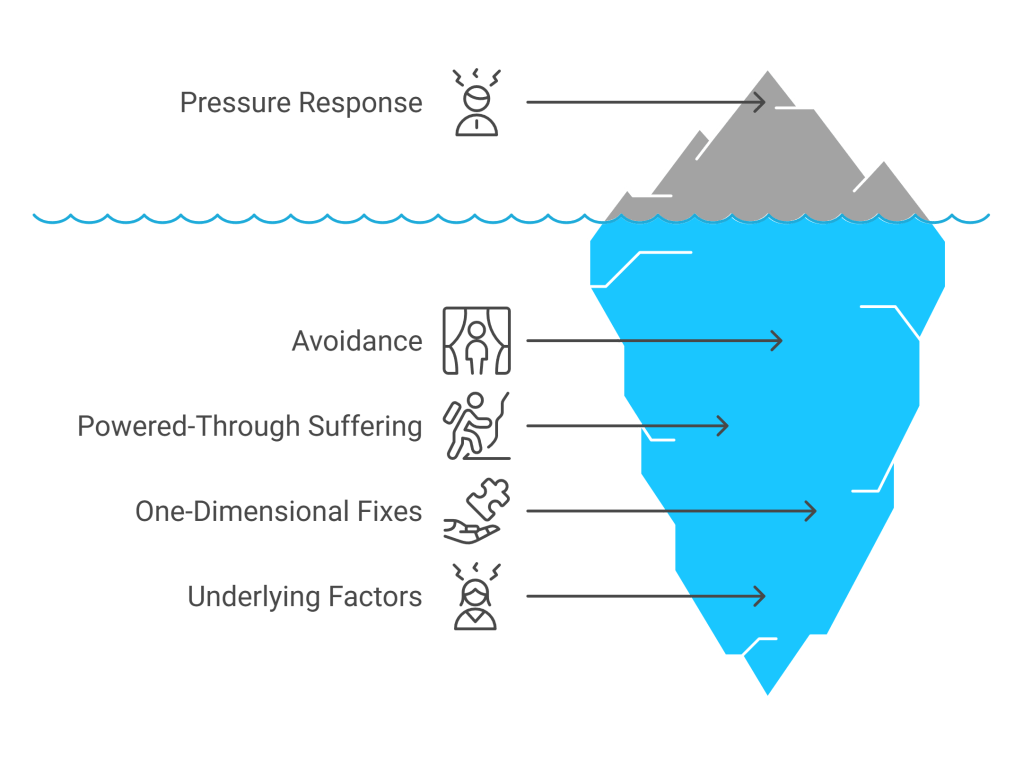
Each approach treats symptoms rather than addressing the fundamental loop that creates and sustains our pressure response. It’s like trying to stop a flooding river by mopping the floor instead of patching the broken dam.
The Promise: Break → Reframe → Rewire
In this comprehensive guide, I’m offering something different: a complete system to interrupt your pressure loop, reconstruct your interpretation of high-stakes situations, and build new neural pathways that transform pressure from enemy to ally.
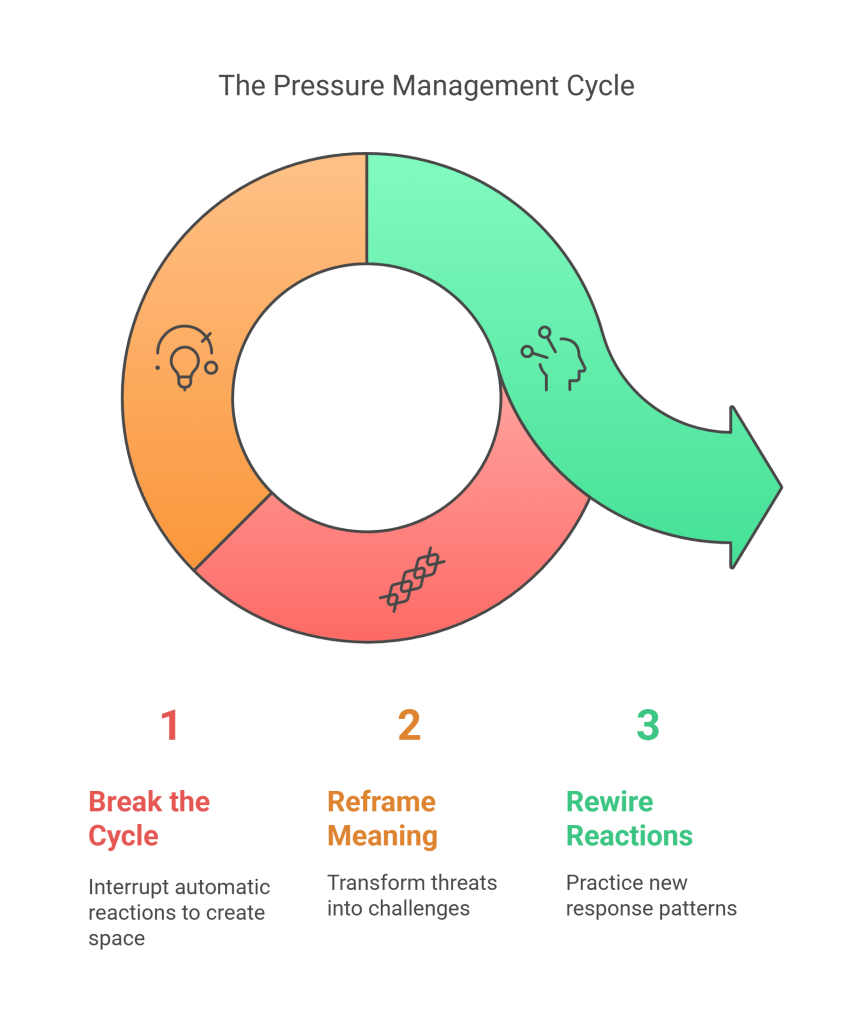
This three-part model—Break, Reframe, Rewire—forms the backbone of every technique we’ll explore:
- Break the automatic cycle using pattern interrupts that create space between stimulus and response
- Reframe the meaning you assign to pressure situations, transforming threats into challenges
- Rewire your default reactions by systematically practicing new response patterns
The techniques we’ll explore aren’t just theoretical constructs. They’re battle-tested tools I’ve personally used to transform my relationship with pressure and have taught to countless professionals facing their own high-stakes moments.
By the end of this article, you’ll have a comprehensive toolkit for recalibrating your mind under pressure—techniques you can apply immediately to break free from the grip of overwhelm, access your best thinking under fire, and even learn to harness pressure as fuel for enhanced performance.
But first, let me share how I discovered these principles through my own journey from pressure-avoidant to pressure-proficient. My story illustrates not just that change is possible, but exactly how this transformation unfolds in real life.
2. My Journey: From Overwhelmed to In Control
Six years ago, I was drowning. Not in water, but in the constant tsunami of pressure that my career had become. As a senior project manager at a fast-growing tech company, I was juggling multiple high-priority initiatives, each with stakeholders who considered their project the most important. My calendar was a patchwork of overlapping meetings. My inbox perpetually hovered around 200 unread messages. My phone buzzed with Slack notifications even in the middle of the night.
I looked successful from the outside—promotions, raises, public recognition—but inside, I was crumbling. Sunday evenings brought a familiar knot of dread in my stomach. During important meetings, my mind would sometimes go completely blank mid-sentence. I developed tension headaches so severe they triggered visual auras. Most concerning, I found myself snapping at my team members—people I genuinely cared about—when the pressure peaked.
Something had to change, but what? And how?
The Breaking Point That Became a Breakthrough
The turning point came during what should have been a career highlight. I was presenting our team’s year-long project to the entire company—over 500 people packed into the main hall, with executives in the front row. Twenty minutes into my carefully rehearched presentation, the CFO asked a question I hadn’t anticipated.
In that moment, my mind didn’t just go blank—it seemed to actively work against me. I could feel my face flushing, my chest tightening. The silence stretched uncomfortably as everyone waited for my response. When I finally managed to speak, I rambled incoherently, contradicting points I’d made earlier.
That night, lying awake replaying the disaster in my mind, I made two decisions: First, I would understand exactly what happened to my brain under pressure. Second, I would develop a systematic approach to prevent it from happening again.
The Research Phase: Building My Pressure Mastery Blueprint
What began as a personal quest quickly became an obsession. I dove into research across multiple disciplines:
- Performance psychology and the science of optimal performance states
- Neuroscience, particularly the brain’s threat-response mechanisms
- Cognitive-behavioral techniques for rewiring thought patterns
- Mindfulness practices for building present-moment awareness
- Military and emergency services training for high-pressure decision making
I didn’t just read about these approaches—I experimented with them, turning myself into a living laboratory. Some techniques worked immediately; others required adaptation. Many failed completely. Gradually, I developed a personalized system that allowed me to remain clear-headed and resourceful even under extreme pressure.
Technique Spotlight: The Daily Reflection Log
One of my most valuable discoveries was the power of systematic self-observation. I created what I now call the “Daily Reflection Log”—a simple but powerful tool for building self-awareness around pressure triggers and responses.
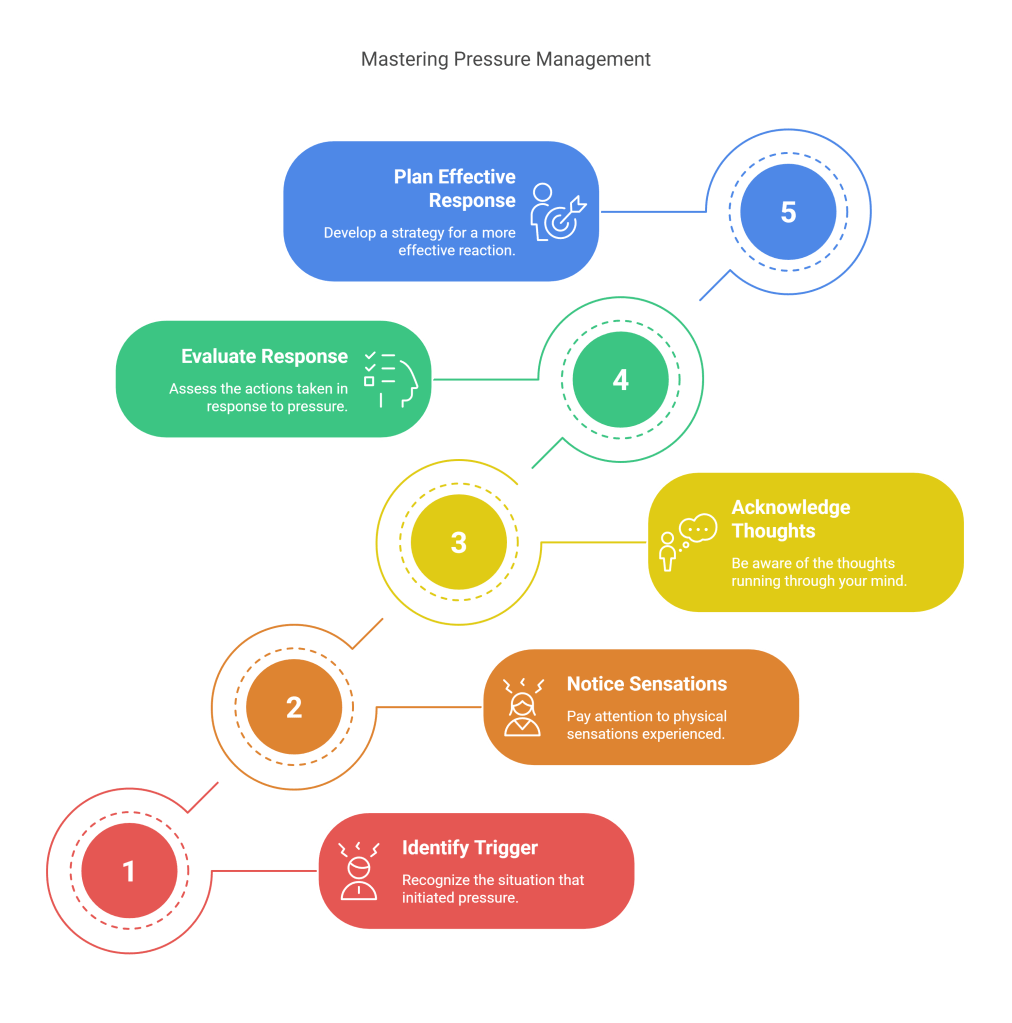
The log consisted of five simple prompts:
- What situation triggered pressure today?
- What physical sensations did I notice first?
- What thoughts ran through my mind?
- How did I respond (actions taken)?
- What would a more effective response have looked like?
For 30 days, I faithfully documented my pressure moments. Patterns quickly emerged. I discovered that:
- Public speaking and impromptu questions consistently triggered my strongest reactions
- My first physical tell was always a tightening in my throat, seconds before I became consciously aware of feeling pressured
- My thoughts typically catastrophized around the theme of “exposure” (“Everyone will see I’m not qualified”)
- My default response was to either rush my speech or overexplain—both making the situation worse
This systematic documentation gave me something invaluable: the ability to recognize my pressure response at its earliest stages, before it could cascade into a full meltdown.
My 30-Day Recalibration Ritual
Armed with this self-knowledge, I designed a 30-day “Recalibration Ritual” to systematically rewire my pressure response. The structured program included:
- Morning visualization of successful responses to anticipated pressure points
- Mid-day pattern-interrupt practices during small moments of stress
- Evening reflection and journaling about the day’s pressure experiences
- Weekly “pressure exposure” exercises where I deliberately sought out challenging situations
By the end of my 30-day experiment, colleagues began commenting on the change. “You seem so much calmer in crisis situations,” my director observed. “How are you doing that?”
That question sparked conversations that eventually led me to formalize these techniques and share them with others facing similar challenges. What began as a personal survival strategy evolved into workshops, coaching sessions, and now this comprehensive guide.
My journey from overwhelmed to in control wasn’t linear or instant. It involved setbacks, discoveries, and continuous refinement. But the fundamental shift in how I relate to pressure has transformed not just my professional effectiveness but my quality of life. The techniques I’m about to share can do the same for you.
3. The Pressure Loop: How Thoughts Fuel Stress
To master pressure, you must first understand the invisible machinery that creates and intensifies it. I call this machinery “The Pressure Loop”—a self-reinforcing cycle that can either elevate you to peak performance or send you spiraling into panic and paralysis.
The loop begins innocently enough with an external trigger, but what happens next is entirely internal—and entirely within your power to reshape.
Anatomy of the Loop: Trigger → Thought → Feeling → Reaction
Let’s break down the cycle that unfolds in milliseconds yet can derail hours or days of your life:
1. The Trigger: This is the external event that initiates the pressure response. It might be:

Subscribe to continue reading
Subscribe to get access to the rest of this post and other subscriber-only content.
 SkillWisor