
Introduction – The Foundation of Emotional Intelligence
In the complex tapestry of human experience, our emotions serve as vibrant threads, coloring our perceptions, driving our actions, and shaping our interactions. Yet, for many, this rich inner world remains largely unexplored. We might react impulsively, feel overwhelmed by confusing feelings, or struggle to understand why certain situations consistently evoke strong responses within us. This lack of clarity about our internal emotional landscape points to a deficit in a crucial skill: self-awareness.
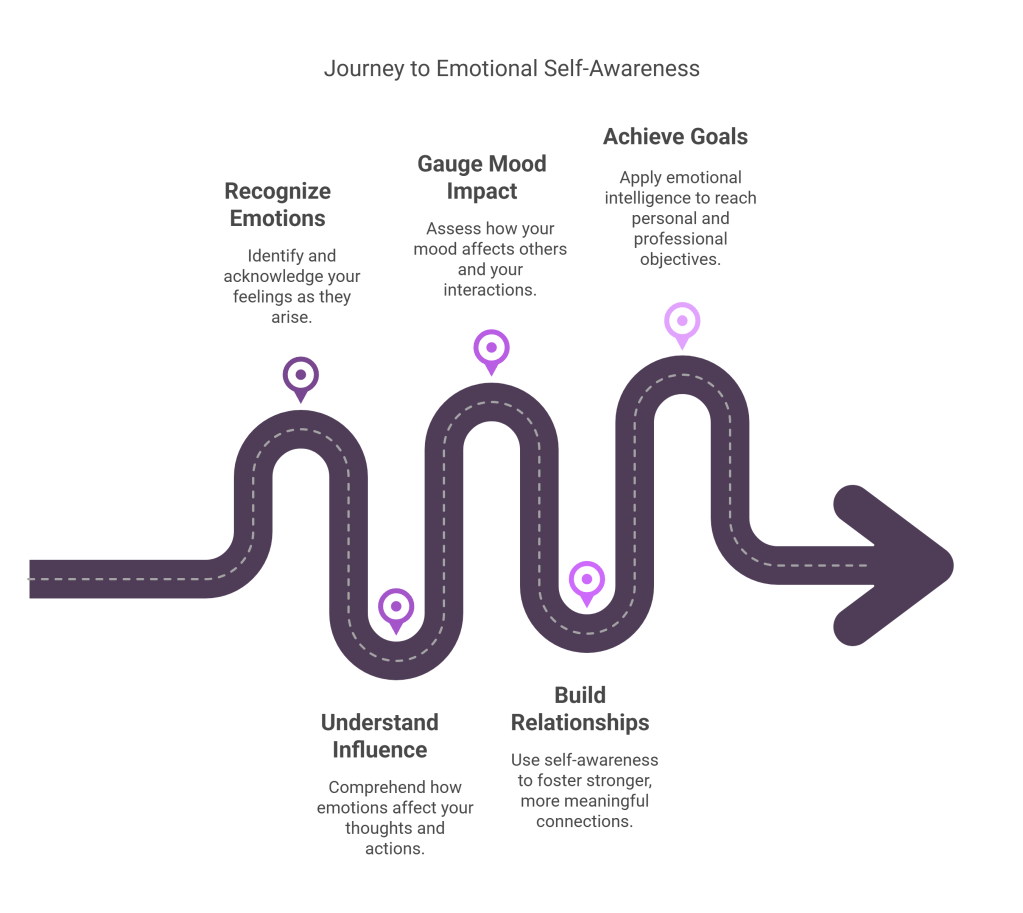
Self-awareness is not merely about knowing your strengths and weaknesses, although those are components. At its heart, emotional self-awareness is the ability to recognize and understand your own emotions, to be aware of how they influence your thoughts and behavior, and to accurately gauge your mood and its impact on others. Think of it as having a clear, accurate mirror reflecting your inner state. Without this mirror, navigating the complexities of life, building meaningful relationships, and achieving personal and professional goals becomes significantly harder. It’s the foundational pillar upon which all other aspects of emotional intelligence (EI) are built. Daniel Goleman, a pioneer in the field of emotional intelligence, identifies self-awareness as the first of his five key components of EI, preceding self-regulation, motivation, empathy, and social skills. It is the bedrock because you cannot effectively manage your emotions, understand others’ feelings, or navigate social situations skillfully if you don’t first understand what’s happening within yourself.
Imagine trying to pilot a ship without knowing its current position, speed, or direction. You might have the most advanced navigation equipment available, but without fundamental awareness of your starting point and current state, the equipment is useless. Similarly, you might read every book on communication or leadership, but without self-awareness of your emotional reactions and how they land on others, your attempts to implement new skills will likely falter. Emotional self-awareness provides that crucial internal positioning system. It allows you to identify an emotion as it arises, understand its potential source, and anticipate its likely effect on your thoughts and actions. This pause, this moment of recognition, creates a vital space between stimulus and response – a space where conscious choice can replace automatic reaction.
Boosting your self-awareness is not a passive endeavor; it requires active effort, curiosity, and a willingness to look honestly at yourself, including the parts that might be uncomfortable. It’s a continuous process of exploration, not a destination to be reached. This journey involves cultivating a deeper relationship with your inner world, paying attention to subtle cues, challenging assumptions, and being open to feedback. It’s about becoming a compassionate observer of your own experience, rather than being swept away by it. The benefits of this practice are profound, leading to improved emotional regulation, better decision-making, stronger relationships, increased empathy, and a greater sense of agency and control over your life.
This article will serve as your guide on this journey. Over the following sections, we will delve into practical, actionable strategies designed to help you cultivate a richer understanding of your emotions and, in turn, significantly boost your emotional self-awareness. From listening to your body’s signals and tracking your emotional patterns to understanding the roots of your reactions and utilizing frameworks for deeper insight, we will explore diverse techniques that you can integrate into your daily life. Prepare to embark on an insightful exploration of your inner landscape, equipping yourself with the tools to navigate your emotions with greater clarity, wisdom, and skill.
Defining Self-Awareness and Emotional Understanding
To effectively boost our self-awareness, particularly in the realm of emotions, we must first establish a clear understanding of what these terms entail. Self-awareness, in essence, is the capacity to introspect and understand oneself. When we apply this specifically to emotions, it becomes emotional self-awareness: the ability to recognize, identify, and understand the nature and intensity of our feelings in the moment they occur. It’s about being able to say, “Right now, I am feeling frustrated,” and having a sense of why that frustration might be arising and what its potential impact could be. This is distinct from simply having an emotion; it’s about knowing you are having it and having some context around it.
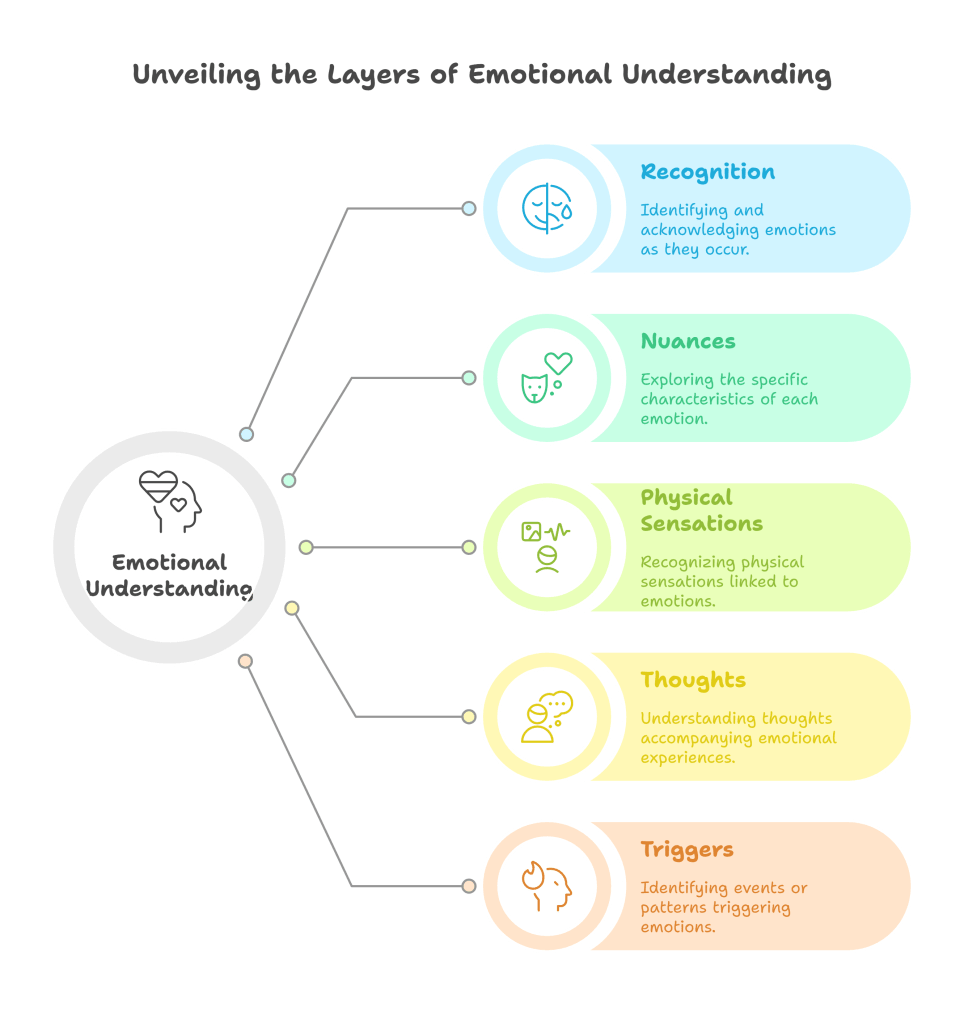
Emotional understanding goes a step further than mere recognition. It involves exploring the nuances of that feeling. What kind of frustration is it? Is it mild annoyance, simmering resentment, or explosive anger? What are the physical sensations associated with it? A tight jaw, tense shoulders, a churning stomach? What thoughts are running through your mind alongside this emotion? “This isn’t fair,” or “I can’t believe this is happening again”? Understanding also involves considering the potential source or trigger of the emotion. Was it a specific event, a comment from someone, or an internal thought pattern? It’s about connecting the dots between the feeling, the physical state, the thoughts, and the context.
Think of your emotional state as a complex weather system within you. Simple self-awareness is knowing whether it’s sunny, cloudy, or raining. Emotional understanding is knowing the temperature, the wind speed, the type of precipitation, and potentially even predicting where the system came from and where it might be heading. It’s a deeper, more granular level of knowing. This depth of understanding is crucial because not all instances of a broad emotion like “sadness” are the same. The sadness of loss is different from the sadness of disappointment, which is different again from the sadness of loneliness. Recognizing these distinctions allows for a more accurate response and a greater ability to address the underlying needs or issues.
Without emotional self-awareness and understanding, we are more likely to be controlled by our emotions rather than having a healthy relationship with them. Unacknowledged or misunderstood emotions can manifest in unhelpful ways: lashing out in anger when the underlying feeling is actually hurt, withdrawing completely when the need is for connection, or feeling perpetually anxious without understanding the specific fears driving it. When we lack awareness, our emotions can feel like unpredictable forces that strike without warning, leaving us feeling helpless and reactive.
Conversely, developing these skills empowers us. When you can identify that you’re feeling anxious because you’re anticipating a difficult conversation, you can then choose to employ coping strategies, prepare more thoroughly for the conversation, or even reframe your thoughts about it. When you understand that your anger stems from a feeling of being disrespected, you can communicate that feeling directly and constructively, rather than just exploding. This ability to pause, understand, and choose a response is the hallmark of emotional intelligence in action, and it all begins with the clarity provided by self-awareness.
This journey of defining and deepening our emotional understanding requires curiosity and a non-judgmental attitude. It’s easy to fall into the trap of labeling emotions as “good” or “bad,” but emotions are simply data. They provide information about our needs, our values, and how we are responding to the world around us. Approaching your emotions with curiosity, like a scientist observing a phenomenon, rather than with criticism or fear, is essential for building accurate self-awareness. In the following sections, we will explore practical methods to cultivate this observational capacity and build a richer, more accurate understanding of your own unique emotional landscape.
The Body-Emotion Connection: Listening to Your Physiological Signals

Subscribe to continue reading
Subscribe to get access to the rest of this post and other subscriber-only content.
 SkillWisor