
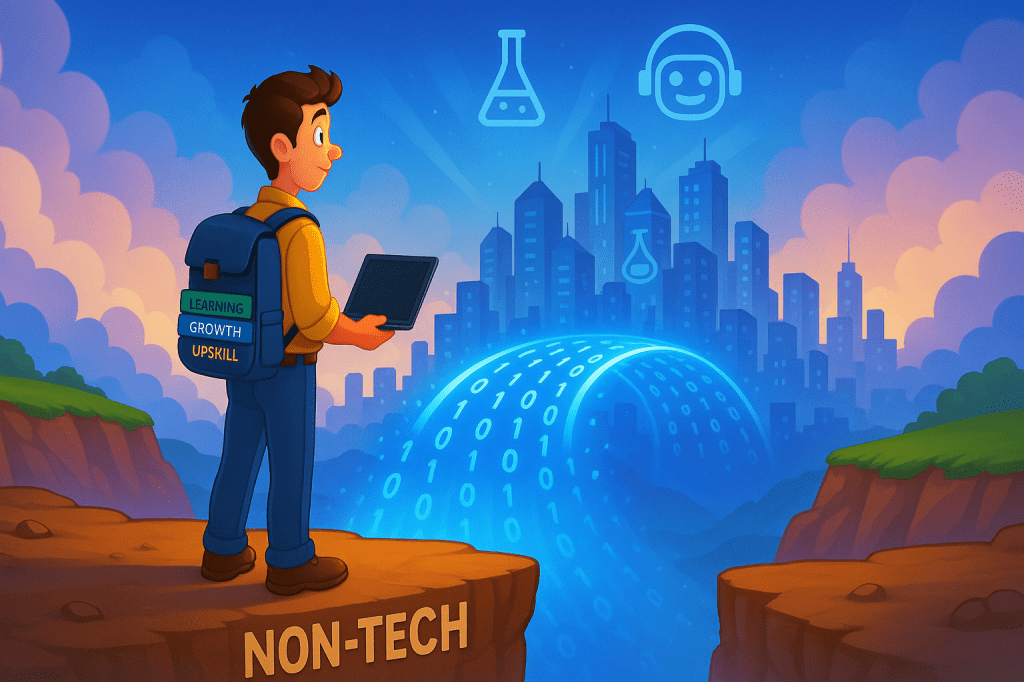
Introduction – Bridging the Gap – Your Journey into the World of Tech
The technology sector, particularly fields like Data Analytics, Data Science, Artificial Intelligence (AI), and Generative AI, is experiencing unprecedented growth and creating a vast number of exciting career opportunities. For many individuals currently working in non-technical roles, these fields represent a compelling future – offering intellectual challenge, significant impact, and often, attractive compensation. However, the prospect of transitioning from a background without formal computer science degrees or extensive coding experience can seem daunting. The perceived gap between a non-tech role and a highly technical one feels wide, filled with unfamiliar jargon, complex concepts, and the assumption that you need to start from scratch.
This perception, while understandable, is often more of a psychological barrier than an insurmountable reality. The truth is, a successful transition into these tech roles is not only possible but is happening every day for individuals from diverse backgrounds – humanities, social sciences, business, arts, and many more. What the tech industry increasingly values, especially in data-centric and AI fields, is not just a traditional technical education, but a blend of analytical thinking, problem-solving skills, creativity, domain expertise, and the willingness and ability to learn continuously. Many non-tech roles cultivate these very attributes.
Your current non-technical background is not a liability; it can be a unique asset. You bring different perspectives, communication skills, and often a deep understanding of specific industries or human behavior that are invaluable in applying technical concepts to real-world problems. Data analysis, model building, and AI development are not purely theoretical exercises; they are tools used to solve challenges in healthcare, marketing, finance, entertainment, and every other sector imaginable. Your experience in a non-tech role has given you exposure to these challenges and the contexts in which technical solutions are needed.
This blog post is designed to be your comprehensive guide on how to bridge that perceived gap. We will demystify the fields of Data Analytics, Data Science, AI, and Generative AI, breaking down what each entails and how they relate to one another. More importantly, we will focus on the practical steps you can take to acquire the necessary skills, leverage your existing strengths, build a compelling portfolio, and successfully navigate the transition into a fulfilling tech career in these dynamic areas. We will cover foundational knowledge, specific learning paths for each field, strategies for gaining practical experience, and advice on positioning yourself for entry-level roles.
Transitioning requires dedication, strategic learning, and a commitment to stepping outside your comfort zone. It’s a journey of acquiring new technical proficiencies while recognizing and valuing the unique insights and skills you already possess. By the end of this guide, you will have a clearer roadmap, actionable strategies, and the confidence to begin your transformation from a non-tech professional to a valuable contributor in the exciting world of data and AI. The tech industry needs diverse perspectives and problem-solvers from all walks of life – and your non-tech background might just be your superpower.
Understanding the Landscape: Data Analytics, Data Science, AI, and Gen AI Defined
Navigating a career transition into tech, especially into the data and AI space, begins with clearly understanding the different roles and disciplines within it. The terms Data Analytics, Data Science, AI, and Generative AI are often used interchangeably, but they represent distinct, albeit overlapping, fields with different focuses and required skill sets. For someone from a non-tech background, getting a clear picture of this landscape is essential for identifying the most suitable entry point and charting a focused learning path.
Let’s break down each of these areas:
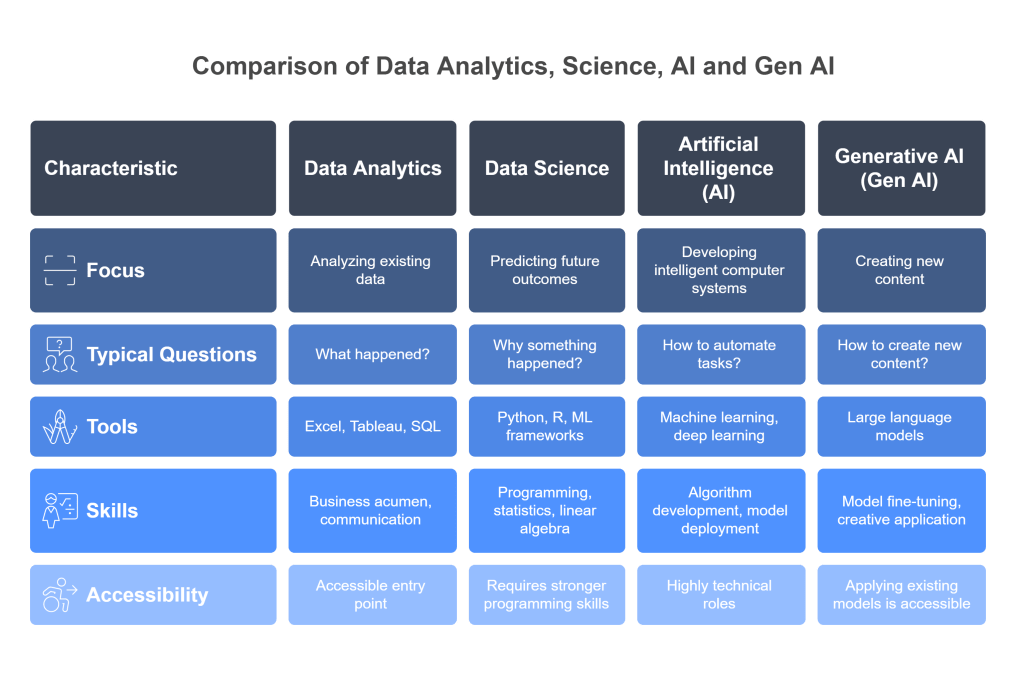
- Data Analytics: This is often the most accessible entry point for individuals transitioning from non-tech roles. Data analytics focuses on examining existing data sets to find trends, patterns, and insights that can inform decision-making. Data analysts use tools like spreadsheet software (Excel), data visualization tools (Tableau, Power BI), and sometimes basic scripting (SQL, Python) to clean, transform, and explore data. Their primary goal is to answer questions about what happened or what is happening based on the data. A strong data analyst is curious, has good business acumen, and can effectively communicate findings to non-technical stakeholders. Your ability to understand business problems from your non-tech role is a significant advantage here.
- Data Science: Data Science is a broader and typically more advanced field that builds upon data analytics. While analysts focus on understanding the past and present, data scientists use more sophisticated statistical methods, machine learning algorithms, and programming to build models that can predict future outcomes or identify deeper, more complex patterns. They answer questions like why something happened or what could happen. Data scientists often have stronger programming skills (Python, R), a deeper understanding of statistics and linear algebra, and experience with machine learning frameworks. This field often requires a blend of analytical skills, programming expertise, and domain knowledge.
- Artificial Intelligence (AI): AI is a broad umbrella term referring to the development of computer systems capable of performing tasks that typically require human intelligence, such as visual perception, speech recognition, decision-making, and translation. Data Science is often considered a subfield of AI, specifically focusing on learning from data to make predictions or decisions. AI encompasses a wider range of techniques, including machine learning, deep learning, natural language processing, and computer vision. AI roles can be highly technical, involving algorithm development and model deployment, but also include roles focused on applying existing AI models to solve problems or managing AI projects.
- Generative AI (Gen AI): This is a cutting-edge subfield of AI that focuses on creating new content, rather than just analyzing or predicting based on existing data. Generative AI models, like large language models (LLMs) that power tools like ChatGPT, can generate text, images, music, code, and other forms of media based on patterns learned from vast datasets. Roles in Gen AI can involve developing these models, fine-tuning them for specific tasks, or applying them creatively and effectively to solve problems in areas like content creation, design, software development, and more. While some roles are highly research-oriented, many involve applying existing Gen AI models, which can be more accessible for those transitioning.

Subscribe to continue reading
Subscribe to get access to the rest of this post and other subscriber-only content.
 SkillWisor