
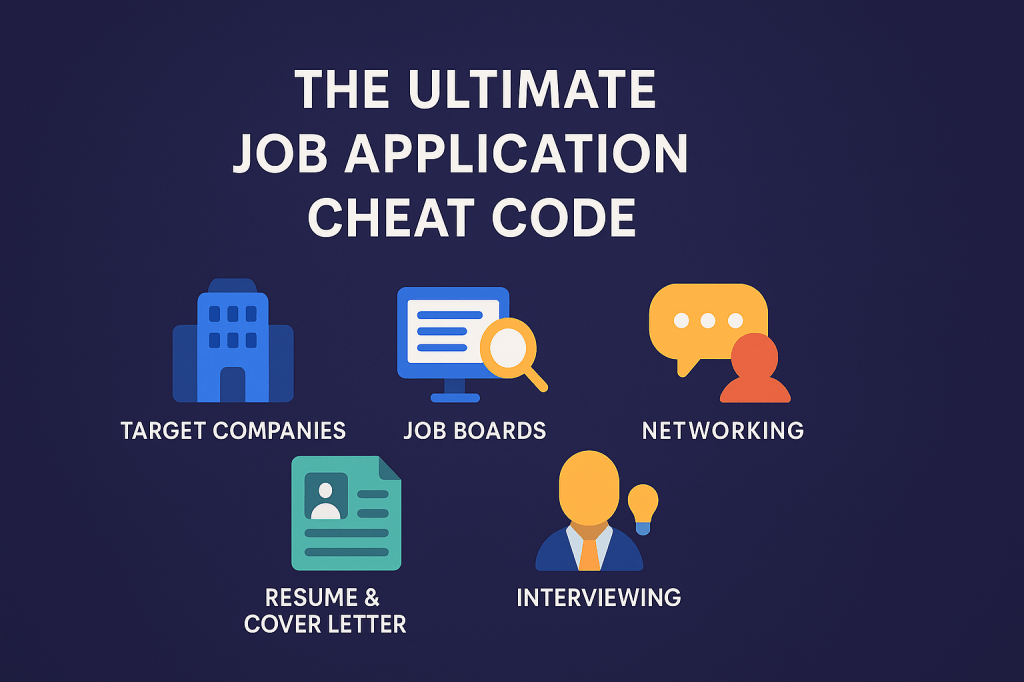
In today’s competitive job market, successfully landing the right position requires more than just submitting applications and hoping for the best. The most successful job seekers approach their search with strategy, preparation, and attention to detail. This comprehensive guide will walk you through every step of the job application process, from initial search to final offer, providing actionable tips and insider knowledge to give you a significant advantage.
1. Job Search Strategy: Finding the Right Opportunities
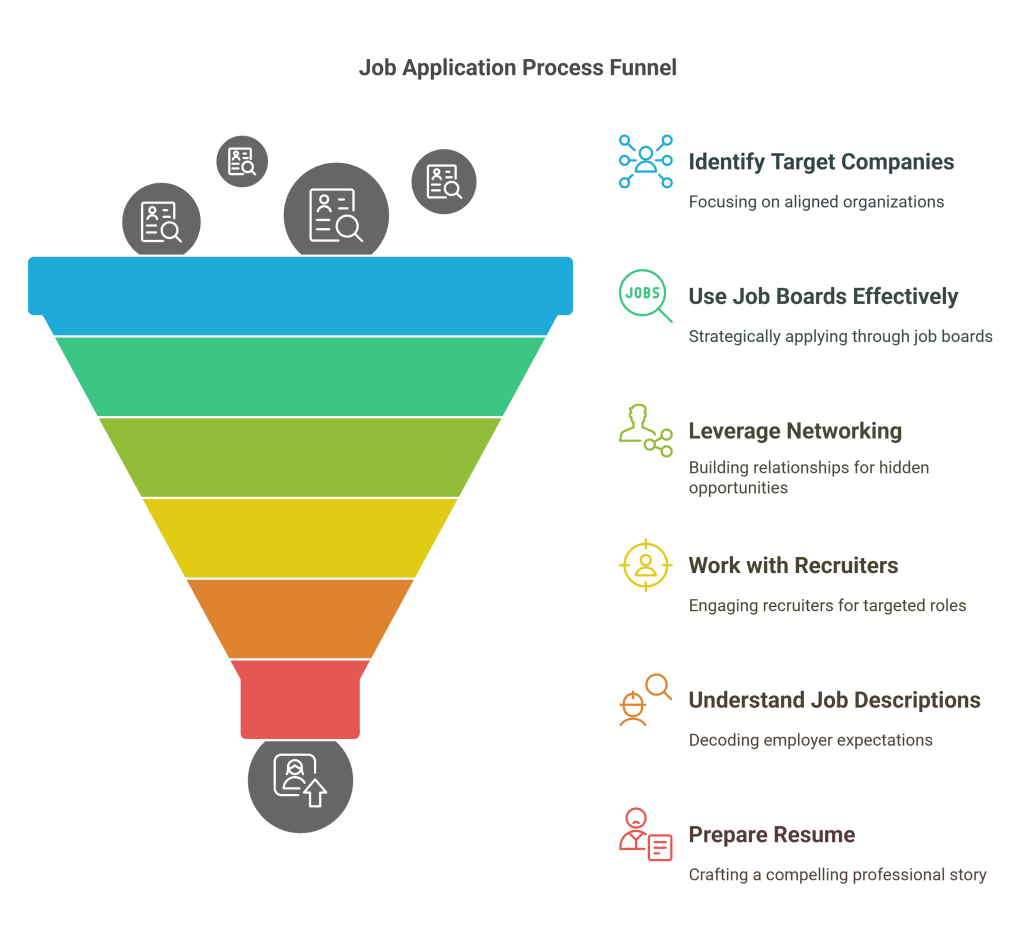
Identifying Target Companies
Strategic Approach to Company Selection The first step in a successful job search is identifying where you want to work. Rather than casting an impossibly wide net, focus your energy on organizations that align with your values, skills, and career aspirations. Research shows that candidates who apply to fewer, well-targeted positions have higher success rates than those who submit hundreds of generic applications.
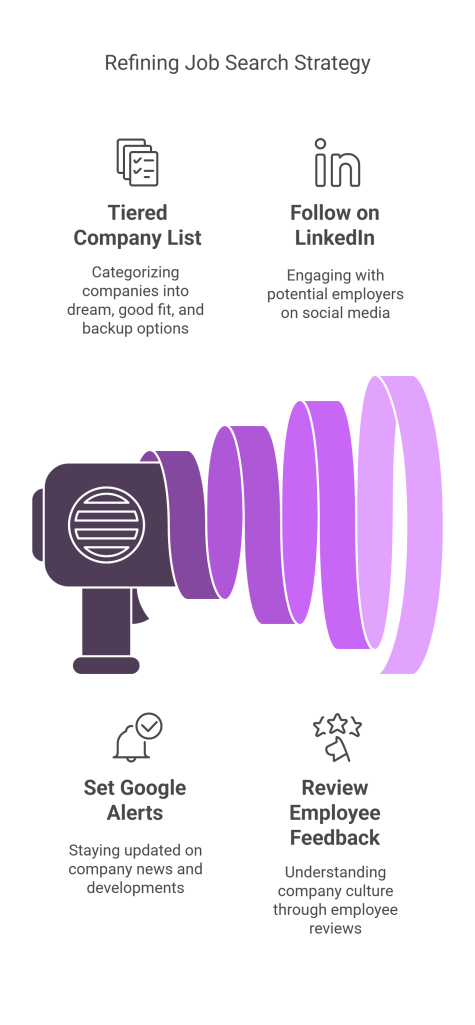
Create a three-tiered list organized by priority:
- Dream companies (aspirational but realistic targets)
- Good fits (solid matches for your skills and interests)
- Backup options (acceptable positions that provide experience)
This approach ensures you’re concentrating your efforts strategically while maintaining options.
Company Research Techniques
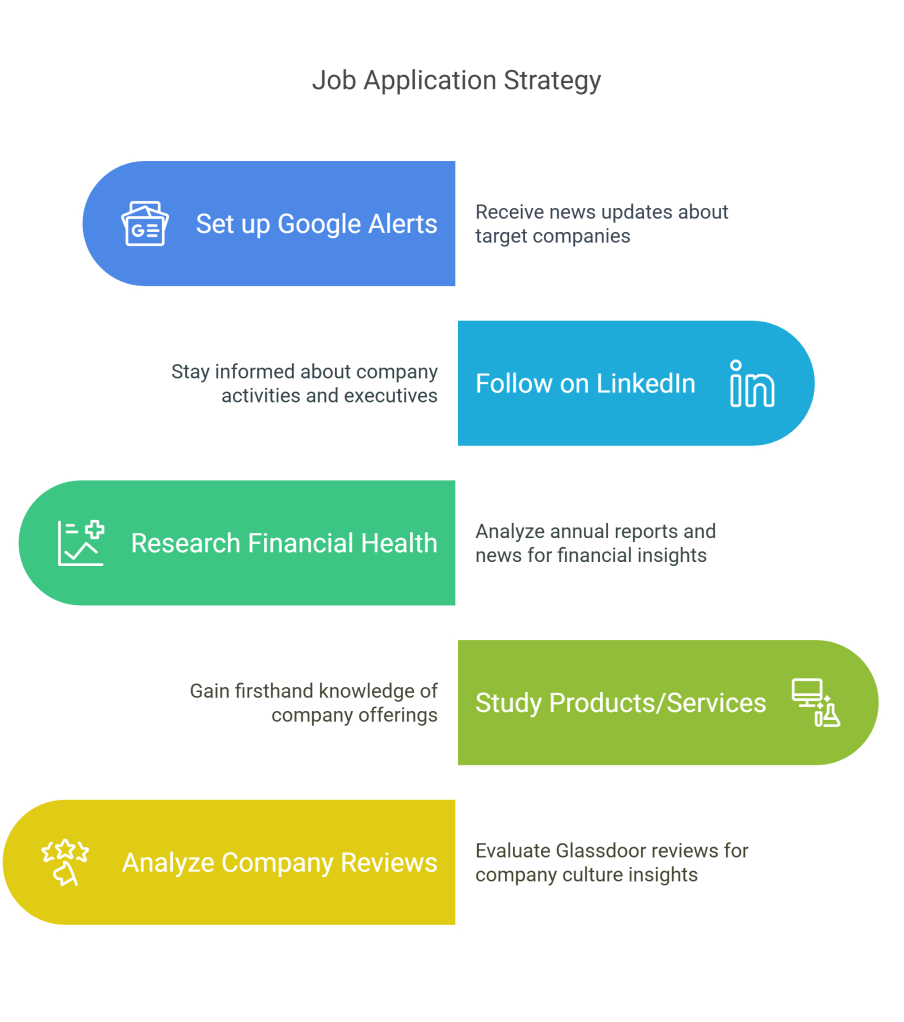
- Set up Google Alerts for your target companies to receive news updates
- Follow key executives and company pages on LinkedIn
- Research company financial health through annual reports and news
- Study the company’s products/services firsthand if possible
- Analyze company reviews on Glassdoor, considering both positive and negative patterns
Industry Insights Different industries have distinct hiring cycles. For example, accounting firms often recruit heavily after tax season, while education positions typically open in spring for fall starts. Understanding these patterns can give you a timing advantage in your applications.
DO:
- Research companies whose mission, values, and culture align with your own
- Create a tiered list of “dream companies,” “good fits,” and “backup options”
- Set up Google Alerts for your target companies to stay informed about news and developments
- Follow potential employers on LinkedIn and other social media platforms
- Research employee reviews on sites like Glassdoor to understand company culture
DON’T:
- Apply indiscriminately to every open position
- Focus exclusively on large, well-known companies
- Ignore company reputation and employee satisfaction metrics
- Overlook smaller companies or startups that might provide better growth opportunities
Using Job Boards Effectively
Job Board Strategy Job boards remain valuable tools, but require strategic use. According to recent data, approximately 60% of job seekers find opportunities through job boards, but only about 20% of available positions are filled this way. The most effective approach combines multiple job search channels.
Beyond the Major Platforms While LinkedIn, Indeed, and Glassdoor capture many listings, industry-specific job boards often feature more targeted opportunities with less competition:
- Tech: Stack Overflow Jobs, GitHub Jobs, AngelList
- Creative: Behance, Dribbble, Mediabistro
- Healthcare: Health eCareers, MedicalJobs.org
- Finance: eFinancialCareers, CFO.com
Application Timing Matters Research from talent acquisition platforms suggests that applications submitted within the first 72 hours after a job posting receive significantly more attention. Setting up daily alerts and maintaining application materials in a ready state allows you to act quickly when ideal positions appear.
DO:
- Use industry-specific job boards alongside major platforms
- Set up saved searches and email alerts for specific roles and companies
- Look beyond the job title to understand the actual responsibilities
- Apply early—many recruiters start reviewing applications immediately
- Create accounts on company career portals for faster applications
DON’T:
- Rely solely on job boards—many positions are filled through referrals
- Apply to positions more than 3-4 weeks old (unless specifically stated as still open)
- Waste time on suspicious listings (e.g., vague descriptions, unrealistic salary ranges)
- Submit generic applications through multiple job boards without customization
Leveraging Networking
The Hidden Job Market Studies consistently show that 70-80% of jobs are never publicly advertised, existing instead in what recruiters call the “hidden job market.” Accessing these opportunities requires strategic networking and relationship building.
Networking Case Study Consider the experience of Sarah, a marketing professional who secured her dream role after connecting with an industry peer at a virtual conference. Their initial conversation wasn’t about job opportunities but about industry trends. Three months later, when a position opened, Sarah was the first person contacted—before the job was even posted publicly.
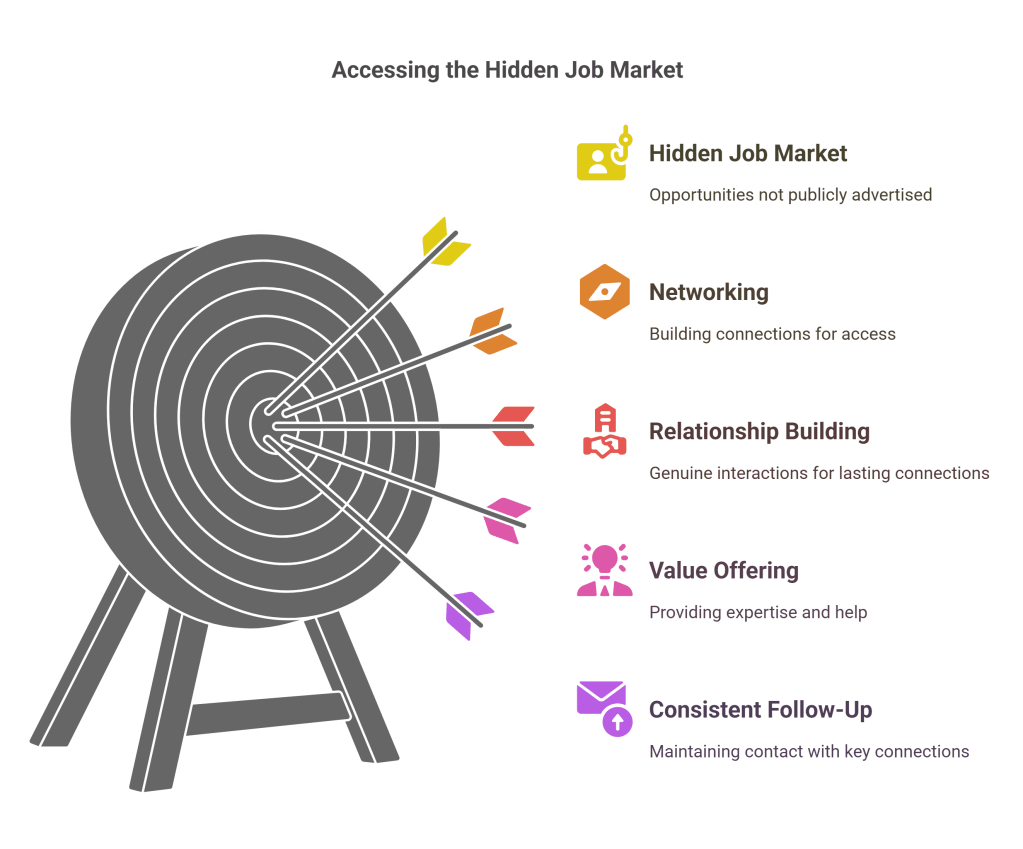
Relationship Building Strategy Effective networking requires genuine relationship building, not transactional interactions. Focus on:
- Offering value before asking for help
- Following up meaningfully after initial connections
- Maintaining regular contact with key connections
- Developing subject matter expertise you can share
Digital Networking Platforms Beyond LinkedIn, consider platforms like:
- Twitter for following industry leaders and participating in discussions
- Discord communities for specific professional interests
- Slack channels for industry-specific conversation
- Reddit’s career-focused subreddits for advice and connections
DO:
- Reach out to connections at target companies before applying
- Attend industry meetups, conferences, and virtual networking events
- Join relevant LinkedIn groups and participate in discussions
- Request informational interviews with professionals in your target field
- Follow up with contacts you meet at events with personalized messages
DON’T:
- Ask directly for jobs upon first connection
- Neglect your network until you need something
- Send generic connection requests without context
- Give up after one networking attempt yields no results
Working with Recruiters
Understanding Recruiter Types Different recruiter types serve distinct purposes in your job search:
- Internal/Corporate Recruiters: Work directly for the hiring company
- Advantage: Direct access to hiring managers
- Approach: Demonstrate specific interest in their company
- Agency/Third-Party Recruiters: Work for recruiting firms serving multiple clients
- Advantage: Access to multiple opportunities
- Approach: Clearly communicate your preferences and boundaries
- Executive Search Recruiters: Focus on senior positions
- Advantage: Access to high-level opportunities not publicly advertised
- Approach: Emphasize leadership experiences and strategic impacts
Building Recruiter Relationships Successful candidates treat recruiters as long-term career connections, not transactional service providers. The relationship should continue beyond your current job search.
Maximizing Recruiter Interactions
- Prepare a “career narrative” that clearly explains your background and goals
- Ask about typical career paths at target companies
- Request honest feedback about how your qualifications match the market
- Inquire about compensation ranges before investing significant time
DO:
- Engage with both in-house and third-party recruiters
- Be clear about your career goals, salary expectations, and non-negotiables
- Maintain regular communication with recruiters who specialize in your field
- Prepare specific questions about company culture and role expectations
- Ask about the recruitment process and timeline
DON’T:
- Work exclusively with one recruiter
- Share confidential information about other interview processes
- Expect recruiters to find you a job—they work for employers, not candidates
- Accept a role that doesn’t fit your career goals just because a recruiter recommends it
2. Understanding Job Descriptions: Decoding What Employers Really Want
Reading JDs Thoroughly
Job Description Anatomy A typical job description contains several key components, each providing valuable insights:
- Job Title: Often indicates seniority level and specialization
- Company Overview: Reveals organizational mission and culture
- Responsibilities: Details daily and long-term expectations
- Requirements: Lists necessary qualifications and experience
- Benefits: Indicates company priorities and compensation philosophy
Reading Between the Lines Job descriptions often contain subtle indicators about organizational culture:
- Language emphasizing “fast-paced environment” may signal high pressure
- Frequent mentions of “team player” suggest collaborative work
- Emphasis on “self-starter” indicates limited supervision
- References to “work hard, play hard” often suggest long hours
Decoding Company Priorities The order of responsibilities and requirements often reflects their importance. Pay special attention to what’s listed first and what receives the most detailed description.
DO:
- Read every section of the job description multiple times
- Pay special attention to required vs. preferred qualifications
- Note the specific language used to describe responsibilities and skills
- Look for clues about company culture and work environment
- Identify the problems the role is meant to solve
DON’T:
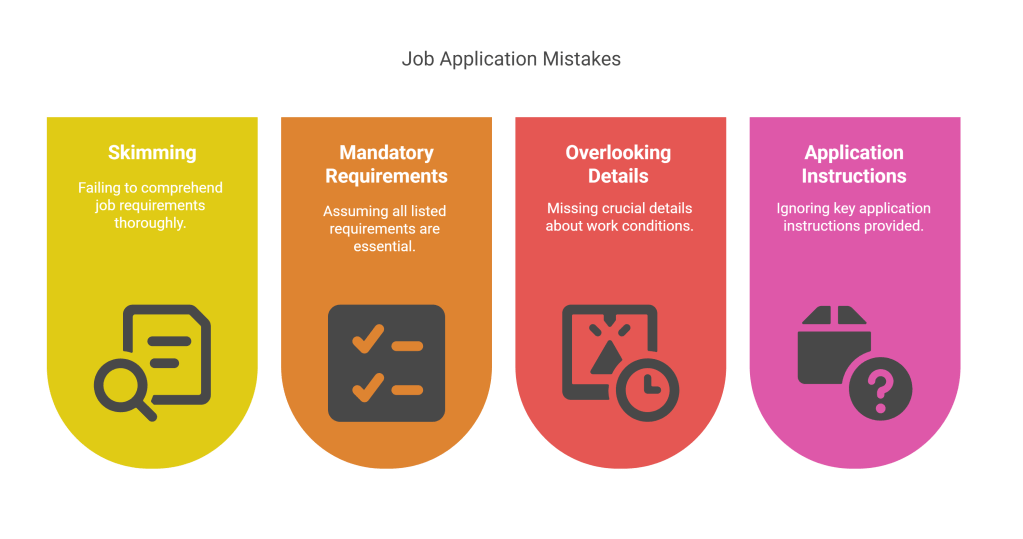
- Skim job descriptions without comprehending key requirements
- Assume all listed requirements are truly mandatory
- Overlook details about work schedule or location flexibility
- Miss important application instructions embedded in the description
Analyzing Key Requirements
Skills Categorization Method When analyzing job requirements, categorize them into:
- Technical Skills: Specific tools, technologies, and methodologies
- Industry Knowledge: Sector-specific experience and understanding
- Soft Skills: Communication, leadership, problem-solving
- Credentials: Degrees, certifications, clearances
This framework helps identify your strengths and gaps while prioritizing what to emphasize in applications.
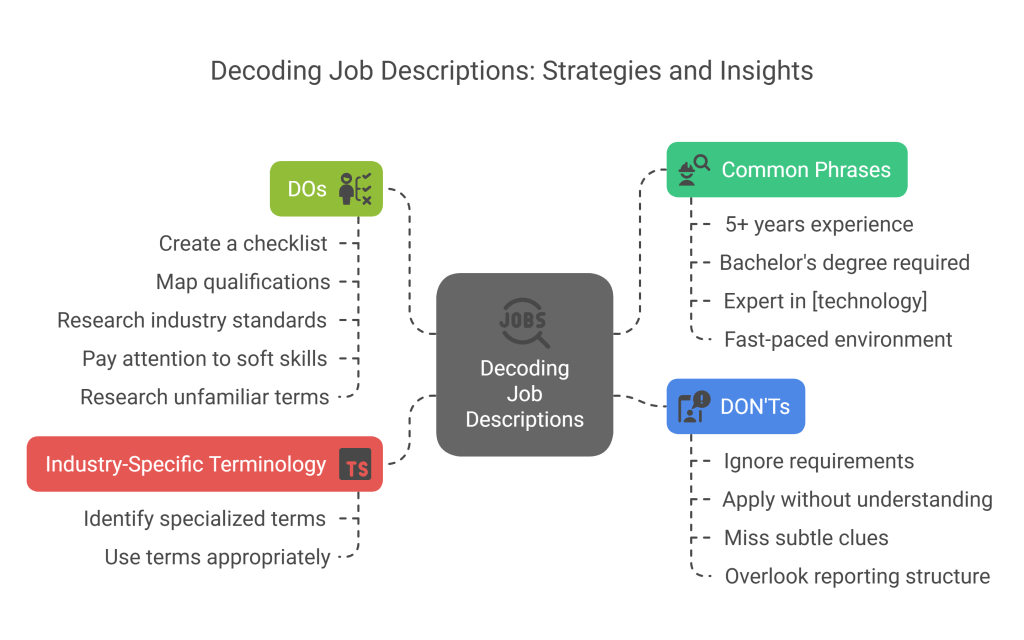
Requirements Translation Guide Common phrases in job descriptions often have specific meanings:
- “5+ years experience” typically means 3+ years of relevant experience
- “Bachelor’s degree required” often means “or equivalent experience”
- “Expert in [technology]” usually means comfortable implementing without guidance
- “Fast-paced environment” typically indicates high workload expectations
Industry-Specific Terminology Each industry has specialized language that signals insider knowledge. Identifying and appropriately using these terms in your application demonstrates familiarity with the field.
DO:
- Create a checklist of required skills and experiences mentioned
- Map your qualifications directly to the listed requirements
- Look for patterns across similar roles to identify industry standards
- Pay attention to soft skills mentioned (communication, leadership, etc.)
- Research industry jargon or technical terms you’re unfamiliar with
DON’T:
- Ignore requirements that don’t match your experience
- Apply without understanding the core responsibilities
- Miss subtle clues about seniority level and expectations
- Overlook the reporting structure or team dynamics
Identifying Must-Have vs. Nice-to-Have Skills
The 70% Rule Research from multiple recruiting platforms suggests that successful candidates typically match about 70-80% of job requirements. Perfect matches are rare and sometimes indicate an overly narrow job description.
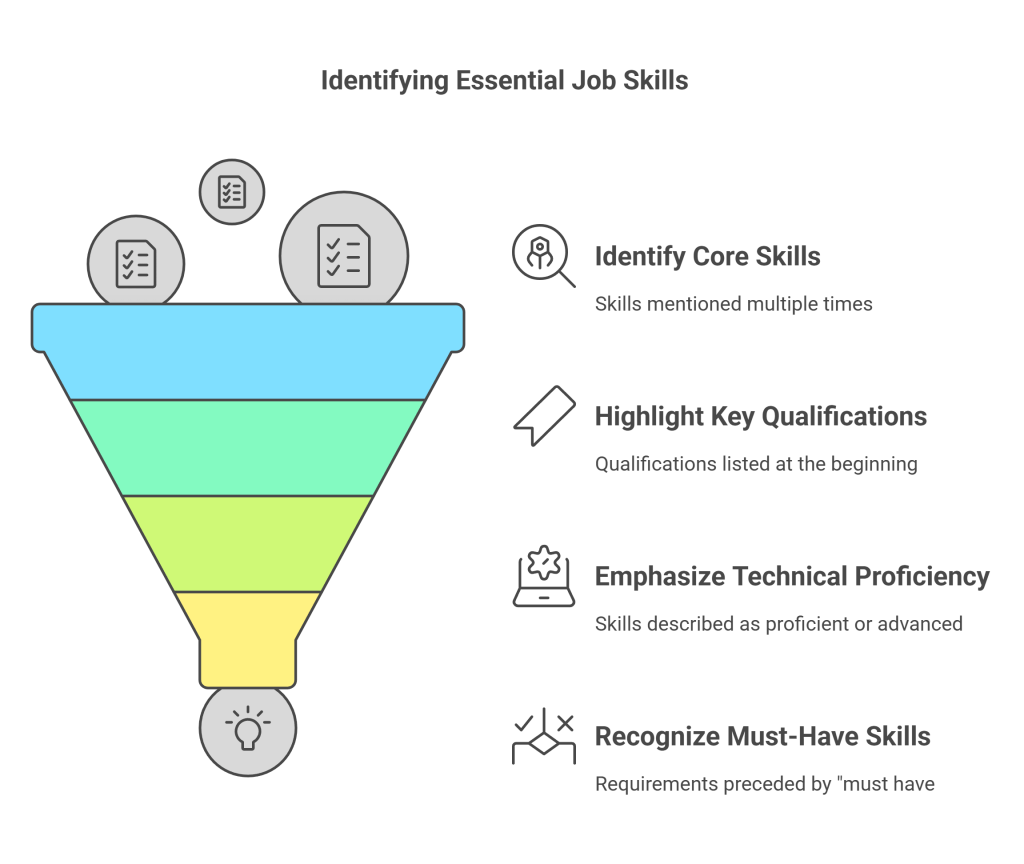
Prioritization Framework When evaluating which requirements are truly essential, consider:
- Skills mentioned multiple times throughout the description
- Qualifications listed at the beginning of requirements sections
- Technical skills described with words like “proficient,” “expert,” or “advanced”
- Requirements preceded by “must have” or similar phrasing
Case Study: The Qualified Non-Perfect Candidate A software developer with 3 years of experience applied for a position requiring “5+ years” and knowledge of 7 programming languages. She focused her application on her expertise in the 5 most critical languages and highlighted her rapid skill acquisition. Despite not meeting the exact requirements, she secured an interview and ultimately received an offer because she demonstrated capability in the essential areas.
DO:
- Distinguish between essential requirements and preferred qualifications
- Focus on matching the must-have skills in your application materials
- Highlight transferable skills if you lack specific experience
- Consider the job description as a whole rather than a checklist
- Apply if you meet 70-80% of the requirements
DON’T:
- Rule yourself out for missing a single requirement
- Assume years of experience requirements are inflexible
- Exaggerate qualifications to match requirements you don’t possess
- Apply for senior roles requiring management experience if you have none
- Overlook growth potential when assessing position fit
Notice Period Considerations
Understanding Notice Period Expectations Notice periods vary significantly by industry, position level, and company culture. While two weeks is standard for many roles in the US, senior positions and certain industries (banking, healthcare) often expect 30-90 days. International positions may have legally mandated notice periods.
Addressing Notice Periods During Application Be prepared to discuss your current notice period obligations early in the hiring process. Many job descriptions now explicitly ask about availability and notice periods in the application section.
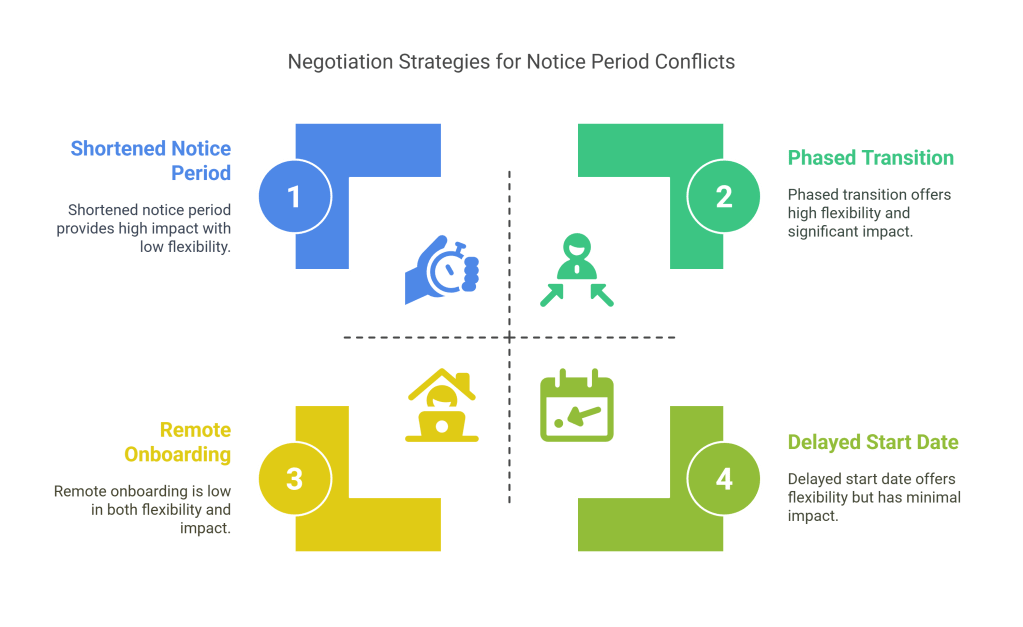
Negotiation Strategies If your current notice period conflicts with the employer’s timeline:
- Offer to begin training or onboarding remotely while completing notice
- Propose a phased transition where you work part-time in both roles
- Negotiate a delayed start date with the new employer
- Discuss the possibility of a shortened notice period with your current employer
Documentation Importance Review your current employment contract before applying to understand your legal obligations regarding notice periods, non-compete clauses, and other potential restrictions.
DO:
- Know your contractual notice period before applying
- Be transparent about your availability timeline
- Consider how to handle overlapping offers with different start dates
- Have a transition plan ready to discuss in interviews
- Understand the new employer’s urgency in filling the position
DON’T:
- Promise start dates you can’t honor
- Burn bridges by leaving current positions without proper notice
- Hide information about contractual obligations
- Forget to consider transition time between roles (e.g., relocation needs)
3. Resume Preparation: Creating Your Professional Story
Resume Structure and Formatting
The Psychology of Resume Scanning Studies tracking recruiter eye movements show they typically spend only 6-7 seconds initially scanning a resume. Your document must be structured to capture attention and communicate key qualifications within this brief window.
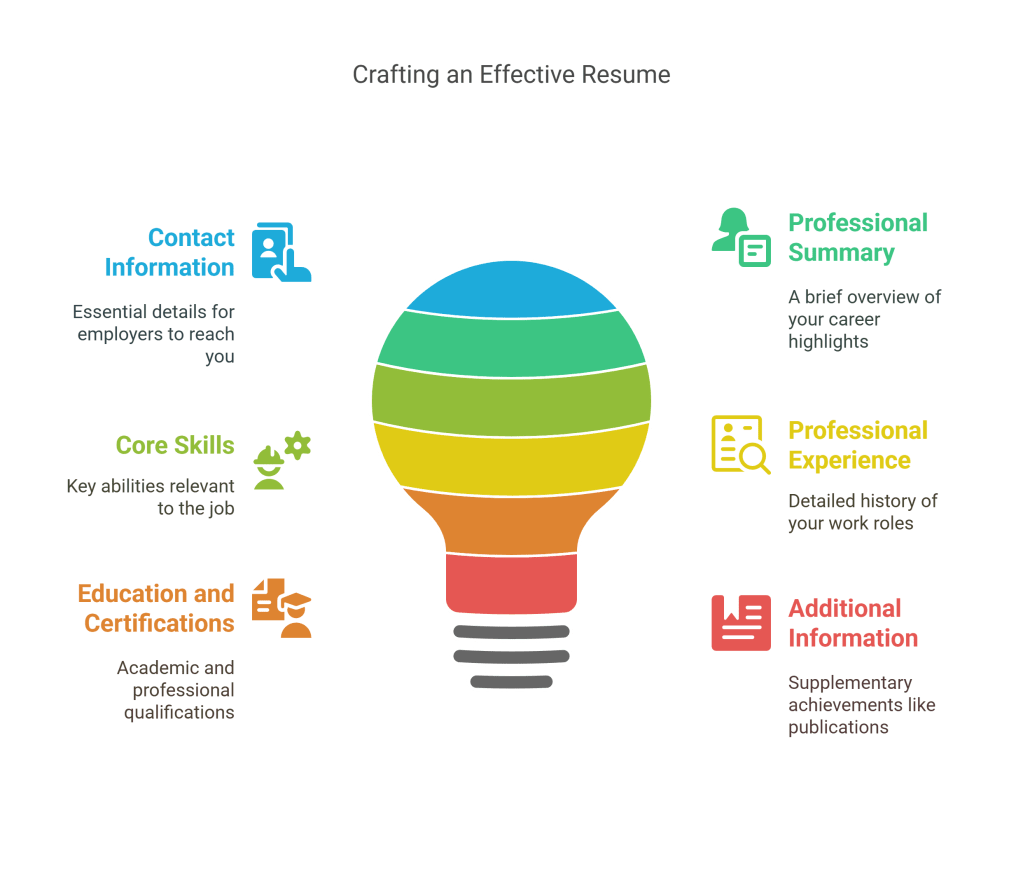
Optimal Resume Architecture An effective modern resume typically includes these sections in order:
- Contact information and professional headline
- Professional summary or profile (3-5 lines maximum)
- Core skills/competencies section (especially for technical roles)
- Professional experience
- Education and certifications
- Additional relevant information (publications, patents, etc.)
Visual Hierarchy Principles Design your resume with clear visual cues that guide the reader’s eye:
- Use consistent heading styles that stand out
- Incorporate strategic white space to separate sections
- Limit to 2-3 font styles maximum
- Ensure adequate margins (minimum 0.7″ on all sides)
- Create balance between text and white space
Resume Length Guidelines While one-page resumes were once the universal standard, current conventions vary:
- Entry-level: Strictly one page
- Mid-career (5-15 years): One or two pages, depending on relevant experience
- Executive/Senior: Two pages acceptable, focusing on recent achievements
DO:
- Use a clean, professional layout with consistent formatting
- Include your name, phone, email, and LinkedIn URL at the top
- Select a readable font between 10-12pt for body text
- Use bullet points rather than paragraphs for experience
- Save your resume as a PDF unless specifically instructed otherwise
DON’T:
- Use creative layouts for roles in traditional industries
- Include photos in North American resumes (common in some international formats)
- Crowd the page with excessive text or tiny margins
- Use outdated email domains (e.g., AOL, Hotmail)
- Include references or “References available upon request”
ATS Optimization Techniques
Understanding ATS Systems Applicant Tracking Systems (ATS) scan resumes for keywords and qualifications before human reviewers see them. Over 75% of mid-to-large companies use ATS software, making optimization essential for getting past this first screening.
Keyword Strategy Identify 10-15 key terms from the job description that appear most frequently. Incorporate these naturally throughout your resume, particularly in:
- The professional summary
- Skills section
- Job descriptions
- Accomplishment statements
Technical Considerations ATS systems vary in sophistication, so follow these technical guidelines:
- Avoid headers/footers (some systems can’t read them)
- Skip text boxes, tables, and columns in most cases
- Use standard section headings (e.g., “Work Experience” not “Professional Journey”)
- Spell out acronyms at least once, followed by the abbreviation
- Include both spelled-out and numerical forms of numbers when relevant
Testing Your ATS Optimization Several online tools can analyze your resume against a job description to determine keyword match percentage. Aim for at least 80% match on key terms for competitive positions.
DO:
- Use industry-standard keywords from the job description
- Format your resume with simple, ATS-friendly layouts
- Include the exact job title you’re applying for when possible
- Use standard section headings that ATS systems recognize
- Submit the file format specified in application instructions
DON’T:
- Stuff keywords unnaturally or use invisible text
- Use creative graphics, charts, or unusual formats
- Rely on tables or columns to organize information
- Include information in headers or footers
- Submit a scanned image of your resume
Content That Makes an Impact
Achievement-Focused Strategy Transform job duties into accomplishment statements using the CAR framework:
- Challenge: The situation or problem faced
- Action: What you specifically did to address it
- Result: The quantifiable outcome or impact
Quantification Techniques Numbers dramatically increase resume effectiveness. Quantify your experience by including:
- Percentages of improvement
- Dollar values of budgets managed or revenue generated
- Team sizes led or coordinated
- Volume of work handled (e.g., customers served, projects completed)
- Time saved through process improvements
Power Verbs by Function Begin bullets with strong action verbs appropriate to your field:
- Management: Directed, Orchestrated, Spearheaded
- Technical: Engineered, Implemented, Programmed
- Creative: Conceptualized, Designed, Transformed
- Financial: Analyzed, Budgeted, Forecasted
Case Study: Before and After Before: “Responsible for customer service and handling complaints.” After: “Resolved 200+ customer escalations monthly with 97% satisfaction rate, developing a new tracking system that reduced response time by 35%.”
DO:
- Quantify achievements with specific metrics
- Start bullet points with strong action verbs
- Highlight promotions and progressive responsibility
- Include relevant achievements from volunteer work if applicable
- Customize content for each application
DON’T:
- List job duties without accomplishments
- Include irrelevant personal information
- Use personal pronouns (I, me, my)
- Include obvious skills (Microsoft Word, email)
- Mention reasons for leaving previous positions
Things to Avoid
Critical Resume Red Flags Certain resume elements immediately damage credibility:
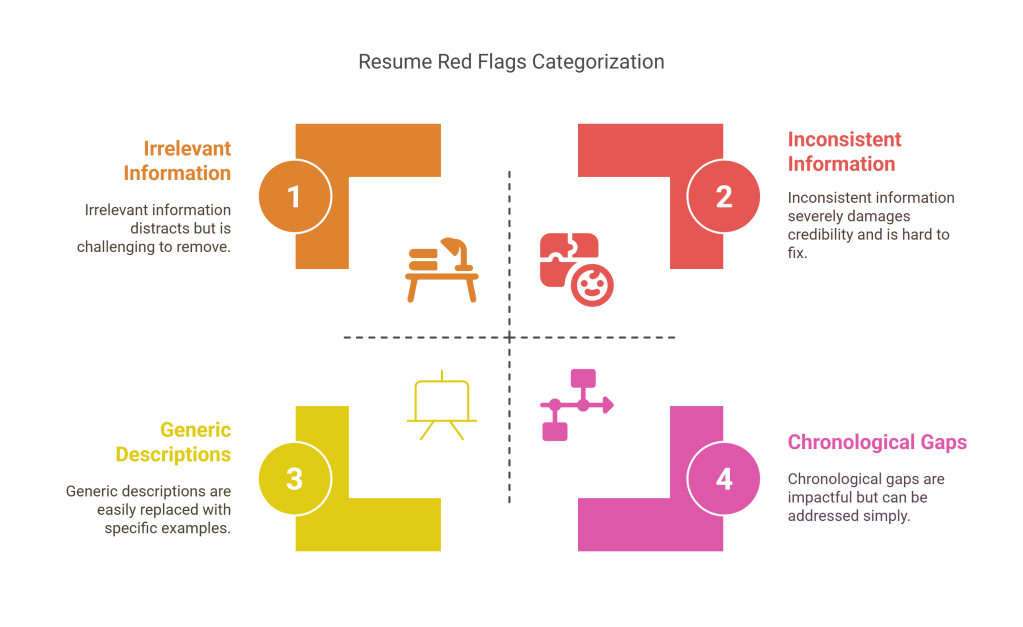
- Chronological Gaps: Unexplained employment gaps raise questions. If unavoidable, briefly address in cover letter.
- Inconsistent Information: Details misaligned with LinkedIn or application forms suggest carelessness or misrepresentation.
- Objective Statements: Replace with professional summaries that focus on what you offer rather than what you want.
- Generic Descriptions: Vague statements like “team player” or “hard worker” without supporting evidence lack impact.
- Irrelevant Information: Personal details (age, marital status), hobbies, and outdated experiences distract from qualifications.
Resume Myths to Ignore Several outdated resume “rules” no longer apply:
- Resume “templates” are acceptable if professionally designed
- Functional resumes can work for career changers (though chronological is still preferred)
- Slight customization is sufficient (deep customization for each role is now expected)
Common Technical Errors Beyond content issues, technical mistakes that prompt immediate rejection include:
- Grammatical errors and typos
- Inconsistent formatting and alignment
- Improper file naming conventions
- Non-standard document sizes
- Broken hyperlinks
DO:
- Proofread multiple times and have others review
- Ensure consistency in formatting, dates, and job titles
- Use specific examples rather than generic statements
- Focus on relevant, recent experience
- Customize for each application
DON’T:
- Include salary information or requirements
- List your full address (city/state is sufficient)
- Use an objective statement instead of a professional summary
- Include references on your resume
- Mention high school education if you have a college degree
4. Cover Letter Strategies: Making Your Case
When to Use Cover Letters
Cover Letter Relevance Despite claims that cover letters are becoming obsolete, 83% of recruiters in a recent survey reported that a well-written cover letter positively influences their decision-making process, especially for:
- Competitive positions receiving numerous applications
- Career transition situations requiring explanation
- Roles where communication skills are critical
- Positions with unique application instructions
Cover Letter Formats Different situations call for different cover letter approaches:
- Traditional Cover Letter: Formal document submitted with resume
- Email Cover Letter: The email itself serves as the cover letter
- Short-Form Cover Letter: Brief introduction in application portals
- Video Cover Letter: Increasingly requested for creative and customer-facing roles
Industry Variations Cover letter expectations vary significantly by industry:
- Financial/Legal: Formal, traditional letters expected
- Creative/Marketing: More personality and style acceptable
- Technical: Often shorter and more direct
- Academic/Research: Longer, more detailed letters common
DO:
- Write a cover letter unless explicitly told not to
- Address specific job requirements and company needs
- Research the appropriate format for your industry
- Keep length to one page maximum
- Follow submission instructions precisely
DON’T:
- Submit a generic cover letter for multiple positions
- Repeat information directly from your resume
- Submit a cover letter with the wrong company or position
- Use overly formal language that doesn’t match company culture
- Omit a cover letter when the application makes it optional
Cover Letter Structure
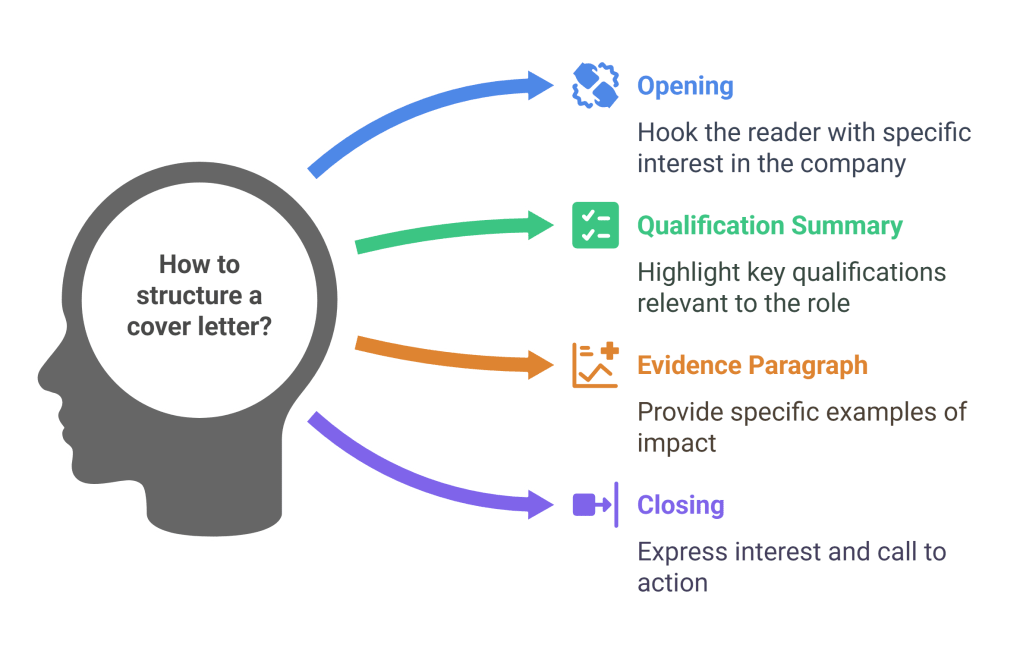
The Four-Paragraph Formula Most effective cover letters follow this structure:
- Opening (Why Them): Hook that shows specific interest in the company
- Example: “As someone who has used [Company]’s products to improve my team’s efficiency by 45%, I was excited to see the Senior Project Manager position.”
- Qualification Summary (Why You): 2-3 key qualifications most relevant to the role
- Example: “My experience leading cross-functional teams through six product launches with an average 23% improvement in time-to-market directly aligns with your focus on agile development.”
- Evidence Paragraph (Proof): Specific example demonstrating your impact
- Example: “While at XYZ Corp, I implemented a new project management system that reduced bottlenecks by 30% and improved team satisfaction scores from 6.8 to 9.2/10, all while managing a $1.2M budget.”
- Closing (Next Steps): Expression of interest and call to action
- Example: “I’m particularly drawn to [Company]’s commitment to sustainability, which aligns with my professional values. I welcome the opportunity to discuss how my background in operational efficiency could contribute to your upcoming initiatives.”
Visual Structure Considerations Beyond content, the physical presentation matters:
- Clean, consistent formatting matching your resume
- 3-4 short paragraphs with white space between
- Left-aligned text in a professional, readable font
- Proper business letter format if submitted as attachment
DO:
- Address to a specific person whenever possible
- Open with a compelling hook relevant to the company
- Include a specific, quantified achievement example
- Reference the exact position title and where you found it
- Close with appreciation and a call to action
DON’T:
- Start with “To Whom It May Concern” if avoidable
- Exceed one page in length
- Focus on what the job would do for your career
- Use clichéd openings (“I am writing to apply…”)
- Submit without proofreading multiple times
Personalization Techniques
Company-Specific Research Effective personalization requires research beyond the company homepage:
- Recent press releases and news articles
- Executive LinkedIn profiles and interviews
- Company blog posts and case studies
- Financial reports for public companies
- Employee reviews on Glassdoor
Demonstrating Cultural Fit Companies increasingly hire for cultural alignment. Research and reference:
- Company values and mission statements
- Language used in company materials
- Causes and initiatives the company supports
- Awards and recognition the company has received
Addressing Career Transitions Cover letters are ideal for explaining career changes or unusual paths:
- Highlight transferable skills relevant to the new role
- Explain your motivation for the transition
- Connect past experiences to current requirements
- Demonstrate commitment to the new direction
DO:
- Reference specific company projects, products, or achievements
- Connect your experience to the company’s stated challenges
- Match your tone to the company’s communication style
- Acknowledge company values that align with yours
- Customize each letter with specific company details
DON’T:
- Use generic statements that could apply to any company
- Focus exclusively on your needs rather than company needs
- Copy and paste content between multiple cover letters
- Mention basic company facts without meaningful connection
- Ignore the company’s tone and culture in your writing style
5. Interview Preparation: Showcasing Your Value
Research Techniques
Company Intelligence Gathering Thorough pre-interview research covers multiple dimensions:
- Business Model Understanding
- How the company makes money
- Major products/services and their market position
- Revenue streams and financial health
- Competitive Landscape
- Main competitors and differentiators
- Industry trends and challenges
- Recent market developments
- Organization Structure
- Company size and growth trajectory
- Key executives and leadership structure
- Reporting relationships if available
- Company Culture
- Stated values and mission
- Work environment (formal vs. casual)
- Employee reviews and experiences
Strategic Research Sources Beyond basic Google searches, valuable information sources include:
- LinkedIn profiles of interviewers and team members
- Company financial reports (for public companies)
- Industry analyst reports and assessments
- Company presentations at conferences/events
- Press releases and news coverage
Research Organization Method Create a one-page “company brief” with key points organized by category, focusing on:
- Recent achievements and challenges
- Growth or change initiatives
- Key terminology and industry language
- Potential questions to ask interviewers
DO:
- Research your interviewers’ backgrounds and interests
- Understand the company’s recent news and developments
- Learn about the specific department or team you’d join
- Know the company’s major products, services, and clients
- Prepare informed questions based on your research
DON’T:
- Rely solely on the company website for information
- Focus only on surface-level facts
- Neglect understanding the company culture
- Overlook recent company changes or challenges
- Skip researching the broader industry context
Common Questions and Effective Answers
The STAR Method for Behavioral Questions For questions beginning with “Tell me about a time when…” use the STAR framework:
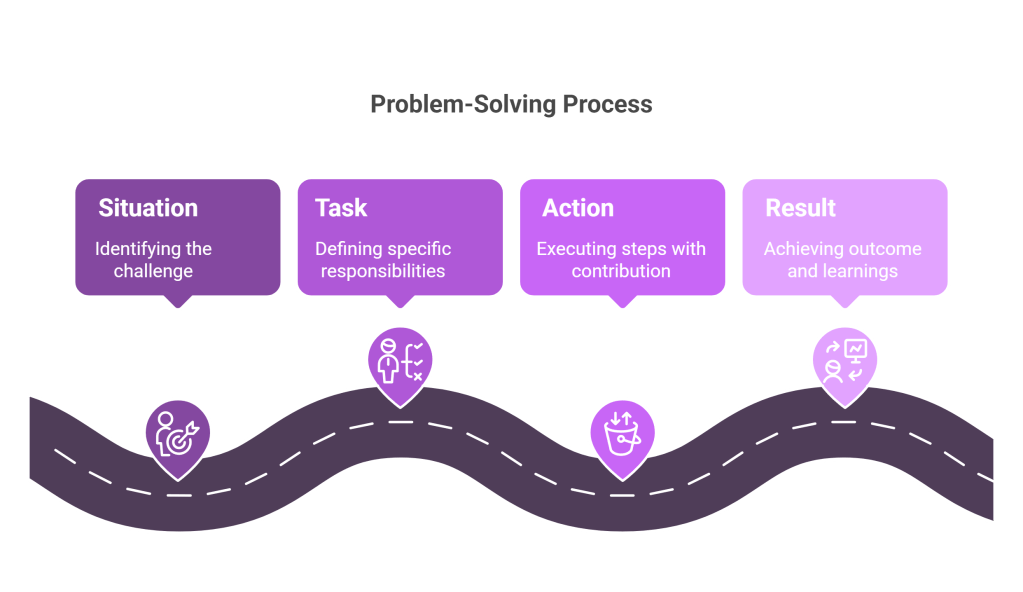
- Situation: Brief context of the challenge
- Task: Your specific responsibility
- Action: Steps you took (emphasize your contribution)
- Result: Quantifiable outcome and learnings
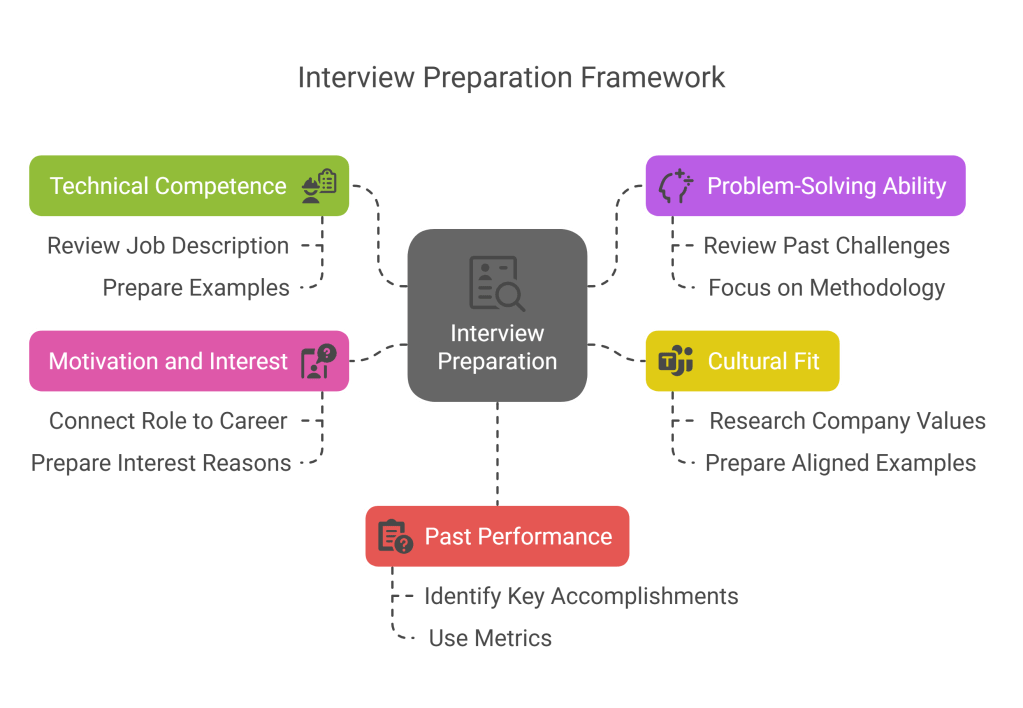
Strategic Preparation Framework Prepare for these five core question categories:
- Technical Competence Questions assessing specific skills required for the role
- Preparation: Review job description requirements, prepare examples
- Example: “How would you approach optimizing our customer database?”
- Problem-Solving Ability Questions evaluating your analytical thinking
- Preparation: Review past work challenges, focus on methodology
- Example: “How would you handle conflicting project deadlines?”
- Cultural Fit Questions about work style and team dynamics
- Preparation: Research company values, prepare aligned examples
- Example: “Describe your ideal work environment.”
- Motivation and Interest Questions about your career goals and company interest
- Preparation: Connect role to your career trajectory
- Example: “Why are you interested in this position?”
- Past Performance Questions about concrete achievements and experience
- Preparation: Identify 5-7 key accomplishments with metrics
- Example: “Tell me about your biggest achievement in your current role.”
The “Tell Me About Yourself” Question This common opener deserves special preparation. Create a 90-second response following this format:
- Present: Brief overview of current role and key responsibilities
- Past: Relevant background highlighting progression
- Future: Why this position aligns with your skills and goals
Addressing Weaknesses Effectively When asked about weaknesses, use the “genuine but strategic” approach:
- Identify a real but non-critical weakness
- Explain steps you’ve taken to address it
- Demonstrate improvement with specific example
Example: “I used to struggle with public speaking. To address this, I joined Toastmasters last year and have since led three department presentations, receiving positive feedback on my delivery and clarity.”
DO:
- Prepare stories demonstrating key competencies
- Use the STAR method for behavioral questions
- Practice concise, focused answers (1-2 minutes per response)
- Align examples with the job requirements
- Demonstrate results using specific metrics when possible
DON’T:
- Memorize responses word-for-word (sounds robotic)
- Share negative stories about previous employers
- Provide vague or generic answers lacking specifics
- Ramble or go off-topic in responses
- Use technical jargon without explanation (unless in a technical interview)
Questions to Ask Employers
Strategic Question Planning The questions you ask reveal your priorities, preparation level, and thinking process. Plan 7-10 questions, expecting to ask 3-5 depending on time constraints.
Question Categories to Cover Prepare questions from these essential categories:
- Role Clarity Questions
- “What would success look like in this role after 90 days?”
- “How has this position evolved over time?”
- “What are the greatest challenges someone in this position faces?”
- Team Dynamic Questions
- “Could you describe the team structure and my potential collaborators?”
- “How does this team typically communicate and collaborate?”
- “What’s the leadership style of the person I’d report to?”
- Company Direction Questions
- “What strategic initiatives is the company focusing on this year?”
- “How does this role contribute to the company’s overall mission?”
- “What changes do you anticipate in your industry over the next few years?”
- Professional Development Questions
- “What learning opportunities are available for someone in this position?”
- “How have others in similar roles grown within the organization?”
- “What skills would you like to see the successful candidate develop further?”
- Assessment and Decision Process Questions
- “What are the next steps in the interview process?”
- “What is your timeline for making a decision?”
- “Are there any concerns about my qualifications that I could address?”
Question Strategy Case Study A marketing professional interviewing for a brand manager position asked: “I noticed your company recently repositioned Product X with a focus on sustainability. What metrics are you using to measure the success of this strategy?” This demonstrated industry awareness, analytical thinking, and results orientation—leading to positive feedback from the interviewing panel.
DO:
- Prepare thoughtful questions that demonstrate research
- Ask about challenges, expectations, and success metrics
- Include questions about company culture and team dynamics
- Show interest in the company’s future direction
- Ask for clarification on any unclear aspects of the role
DON’T:
- Ask basic questions answered on the company website
- Focus exclusively on benefits, salary, or time off
- Ask about controversial topics or company problems
- Request information that could be seen as confidential
- Ask too many questions (quality over quantity)
Virtual vs. In-Person Interview Differences
Virtual Interview Environment Optimization With remote interviews now standard practice, environment preparation is crucial:
- Technical Setup
- Test camera, microphone, and internet connection 24 hours before
- Install required software and create necessary accounts in advance
- Position camera at eye level for natural eye contact
- Use earbuds or headphones to improve audio quality
- Visual Considerations
- Create a neutral, professional background (physical or virtual)
- Ensure proper lighting (front-facing, avoiding backlighting)
- Dress professionally from head to toe (in case you need to stand)
- Remove visual distractions from camera view
- Engagement Techniques
- Look directly at the camera when speaking (not at yourself)
- Use slightly more animated facial expressions than in person
- Nod visibly to show understanding
- Keep hand gestures within camera frame
In-Person Interview Logistics For traditional interviews, advance preparation includes:
- Confirming exact location, parking options, and building access
- Planning to arrive 15-20 minutes early (but entering 5-10 minutes before)
- Bringing multiple resume copies, notepad, and pen
- Researching appropriate attire for the company culture
Communication Adjustments Each interview format requires different communication strategies:
Virtual:
- Pause slightly longer before responding to avoid talking over others
- Speak at 85% of your normal pace to account for potential lag
- Use verbal acknowledgments since body language is limited
- Practice “virtual handshakes” (brief greeting and smile)
In-Person:
- Focus on nonverbal communication (posture, handshake, eye contact)
- Use the interviewer’s name periodically
- Be aware of personal space and physical presence
- Pay attention to all panel members, not just the person asking questions
DO:
- Practice with the actual technology you’ll use for virtual interviews
- Create backup plans for technical issues
- Minimize potential interruptions in your environment
- Maintain professional demeanor regardless of format
- Follow up appropriately based on interview type
DON’T:
- Assume virtual interviews are less formal
- Allow distractions in your environment during virtual interviews
- Forget to silence notifications on your device
- Read directly from notes during video interviews
- Sacrifice preparation quality for either format
6. Following Up: Maintaining Momentum
Post-Application Follow-Up
Timing Strategy Strategic follow-up demonstrates interest without appearing desperate:
- Initial application: Allow 5-7 business days before first follow-up
- After screening interview: 3-5 business days if no timeline provided
- After final interview: 5-7 business days unless given specific timeframe
Follow-Up Channels Select the appropriate communication channel:
- Email: Professional standard, provides documentation
- LinkedIn: Appropriate if initial contact was through platform
- Phone: Use sparingly, primarily when time-sensitive
- Application Portal: Some systems allow status inquiries
Effective Follow-Up Communication Well-crafted follow-ups include these elements:
- Clear subject line referencing position and interaction
- Brief reminder of your application and qualifications
- Expression of continued interest
- Reference to specific conversation points
- Professional closing with clear contact information
Sample Follow-Up Structure:
Subject: Following Up - Marketing Manager Application (Reference #12345)

Dear [Name],

I hope this message finds you well. I'm writing to follow up on my application for the Marketing Manager position submitted on [date].

During our conversation on [date], we discussed [specific topic] and your team's goals for [specific initiative]. Since then, I've been reflecting on how my experience with [relevant skill/project] aligns with these objectives.

I remain very interested in this opportunity and would welcome the chance to discuss how I could contribute to [company name]'s continued success.

Thank you for your consideration. I look forward to hearing from you.

Best regards,
[Your Name]
[Phone]
[LinkedIn URL]
DO:
- Keep follow-ups brief and professional
- Reference specifics from previous communications
- Add new relevant information if available
- Follow the company’s stated timeline before following up
- Maintain a tracking system for all applications and follow-ups
DON’T:
- Send multiple follow-ups to the same person
- Express frustration or impatience
- Contact employees not involved in hiring process
- Send generic template messages
- Give up after one follow-up attempt
Thank You Notes
Thank You Note Impact According to a CareerBuilder survey, 22% of employers are less likely to hire candidates who don’t send thank-you notes, while 91% say a well-crafted note positively influences their decision.
Timing is Critical Send thank you notes within 24 hours of the interview—the same day is ideal. This demonstrates promptness and genuine interest while keeping you fresh in the interviewer’s mind.
Personalization Strategy For panel interviews, send individual notes to each interviewer with unique content referencing:
- Specific topics they discussed
- Their particular role or perspective
- Questions they asked or answered
- Connections you established
Format Options Consider the company culture when choosing between:
- Email (standard, timely, appropriate for most industries)
- Handwritten note (traditional industries, personal touch)
- LinkedIn message (appropriate if connection already established)
Effective Structure A powerful thank you note includes:
- Expression of appreciation for time and consideration
- Reinforcement of key qualifications discussed
- Additional information addressing any concerns raised
- Reference to specific conversation points
- Reaffirmation of interest and enthusiasm
- Professional closing with contact information
DO:
- Send individual notes to each interviewer
- Reference specific discussion points
- Address any concerns raised during the interview
- Express genuine enthusiasm for the role
- Proofread carefully for errors
DON’T:
- Send generic, template-style notes
- Write excessively long messages
- Introduce completely new information
- Appear desperate or presumptuous
- Forget to include contact information
Negotiation Strategies
Pre-Negotiation Research Effective negotiation begins with comprehensive salary research from multiple sources:
- Industry-specific compensation reports
- Geographic salary data (accounting for cost of living)
- Company-specific information on Glassdoor, PayScale, etc.
- Professional association salary surveys
- Network connections at similar companies
Total Compensation Perspective Focus negotiations on the complete package, not just base salary:
- Base compensation
- Performance bonuses and incentives
- Equity or stock options
- Retirement benefits and matching
- Healthcare and insurance
- Paid time off and flexibility
- Professional development allowances
- Relocation assistance
Strategic Response to the First Offer When receiving an initial offer:
- Express appreciation regardless of the amount
- Ask for time to consider (24-48 hours is standard)
- Prepare a thoughtful counter based on research
- Focus on your value proposition, not personal needs
Negotiation Psychology Understanding the psychological aspects of negotiation improves outcomes:
- Frame requests in terms of mutual benefit
- Use silence strategically after stating your counter
- Approach with collaborative rather than adversarial mindset
- Express enthusiasm for the role throughout negotiations
DO:
- Know your absolute minimum acceptable offer
- Practice your negotiation conversation
- Consider multiple compensation elements, not just salary
- Document the final agreement in writing
- Maintain professional, positive communication throughout
DON’T:
- Accept the first offer immediately
- Make ultimatums or threats
- Fabricate competing offers
- Focus exclusively on salary
- Negotiate via email if a phone conversation is possible
7. Online Presence Optimization: Your Digital Professional Brand
LinkedIn Profile Optimization
Strategic Profile Development Your LinkedIn profile serves multiple functions in the job search process:
- Passive recruiting tool for headhunters
- Verification source for hiring managers
- Networking platform for industry connections
- Professional brand statement
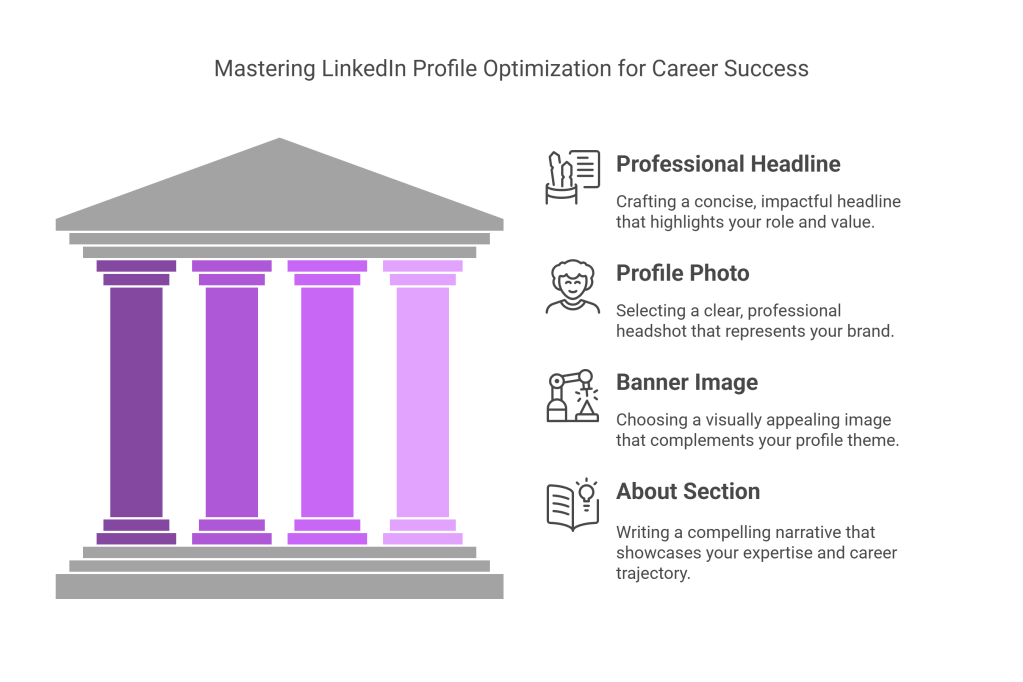
Key LinkedIn Elements to Optimize
- Professional Headline (120 characters)
- Include current role, industry keywords, and unique value proposition
- Example: “Marketing Director | Digital Strategy Expert | Driving 40%+ Revenue Growth Through Data-Driven Campaigns”
- Profile Photo
- Professional headshot with neutral background
- Current (within last 2 years)
- Clear face shot (head and shoulders)
- Appropriate attire for industry
- Banner Image
- Industry-relevant or brand-aligned graphic
- Professional quality with appropriate resolution
- Complementary to overall profile theme
- About Section (2,600 characters)
- Professional narrative highlighting expertise
- Industry keywords throughout
- Unique value proposition
- Clear career trajectory
- Call to action for connections
- Experience Section
- Achievements rather than responsibilities
- Quantified results with metrics
- Multimedia content where relevant
- Keywords aligned with target positions
- Skills & Endorsements
- 30-50 relevant skills prioritized by importance
- Grouped by category (technical, soft, industry-specific)
- Endorsements from relevant connections
- Recommendations
- Both given and received from industry peers
- Specific rather than generic content
- Strategic coverage of different skills/qualities
Activity Strategy Regular engagement increases profile visibility:
- Share industry content 1-3 times weekly
- Comment thoughtfully on industry discussions
- Publish original content quarterly
- Engage with company pages of target employers
DO:
- Use keywords relevant to target positions throughout
- Complete every section of your profile
- Request recommendations from supervisors and colleagues
- Update your profile regularly with achievements
- Engage consistently with industry content
DON’T:
- Use the default connection request message
- Leave employment gaps unexplained
- Contradict information on your resume
- Use unprofessional or outdated photos
- Write in the third person
Professional Social Media Audit
Comprehensive Digital Footprint Assessment Before applying to positions, conduct a thorough audit of your online presence:
- Search Engine Review
- Google your name with various combinations (+”previous employer,” +”city”)
- Check image search results
- Review first 3-5 pages of search results
- Set up Google Alerts for your name
- Social Media Assessment
- Review all platforms with public content
- Evaluate posts, comments, photos, and tags
- Consider both content and context
- Assess through the lens of potential employers
- Content Categorization Classify existing content into:
- Professional assets (highlighting expertise)
- Neutral content (personal but appropriate)
- Potential concerns (requiring action)
Privacy Setting Strategy Different platforms require different approaches:
- LinkedIn: Primarily public, professional content
- Facebook: Higher privacy settings, friend content review
- Twitter: Either fully professional or highly private
- Instagram: Consider separate personal/professional accounts
Professional Content Development Beyond cleanup, develop positive professional content:
- Industry blog contributions
- Professional association engagement
- Portfolio websites or projects
- Thoughtful comments on industry publications
DO:
- Search yourself regularly from an incognito browser
- Adjust privacy settings on personal accounts
- Request removal of inappropriate tags or content
- Develop a consistent professional brand across platforms
- Create positive professional content to improve digital footprint
DON’T:
- Post controversial content on public platforms
- Complain about current or previous employers online
- Share confidential or proprietary information
- Neglect checking content shared by others that tags you
- Assume private accounts are truly private
8. Handling Rejection: Learning and Moving Forward
Learning from Unsuccessful Applications
Rejection Analysis Framework Extract valuable insights from unsuccessful applications by analyzing:
- Application Stage Analysis
- Resume/Application stage: Likely qualification or presentation issues
- Phone screen: Possible communication or initial impression concerns
- First interview: Potential fit or specific skill questions
- Final rounds: Likely competing candidate advantages or specific concerns
- Feedback Collection Strategies
- Direct request: “I appreciate your consideration. To help my professional development, could you share any feedback on areas I could improve?”
- Specific inquiry: “Was there a particular qualification or experience that would have made me a stronger candidate?”
- Recruiter insight: Third-party recruiters often have candid feedback
- Pattern Recognition
- Track all feedback received across applications
- Identify recurring themes or suggestions
- Distinguish between skill gaps and presentation issues
Practical Application of Learning Transform feedback into actionable improvements:
- Skill gaps: Pursue relevant training or certifications
- Experience needs: Seek volunteer or project opportunities
- Presentation issues: Revise resume or interview approach
- Cultural fit concerns: Research target companies more thoroughly
DO:
- Request specific, constructive feedback
- Thank interviewers for any insights provided
- Document feedback for future reference
- Look for patterns across multiple interviews
- Develop an improvement plan based on feedback
DON’T:
- React defensively to constructive criticism
- Argue with rejection decisions
- Burn bridges with companies or recruiters
- Ignore patterns in feedback
- Take rejection as a personal judgment
Maintaining Momentum
Psychological Resilience Strategies Job searching can be emotionally taxing. Maintain resilience through:
- Structured Routine
- Set specific job search hours (treating it as a job)
- Establish daily and weekly goals (applications, networking, skill development)
- Build in regular breaks and rewards
- Track progress with visual indicators of activity
- Psychological Framing
- View rejection as redirection rather than failure
- Focus on factors within your control
- Celebrate small wins throughout the process
- Practice self-compassion during setbacks
- Support Network Activation
- Connect with peers in similar situations
- Share experiences with trusted mentors
- Consider job search accountability partners
- Separate identity from job search outcomes
Practical Momentum Maintenance Beyond mindset, practical strategies help maintain forward progress:
- Diversified Approach
- Balance application submission with networking
- Alternate between different job search activities
- Pursue multiple paths simultaneously
- Explore temporary or contract opportunities
- Skill Development During Search
- Identify and address skill gaps through courses
- Pursue relevant certifications
- Volunteer for projects showcasing target skills
- Create portfolio pieces demonstrating capabilities
- Regular Process Refinement
- Analyze results weekly to identify what’s working
- Test different resume versions or application approaches
- Refine target position types based on feedback
- Adjust strategy based on market response
Case Study: Strategic Persistence After six weeks of applications with no interviews, a project manager candidate:
- Sought resume review from industry professionals
- Discovered ATS optimization issues with format
- Restructured experience to highlight relevant achievements
- Increased networking activity while reducing applications
- Secured three interviews within two weeks of changes
DO:
- Maintain a consistent schedule for job search activities
- Track progress metrics beyond just interviews
- Celebrate small wins throughout the process
- Adjust strategies based on results
- Build skills and network during the search
DON’T:
- Take rejection personally or let it define your worth
- Isolate yourself during challenging periods
- Continue ineffective strategies without adjustment
- Neglect self-care during the search process
- Compare your journey to others’
Conclusion: Your Strategic Advantage
The job application process is complex and competitive, but strategic preparation creates significant advantages. By approaching each stage with intention and insight, you can navigate the process more effectively than most candidates.
Remember these key principles:
- Research thoroughly before applying to understand both requirements and company culture
- Customize your materials for each application rather than using generic versions
- Quantify achievements whenever possible to demonstrate concrete impact
- Prepare meticulously for interviews with both questions and answers
- Follow up professionally at each stage of the process
- Learn continuously from both successes and setbacks
The ultimate “cheat code” for job applications isn’t a shortcut—it’s a commitment to excellence at every stage of the process. By applying these strategies consistently, you’ll significantly increase your chances of not just landing any job, but finding the right role where you can thrive professionally.
Your career journey is a marathon, not a sprint. Each application, interview, and even rejection provides valuable experience that builds toward your ultimate success. Stay focused, remain adaptable, and trust the process of continuous improvement. Your ideal position awaits—and now you have the strategic tools to secure it.
Discover more from SkillWisor
Subscribe to get the latest posts sent to your email.
 SkillWisor