
In a world filled with distractions and instant gratification, self-discipline stands as the cornerstone of personal achievement and lasting success. The ability to stay consistent, make intentional choices, and persist through challenges doesn’t come naturally to most people—it’s developed through deliberate practice and strategic approaches. This comprehensive guide explores practical strategies organized around four key pillars of self-discipline: effective planning, habit formation, environmental optimization, and resilience building.

Understanding Self-Discipline: The Foundation of Achievement
Self-discipline isn’t about rigid control or denying yourself pleasure. Rather, it’s the developed ability to act in alignment with your long-term goals despite temporary discomfort or temptation. It’s the bridge between who you are today and who you aspire to become.
Research consistently shows that self-discipline is a stronger predictor of success than IQ or socioeconomic status. The famous “marshmallow experiment” by Walter Mischel demonstrated that children who could delay gratification (resist eating one marshmallow to get two later) went on to have better life outcomes decades later, including higher SAT scores, better health, and more fulfilling relationships.
The good news? Self-discipline isn’t a fixed trait but a skill that can be cultivated through intentional practice and strategic approaches. Let’s explore how.
Strategic Planning – The Foundation of Self-Discipline

Setting Clear Daily and Weekly Goals
Self-discipline begins with clarity. Without clear goals, even the most disciplined person will struggle to direct their energy effectively. Take time to establish specific, measurable, achievable, relevant, and time-bound (SMART) goals for both daily activities and weekly accomplishments.
Instead of vague intentions like “work on project,” define exactly what success looks like: “Complete research section of the marketing report by 2 PM.” This specificity eliminates ambiguity and creates a clear target for your disciplined efforts.
Weekly goal-setting creates momentum that carries through each day. Sunday evenings or Monday mornings are ideal times to outline your key priorities for the week ahead, ensuring your daily tasks align with broader objectives.
Planning Your Day in Advance
Decision fatigue—the deterioration of decision quality after a long session of decision-making—is a silent saboteur of self-discipline. Each decision throughout your day depletes your mental energy, making it progressively harder to maintain discipline.
Combat this by planning your day the night before. When you wake up with a clear roadmap, you conserve valuable willpower for important tasks rather than spending it deciding what to do next. This practice also reduces anxiety and improves sleep quality, as your brain isn’t processing unresolved plans during rest hours.
A simple planning session of 10-15 minutes before bed can dramatically improve your productivity and discipline the following day.
Breaking Down Large Tasks
Large projects often trigger procrastination due to their intimidating scope. The psychology behind this is clear: our brains resist activities that seem overwhelming. By breaking big tasks into smaller components, you make them more approachable and reduce the psychological resistance to starting.
For example, instead of “write research paper,” create a sequence of smaller tasks: “gather sources,” “create outline,” “draft introduction,” “write section one,” etc. Each completed subtask creates a sense of progress and momentum, fueling continued discipline.
This approach also allows for more accurate time estimation and reduces the likelihood of becoming overwhelmed—a common trigger for abandoning disciplined behavior.
Balancing Work and Rest
Sustainable self-discipline isn’t about constant productivity—it requires strategic rest. The most disciplined individuals understand that recovery isn’t a reward for hard work; it’s a necessary component of sustained performance.
Schedule specific times for both focused work and intentional rest. The Pomodoro Technique (25 minutes of focused work followed by 5 minutes of rest) is one structured approach, but you might also consider longer blocks based on your personal energy patterns.
Remember that rest quality matters as much as quantity. Passive scrolling through social media doesn’t provide the same recovery benefits as a short walk, deep breathing, or brief meditation. Design your breaks to genuinely refresh your mental resources.
Tracking Progress for Accountability
What gets measured gets managed. Tracking your progress creates both accountability and motivation, two essential ingredients for sustained discipline. The visible evidence of consistency reinforces your identity as a disciplined person and provides valuable feedback on your strategies.
Consider using a simple habit tracker, journal, or app to monitor key behaviors and outcomes. Review your tracking weekly to identify patterns—perhaps you’re more disciplined in the mornings or after certain activities. These insights allow you to optimize your approach over time.
Progress tracking also combats the “valley of disappointment”—that frustrating period where you’re putting in effort but not yet seeing dramatic results. Having evidence of your consistent actions maintains motivation during these crucial periods.
Habit Development – The Architecture of Self-Discipline
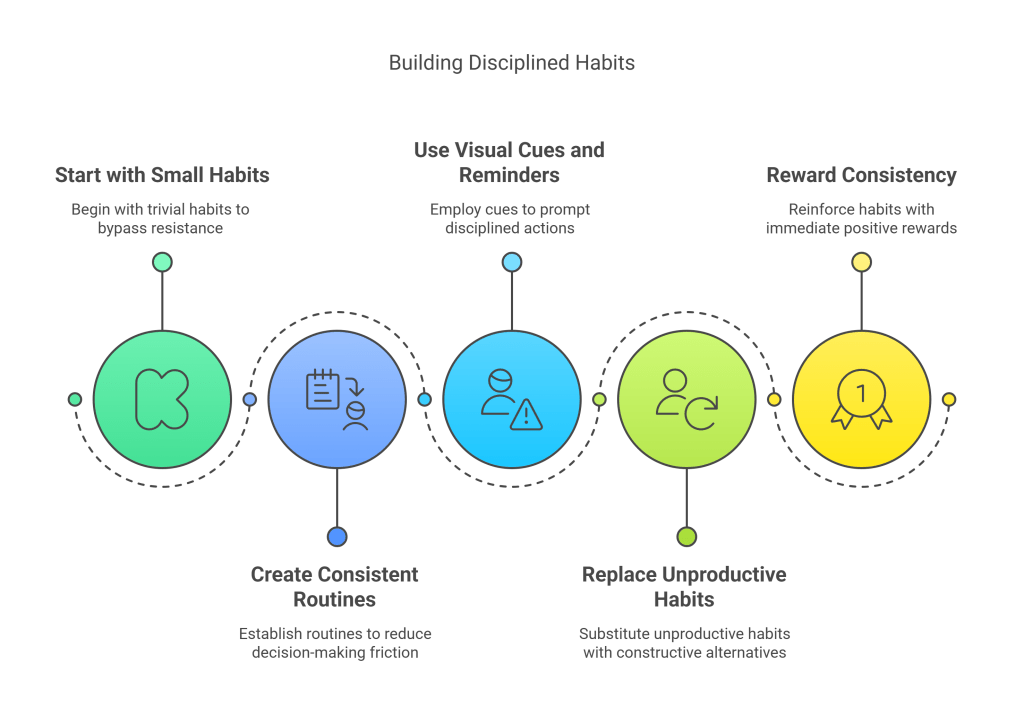
Starting with Small Habits
Ambitious goals often inspire ambitious beginnings, but this approach frequently leads to burnout and abandonment. The science of behavior change suggests a different path: start with habits so small they seem almost trivial.
Begin with what author James Clear calls a “two-minute habit”—a behavior that takes less than two minutes to complete. Want to read more? Start with reading just one page per day. Want to exercise regularly? Begin with a single push-up each morning.
These micro-habits bypass resistance because they require minimal effort and willpower. Over time, these small actions establish neural pathways that make the behavior increasingly automatic. Once the initial habit is established, gradually expand its scope and duration.
Creating Consistent Routines
Routines are the scaffolding that supports self-discipline. By performing specific activities at consistent times, you reduce the friction of decision-making and leverage the power of environmental cues.
Identify your most important behaviors and assign them specific slots in your daily schedule. Morning routines are particularly powerful, as they set the tone for the day before distractions multiply. However, don’t overlook the importance of closing routines in the evening, which help prepare both mind and environment for the next day.
The key is consistency. A moderate routine followed consistently yields better results than an ambitious routine followed sporadically. Your brain craves predictability, and consistent routines create momentum that carries you through periods of lower motivation.
Using Visual Cues and Reminders
Our environments speak to us constantly, influencing our behaviors in subtle but significant ways. Visual cues serve as environmental triggers that prompt disciplined actions without requiring conscious decision-making.
Place visual reminders in your physical space where they’ll naturally enter your awareness at relevant times. A water bottle on your desk promotes hydration; workout clothes laid out the night before increase morning exercise adherence; a prominently placed journal encourages daily reflection.
Digital reminders can complement physical cues. However, be selective—too many notifications create noise that’s easily ignored. Focus on cueing your most high-impact disciplined behaviors, especially those still being established.
Replacing Unproductive Habits
Eliminating unhelpful habits rarely works through willpower alone. The most effective approach is displacement—replacing unproductive patterns with constructive alternatives that satisfy the same underlying needs.
Start by identifying the cue and reward of your current habit. If you reflexively check social media when bored (cue: boredom; reward: stimulation), design a replacement behavior that provides similar benefits, such as reading a fascinating book kept within arm’s reach.
The replacement should be both more aligned with your goals and comparably satisfying. Cold turkey elimination without replacement typically leads to relapse or the emergence of different unproductive behaviors.
Rewarding Consistency
Reinforcement accelerates habit formation. While discipline is often associated with delayed gratification, immediate positive reinforcement creates faster behavior change. Design small, healthy rewards that immediately follow your disciplined actions.
These rewards need not be elaborate or costly. A moment of celebration, a check mark in your journal, or a small pleasure like a favorite tea after completing a challenging task can create powerful associations in your brain. The key is immediacy—the reward should follow the behavior as closely as possible.
As disciplines become more established, the behavior itself often becomes intrinsically rewarding. However, strategic reinforcement remains valuable during periods of lower motivation or when expanding your disciplined behaviors.
Environment Design – Creating Spaces that Support Success

Removing Distractions
Willpower is a finite resource, and continuous resistance to temptation depletes it rapidly. Environmental design offers a more sustainable approach: removing distractions entirely eliminates the need for ongoing willpower expenditure.
Audit your physical and digital spaces for common distractions. In your physical workspace, this might involve clearing visual clutter, silencing notifications, or establishing boundaries with others during focus periods. Digitally, consider browser extensions that block distracting websites, app timers that limit usage, or designated devices for specific purposes only.
Remember that environmental design isn’t about perfect sterility—it’s about making disciplined choices the path of least resistance. Even small adjustments like placing your phone in another room during work sessions can dramatically increase focused productivity.
Surrounding Yourself with Supportive People
Social influence profoundly impacts our behavior patterns. Research consistently shows that we tend to adopt the norms, values, and habits of those we spend the most time with—a phenomenon some researchers call “behavioral contagion.”
Intentionally cultivate relationships with individuals who demonstrate the disciplines you wish to develop. This might involve joining communities organized around specific goals, finding accountability partners, or simply being more selective about your social circle.
Be particularly mindful of who you turn to for advice. Seek guidance from those who have demonstrated consistent discipline in areas where you wish to improve, rather than from those who merely have opinions on the subject.
Keeping Goals Visible
Out of sight often means out of mind. Visual exposure to your goals serves as a constant reminder of your deeper motivations, helping maintain focus during moments of temptation or fatigue.
Create visual representations of your goals and place them where you’ll encounter them regularly. This might be a vision board in your office, a single image on your phone background, or written affirmations on your bathroom mirror. The form matters less than the regular exposure.
For optimal impact, include both the what and the why of your goals. Visual reminders of your desired outcome combined with written reflections on its personal importance create powerful motivation during challenging moments.
Structuring Your Environment for Good Habits
Beyond removing negatives, proactively design your environment to facilitate positive behaviors. Make disciplined choices convenient and undisciplined choices inconvenient.
Want to exercise more? Keep equipment visible and accessible. Trying to eat healthier? Keep nutritious options front and center in your refrigerator. Working to reduce screen time? Create comfortable reading nooks that invite deeper engagement than digital alternatives.
Environmental pre-commitment is particularly powerful: preparations that make future disciplined actions nearly automatic. Preparing gym clothes the night before, batch-cooking healthy meals on weekends, or downloading focused work materials before travel all leverage this principle.
Setting Clear Boundaries
Boundaries protect your most valuable resources: time, energy, and attention. They’re not selfish limitations but necessary conditions for sustained discipline and meaningful achievement.
Establish clear parameters around when you’re available to others, which activities deserve your focus, and how you’ll protect your priorities from encroachment. This includes both external boundaries (communicating clear expectations to others) and internal boundaries (personal rules about how you allocate attention).
Digital boundaries are increasingly crucial. Consider designated times for email and messaging, clear separation between work and personal devices, and technology-free zones or periods to support deeper focus and presence.
Resilience Building – Maintaining Discipline Through Challenges

Pushing Through Discomfort
Discomfort is an inevitable companion on any path of growth. The ability to tolerate discomfort—what psychologists call “distress tolerance”—is a cornerstone of self-discipline.
When faced with the urge to abandon disciplined behavior, practice the “five-minute rule”: commit to just five more minutes of the challenging activity. Often, the strongest resistance occurs at the beginning, and momentum builds once you’re engaged.
Remember that discomfort itself isn’t harmful—it’s simply information from your brain about leaving familiar patterns. Acknowledge the discomfort without allowing it to dictate your choices. With practice, your discomfort threshold increases, making disciplined actions progressively easier.
Understanding Motivation Cycles
Motivation naturally fluctuates—it’s a biological reality, not a personal failure. Sustainable discipline requires strategies for maintaining consistency despite these natural ebbs and flows.
During high-motivation periods, build systems and create resources that will carry you through lower periods. This might include preparing materials, eliminating obstacles, or completing the most challenging aspects of important projects.
When motivation is lower, rely more heavily on your established routines, environmental design, and social accountability. Focus on maintaining momentum through minimum viable actions rather than expecting peak performance.
Reframing Setbacks as Learning
Perfectionism is often the enemy of sustainable discipline. The belief that any lapse represents total failure leads many to abandon their efforts entirely after small setbacks.
Develop a growth mindset that views setbacks as valuable data rather than moral failures. When you miss a workout, skip a writing session, or fall short of a goal, ask: “What specific factors contributed to this outcome? What adjustments would make success more likely next time?”
Document these insights and implement the adjustments immediately. This transforms setbacks from discouraging failures into stepping stones toward more robust systems and self-knowledge.
Practicing Delayed Gratification
The ability to postpone immediate pleasure for greater future reward is perhaps the most fundamental aspect of self-discipline. Like any skill, delayed gratification improves with deliberate practice.
Start with small delays and gradually extend the duration. If you typically check social media immediately when bored, practice waiting just five minutes while observing the urge without acting on it. As your capacity grows, extend these periods.
Visualization strengthens this ability—vividly imagine the specific benefits of your disciplined choice whenever temptation arises. The more detailed and emotionally resonant these visualizations, the more effectively they counter immediate temptations.
Using Positive Self-Talk
Your internal dialogue profoundly influences your behavior. Harsh self-criticism after lapses typically decreases motivation and makes renewed effort less likely, while constructive, encouraging self-talk builds resilience and persistence.
Develop awareness of your automatic self-talk patterns, particularly after challenges or setbacks. Practice replacing demoralizing statements (“I always fail at this”) with more accurate and constructive alternatives (“This approach didn’t work, but I can adjust and try again”).
Consider writing out specific self-talk scripts for common challenging situations. Having these prepared in advance provides valuable mental resources when your discipline is being tested.
Integration: Creating Your Personal Discipline System
Self-discipline isn’t about isolated techniques but an integrated system where each element reinforces the others. Planning creates the foundation for habit development; well-designed environments support resilience; resilience maintains habits during challenging periods.
Start by assessing your current strengths and challenges across these four pillars. Where do you already excel? Where do you encounter the most significant obstacles? This assessment helps prioritize your initial focus areas.
Begin with small, strategic changes rather than wholesale transformation. Select one high-impact practice from each pillar that addresses your specific challenges, and implement them consistently for at least three weeks before adding additional elements.
Remember that self-discipline is highly individual. Experiment with different approaches, observe your results carefully, and refine your system based on personal data rather than generic advice. What works brilliantly for others might need adjustment to fit your unique psychology and circumstances.
Conclusion: Discipline as a Path to Freedom
While discipline is often perceived as restrictive, its true outcome is expanded freedom and choice. The disciplined individual gains increasing control over their time, finances, health, and capabilities—creating more options in every area of life.
This perspective transforms discipline from burden to opportunity. Each small choice becomes not a denial of immediate pleasure but an investment in your future self and expanded possibilities.
The journey toward greater self-discipline is gradual and nonlinear. Expect both progress and setbacks, with an overall trajectory of improvement over time. Be patient with yourself, celebrate consistent effort more than perfect outcomes, and remember that the capacity for self-discipline grows through deliberate practice just like any other skill.
Through thoughtful planning, systematic habit development, strategic environment design, and cultivated resilience, you build not just discipline but a foundation for achievement in every area that matters to you. The rewards of this investment extend far beyond any single goal, creating a lifetime of expanded capability and choice.
Discover more from SkillWisor
Subscribe to get the latest posts sent to your email.
 SkillWisor