

AI agents stand at the forefront of artificial intelligence, representing systems capable of autonomous action within complex environments. They can perceive their surroundings, process information, make intelligent decisions, and execute actions to achieve predefined objectives. This roadmap expands upon the foundational concepts, guiding aspiring AI agent builders from novice stages to advanced expertise.
Level 1: Building Your Foundation – The Bedrock of AI Agent Development
A robust foundation in programming and core AI concepts is non-negotiable. This level focuses on equipping you with the essential tools and understanding before diving into agent-specific technologies.
Programming Fundamentals
Proficiency in programming is the language of AI agent development. While many languages exist, Python and TypeScript are particularly relevant for their ecosystems and applications in AI.
- Python: Dominant in AI due to its vast libraries (like NumPy, Pandas, Scikit-learn, TensorFlow, PyTorch) and clear syntax.
- Key Concepts:
- Data Types and Structures: Understanding lists, dictionaries, sets, tuples, and how to efficiently manipulate data.
- Control Flow and Functions: Mastering loops, conditionals, and structuring code into reusable functions.
- File I/O Operations: Reading from and writing to files, essential for data handling and configuration.
- Network Programming Basics: Understanding how to make HTTP requests, handle responses, and interact with web services – crucial for API integration.
- Key Concepts:
- TypeScript: Increasingly important for building web-based AI applications and interfaces, providing type safety and scalability.
- Key Concepts:
- Static Typing: Leveraging types to catch errors early and improve code maintainability.
- Asynchronous Programming: Handling non-blocking operations, vital for responsive web applications interacting with APIs.
- Module Systems: Organizing code into reusable components.
- Key Concepts:
Machine Learning Essentials
Machine learning provides the intelligence layer for many AI agents, enabling them to learn from data and adapt their behavior.
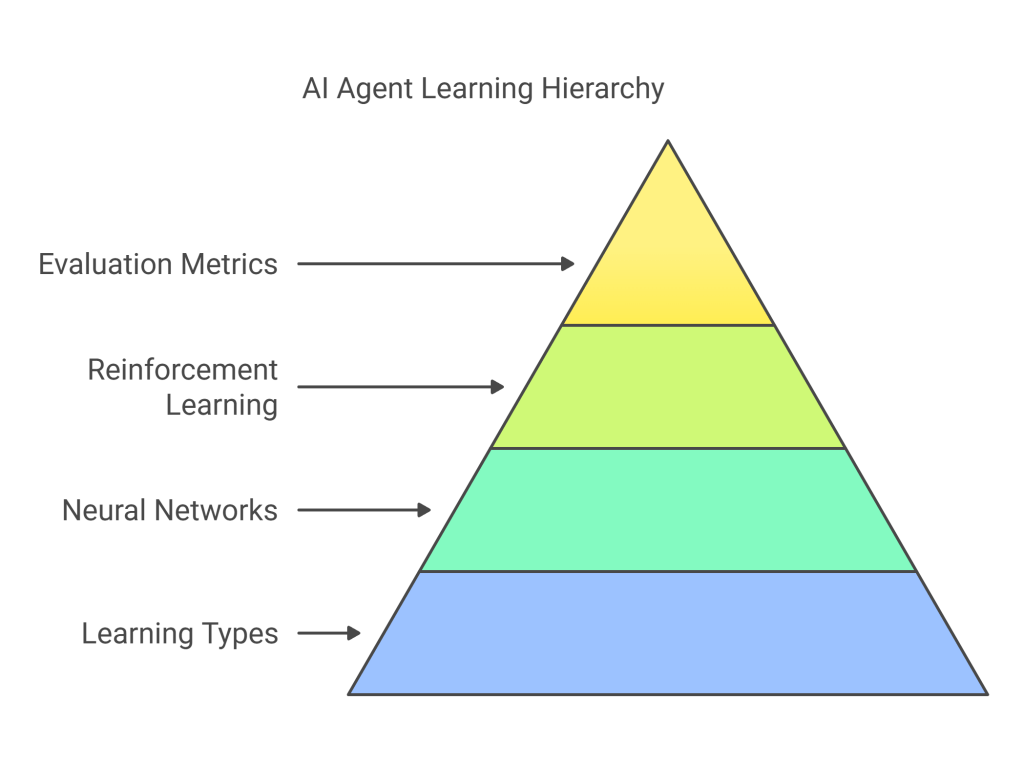
- Supervised vs. Unsupervised Learning:
- Supervised: Learning from labeled data (e.g., classification, regression) – useful for agents that need to predict outcomes or categorize inputs.
- Unsupervised: Finding patterns in unlabeled data (e.g., clustering, dimensionality reduction) – useful for agents that need to discover insights or group similar information.
- Neural Networks Architecture and Training:
- Understanding the basic structure (layers, neurons, activation functions).
- Concepts like backpropagation, gradient descent, and optimization algorithms for training models.
- Introduction to different architectures like Feedforward Networks, Convolutional Neural Networks (CNNs – for image processing), and Recurrent Neural Networks (RNNs – for sequential data).
- Reinforcement Learning Principles:
- Learning through trial and error, receiving rewards or penalties based on actions.
- Concepts like agents, environments, states, actions, rewards, and policies.
- Understanding algorithms like Q-learning and Policy Gradients – fundamental for agents that learn to navigate and interact within dynamic environments to maximize rewards.
- Evaluation Metrics and Validation Techniques:
- Knowing how to measure the performance of machine learning models (accuracy, precision, recall, F1-score, MSE, RMSE).
- Techniques like cross-validation to ensure models generalize well to unseen data.
Large Language Models (LLMs)
LLMs have become central to many modern AI agents, providing powerful natural language processing capabilities.
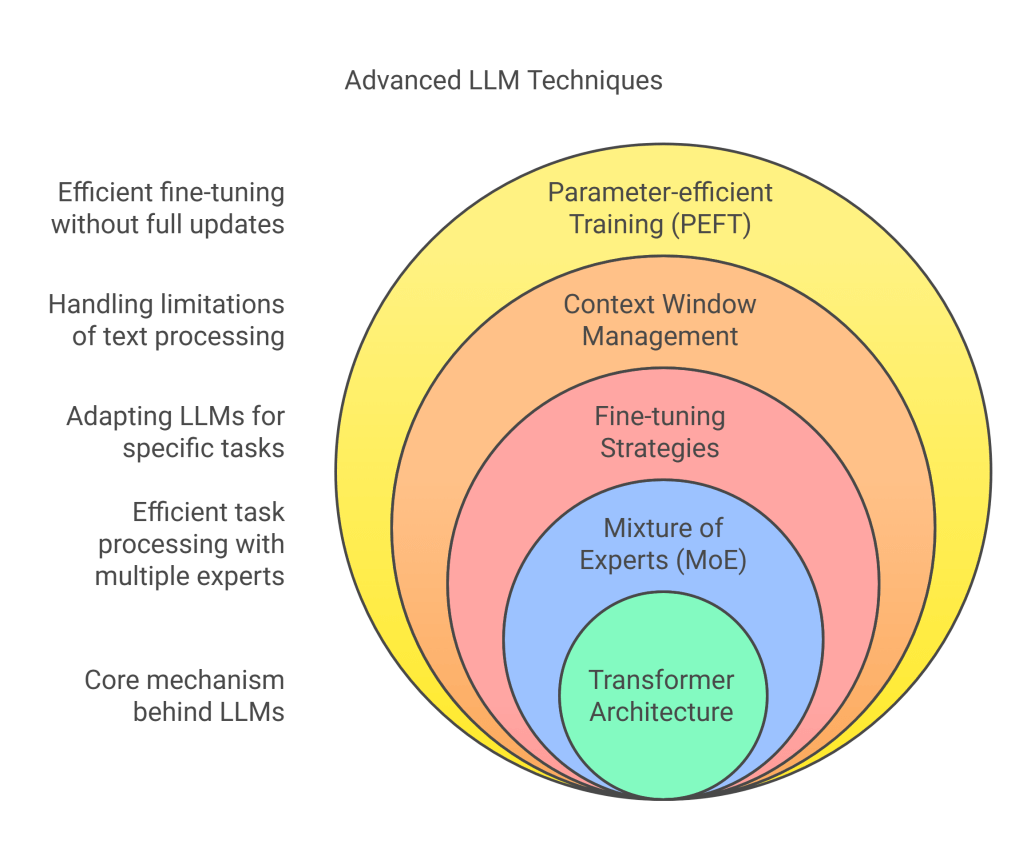
- Transformer Architecture: Understanding the core mechanism behind models like GPT, BERT, and others, including attention mechanisms.
- Mixture of Experts (MoE) Designs: Learning about models that utilize multiple “expert” networks, allowing for more efficient processing of diverse tasks.
- Fine-tuning Strategies: Adapting a pre-trained LLM to a specific task or domain using a smaller dataset.
- Context Window Management: Understanding the limitations of how much text an LLM can process at once and strategies for handling longer inputs.
- Parameter-efficient Training Methods (PEFT): Techniques like LoRA (Low-Rank Adaptation) that allow for efficient fine-tuning of large models without updating all parameters.
Level 2: Core AI Agent Technologies – Connecting Intelligence to Action
This level focuses on the technologies that enable AI agents to interact with the world, access information, and communicate effectively.
API Integration
AI agents often need to interact with external services, databases, or other AI models via APIs..

- REST and GraphQL API Patterns: Understanding how to consume and interact with common web service architectures.
- GPT Wrapper Libraries: Utilizing libraries (like OpenAI’s Python library, LangChain, LlamaIndex) that simplify interaction with LLMs and other AI services.
- Authentication Flows: Implementing secure methods for agents to access protected resources (e.g., API keys, OAuth).
- Rate Limiting and Error Handling: Designing agents to gracefully handle limitations on API usage and respond to errors.
Prompt Engineering
The art and science of crafting inputs (prompts) to guide the behavior and output of LLMs.

- Chain-of-Thought Prompting: Designing prompts that encourage the model to show its reasoning steps, leading to more accurate and reliable outputs.
- Graph-of-Thought Techniques: More advanced methods that structure the model’s thinking process as a graph, exploring multiple reasoning paths.
- Few-shot and Zero-shot Learning: Understanding how to get models to perform tasks with minimal or no examples provided in the prompt.
- Role-based Prompt Design: Assigning a specific persona or role to the agent within the prompt to influence its responses.
- System and User Message Patterns: Structuring conversations with the model using distinct roles (system instructions, user input).
Retrieval-Augmented Generation (RAG)
RAG systems enhance LLMs by giving them access to external, up-to-date, or domain-specific knowledge.

- Embedding Technologies: Converting text and other data into numerical representations (vectors) that capture semantic meaning (e.g., using models like BERT, Sentence-BERT).
- Vector Store Implementation: Storing and indexing these vector embeddings in specialized databases (vector databases like Pinecone, Milvus, Chroma) for efficient searching.
- Retrieval Model Optimization: Improving the process of finding the most relevant information from the vector store based on a user query.
- Generation Model Integration: Combining the retrieved information with the LLM to generate a more informed and accurate response.
- Hybrid Retrieval Approaches: Combining vector search with other retrieval methods (like keyword search) for improved results.
Level 3: Advanced Agent Development – Building Complex and Intelligent Systems
This level delves into the architectural patterns, frameworks, and collaborative aspects of building sophisticated AI agents.
AI Agent Architecture
Understanding how to structure and design agents for different levels of complexity and autonomy.
- Reactive, Deliberative, and Hybrid Agents:
- Reactive: Simple agents that act based on immediate perception without internal state or planning.
- Deliberative: Agents that build internal models of the world, plan actions, and reason about consequences.
- Hybrid: Combining aspects of both reactive and deliberative approaches.
- Design Patterns for Agent Systems: Exploring common ways to structure agent code and interactions (e.g., Observer pattern, State pattern).
- Tool Use and Multi-Capability Planning (MCP): Enabling agents to use external tools (like search engines, calculators, APIs) and planning sequences of actions involving multiple tools.
- Agent Memory Systems and Persistence: Implementing ways for agents to remember past experiences, conversations, and learned information over time.
AI Agent Frameworks
Leveraging existing frameworks can significantly accelerate agent development by providing pre-built components and orchestration capabilities.
- Orchestration Patterns: Understanding how frameworks manage the flow of information and control between different agent components (e.g., perception, processing, action).
- Planning Algorithms: Exploring algorithms that enable agents to devise sequences of actions to achieve goals (e.g., A* search, PDDL).
- Feedback Loop Implementation: Designing systems where agents can learn from the results of their actions and adjust their behavior.
- Streaming Response Management: Handling and processing continuous streams of information or generating responses incrementally.
- Scaffolding Approaches: Using frameworks to quickly set up the basic structure of an agent project.
Multi-Agent Systems (MAS)
Building systems where multiple specialized agents interact and collaborate to solve problems that are difficult for a single agent.
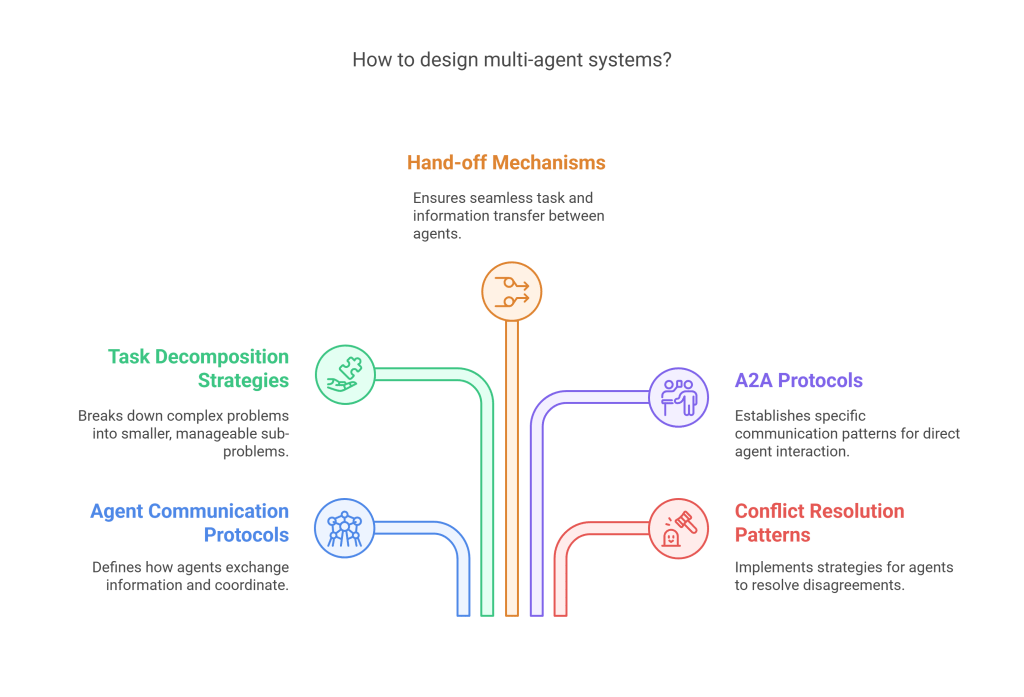
- Agent Communication Protocols: Defining how agents exchange information and coordinate (e.g., FIPA standards, custom protocols).
- Task Decomposition Strategies: Breaking down a complex problem into smaller sub-problems that can be handled by different agents.
- Hand-off Mechanisms: Designing how tasks and information are seamlessly passed between agents.
- Agent-to-Agent (A2A) Protocols: Specific communication patterns for direct interaction between agents.
- Conflict Resolution Patterns: Implementing strategies for agents to resolve disagreements or conflicting goals.
Level 4: Production and Evaluation – Deploying and Measuring Agent Performance
This final level focuses on the practical aspects of deploying AI agents and rigorously evaluating their performance in real-world scenarios.
Evaluation Systems
Developing robust methods to measure how well an agent is performing against its objectives.

- Success Rate Tracking: Defining clear metrics for what constitutes a successful outcome for the agent’s tasks.
- Response Latency Analysis: Measuring the time it takes for the agent to process information and take action.
- Comprehensive Logging Systems: Implementing detailed logging to track agent behavior, decisions, and interactions for debugging and analysis.
- Stress Testing Methodologies: Evaluating agent performance under heavy load or challenging conditions.
- Hallucination Detection: Developing methods to identify instances where the agent generates factually incorrect or nonsensical information.
- Safety Alignment Verification: Ensuring the agent’s behavior aligns with ethical guidelines and avoids harmful or biased outcomes.
Getting Started Today – Your Journey Begins Now
The path to becoming proficient in building AI agents is a continuous learning process, but incredibly rewarding.
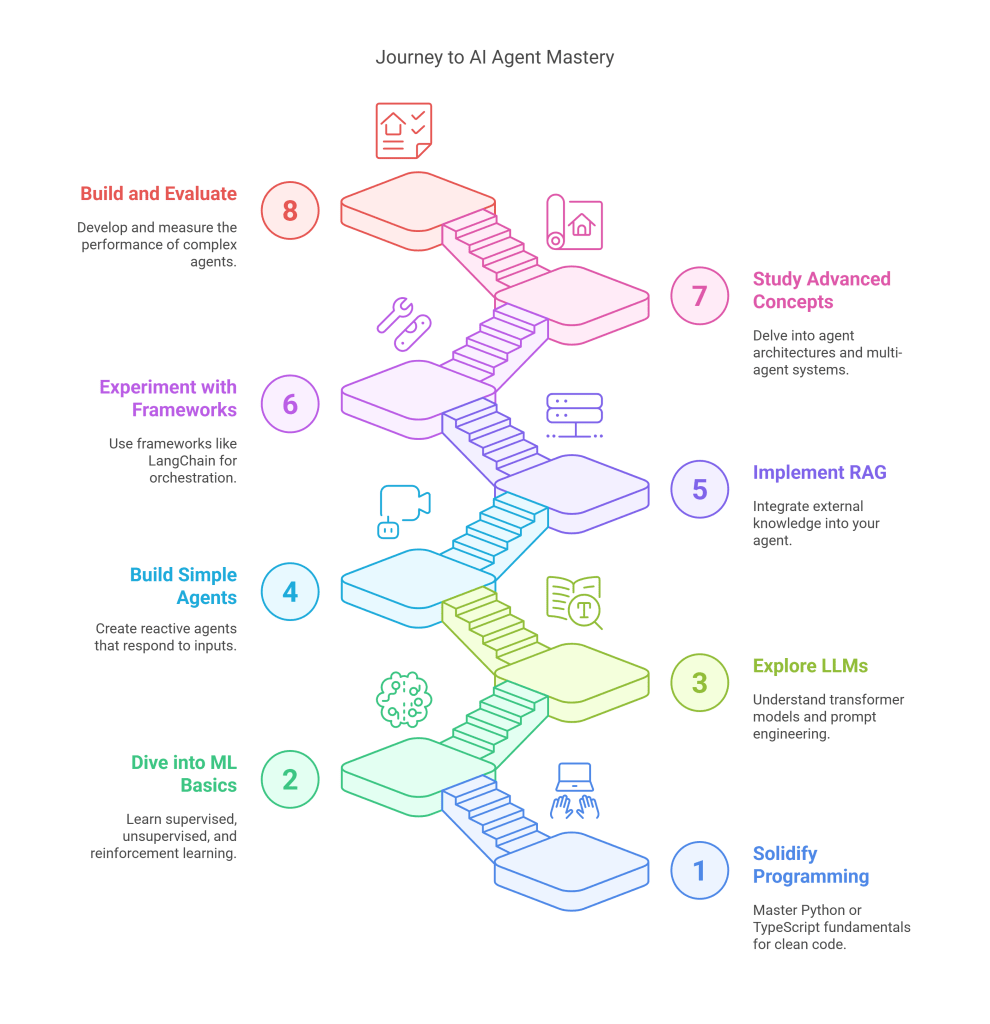
- Solidify Your Programming: If you’re new, start with Python or TypeScript fundamentals. Practice writing clean, modular code.
- Dive into ML Basics: Take introductory courses on supervised, unsupervised, and reinforcement learning. Experiment with libraries like Scikit-learn, TensorFlow, or PyTorch.
- Explore LLMs: Learn about transformer models and experiment with using APIs from providers like OpenAI, Anthropic, or Google. Practice prompt engineering.
- Build Simple Agents: Start with small projects. Build a simple reactive agent that responds to specific inputs.
- Implement RAG: Integrate a vector database and embedding models to give your agent access to external knowledge.
- Experiment with Frameworks: Explore agent frameworks like LangChain, LlamaIndex, or AutoGen to understand orchestration and planning.
- Study Advanced Concepts: As you gain confidence, delve into different agent architectures and multi-agent systems.
- Build and Evaluate: Work on more complex agent projects and focus on developing robust evaluation systems to measure their performance.
The field of AI agents is dynamic and rapidly evolving. Stay curious, experiment with new technologies, read research papers, and engage with the community. With dedication and persistent practice, you will be well-equipped to build innovative AI agents that can tackle complex problems and shape the future of artificial intelligence.
Discover more from SkillWisor
Subscribe to get the latest posts sent to your email.
 SkillWisor