
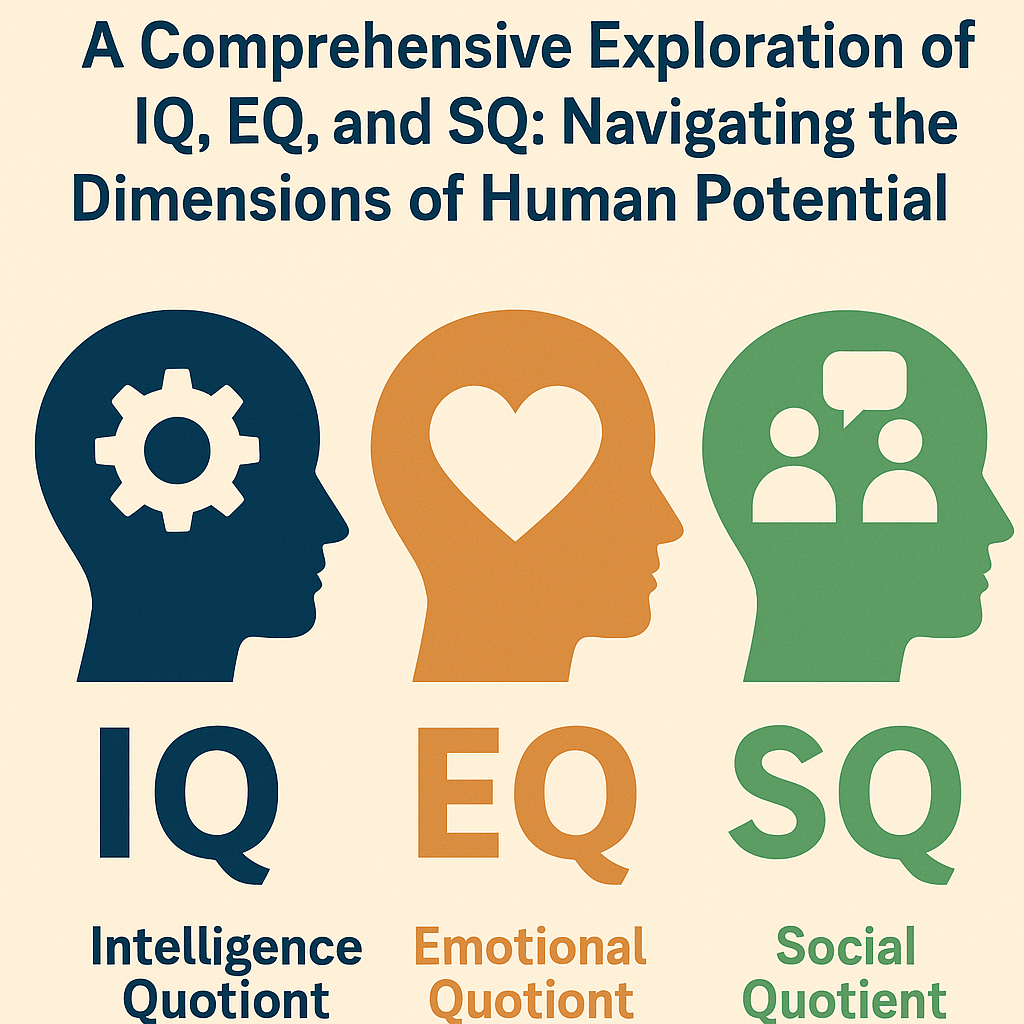
For centuries, humanity has grappled with the multifaceted nature of intelligence. What does it truly mean to be intelligent? Is it solely about cognitive prowess, or do other dimensions of our being contribute equally, if not more, to a life of success, fulfillment, and meaning? In recent decades, the traditional view, largely centered around the concept of Intelligence Quotient (IQ), has expanded significantly to include Emotional Quotient (EQ) and Social Quotient (SQ). These three constructs offer distinct yet interconnected lenses through which to understand the vast landscape of human capability and potential. This article delves deeply into each of these quotients, exploring their definitions, historical contexts, components, measurement, importance, and the intricate ways they interact to shape our lives and the world around us.
The Traditional Pillar: Intelligence Quotient (IQ)
For a long time, IQ stood as the primary, and often sole, metric for judging intelligence. It emerged from the desire to quantify cognitive abilities, initially for educational purposes.
What is IQ?
Intelligence Quotient (IQ) is a score derived from a set of standardized tests designed to assess a person’s cognitive abilities relative to their age group. It is intended to be a measure of general cognitive ability, often referred to as “g.” IQ tests typically evaluate a range of mental skills, including:

- Logical Reasoning: The ability to analyze information and make inferences or conclusions.
- Problem-Solving: The capacity to identify problems, evaluate options, and find effective solutions.
- Abstract Thinking: Understanding concepts that are not concrete or physical.
- Verbal Ability: Comprehension, vocabulary, and the ability to use language effectively.
- Spatial Ability: The capacity to visualize and manipulate objects in space.
- Memory: The ability to encode, store, and retrieve information.
The score is typically calculated by comparing an individual’s test score to the average score of people in their age group. An average IQ is set at 100, with scores above 100 indicating higher-than-average cognitive ability and scores below 100 indicating lower-than-average ability.
A Brief History of IQ Testing
The roots of modern IQ testing can be traced back to the early 20th century in France. In 1904, psychologist Alfred Binet was commissioned by the French government to develop a method to identify schoolchildren who needed special educational assistance. Binet, along with his colleague Theodore Simon, developed the Binet-Simon Scale, which measured skills like memory, attention, and problem-solving. Their goal was not to measure innate intelligence but rather to identify children who were lagging behind their peers and could benefit from intervention.
The Binet-Simon Scale was later adapted and popularized in the United States by Lewis Terman at Stanford University. Terman revised the scale, standardized it on a large American sample, and introduced the term “Intelligence Quotient” (IQ). The formula he used was (Mental Age / Chronological Age) * 100. This Stanford-Binet Intelligence Scale became widely used in the U.S.
During World War I, IQ tests were used on a large scale to assess recruits for the U.S. Army (the Army Alpha and Army Beta tests). This marked a significant expansion of IQ testing beyond educational settings.
Throughout the 20th century, other prominent IQ tests were developed, most notably the Wechsler Adult Intelligence Scale (WAIS) and the Wechsler Intelligence Scale for Children (WISC), developed by David Wechsler. Wechsler’s tests moved away from the “mental age” concept for adults, using a deviation IQ score that compares an individual’s score to the scores of others in their age group on a normal distribution.
What IQ Tests Measure (and Don’t Measure)
While IQ tests are effective at measuring certain cognitive abilities, it’s crucial to understand their limitations. IQ tests are good predictors of academic performance and performance in jobs that require significant cognitive processing and problem-solving. They can provide insights into a person’s capacity for learning and their ability to grasp complex concepts quickly.
However, IQ tests do not measure:
- Creativity: The ability to generate new and valuable ideas.
- Practical Intelligence: The ability to solve real-world problems and adapt to new situations.
- Emotional Intelligence: The ability to understand and manage emotions (which we will discuss in detail).
- Social Skills: The ability to interact effectively with others.
- Motivation and Drive: The willingness to work hard and persevere.
- Wisdom: The ability to use knowledge and experience with good judgment.
- Talents: Specific aptitudes in areas like music, art, or athletics.
Focusing solely on IQ provides an incomplete picture of a person’s overall capabilities and potential for success and well-being. It measures a specific set of cognitive skills, but human intelligence and the factors contributing to a successful life are far broader.
The Role and Limitations of IQ in Modern Society
IQ remains a relevant concept in certain contexts. It is still used in educational psychology to identify learning disabilities or giftedness. Some employers use cognitive ability tests, which are related to IQ, as part of their hiring process, particularly for roles requiring strong analytical skills. Research in psychology and neuroscience continues to explore the biological and environmental factors influencing cognitive abilities as measured by IQ tests.
However, there is a growing consensus that while IQ is important, it is not the sole determinant of success or happiness. Over-reliance on IQ scores can be misleading and can lead to overlooking other crucial aspects of human potential. The concept of multiple intelligences, proposed by Howard Gardner, further challenged the idea of a single, monolithic intelligence measured by IQ tests, suggesting that humans possess distinct intelligences in areas like music, spatial reasoning, bodily-kinesthetic skills, and interpersonal understanding.
Understanding IQ is essential for appreciating its historical significance and its role in assessing a specific dimension of cognitive function. However, to gain a more holistic view of human potential, we must turn our attention to other vital dimensions, starting with emotional intelligence.
The Rise of Emotional Intelligence (EQ)
In recent decades, the spotlight has increasingly shifted to the realm of emotions and their profound impact on our lives. The concept of Emotional Intelligence (EQ) has moved from academic discussion to mainstream recognition, becoming a key factor in understanding personal and professional success.
What is EQ?
Emotional Quotient (EQ), or Emotional Intelligence (EI), is defined as the ability to perceive, understand, manage, and use emotions effectively. It involves recognizing your own emotions and those of others, discerning between different feelings and labeling them appropriately, and using emotional information to guide thinking and behavior.
Pioneering researchers in the field, such as Peter Salovey and John Mayer, defined EQ as “the subset of social intelligence that involves the ability to monitor one’s own and others’ feelings and emotions, to discriminate among them and to use this information to guide one’s thinking and actions.”
The concept gained significant popular traction with Daniel Goleman’s 1995 book, “Emotional Intelligence: Why It Can Matter More Than IQ.” Goleman synthesized existing research and argued compellingly that EQ is a critical predictor of success, often more so than IQ.
Key Components of Emotional Intelligence

Daniel Goleman’s model of Emotional Intelligence outlines five key components:
- Self-Awareness: This is the ability to recognize and understand your own emotions, moods, and drives, as well as their effect on others. It involves being honest with yourself about your strengths and weaknesses. Self-aware individuals understand their emotional triggers and how their feelings influence their thoughts and behaviors. This isn’t about being overly analytical but rather about having a clear, objective view of your internal state. It includes recognizing your typical emotional responses to different situations and understanding the connection between your feelings and your actions. For example, a self-aware person might notice they become irritable when stressed and take steps to manage their stress before it negatively impacts their interactions with others.
- Self-Regulation: This is the ability to control or redirect disruptive impulses and moods, and the propensity to suspend judgment—to think before acting. It’s about managing your internal state, ensuring your emotions don’t hijack your behavior in unproductive ways. Self-regulation involves managing stress, controlling anger, overcoming anxiety, and bouncing back from setbacks. It’s not about suppressing emotions but about choosing how and when to express them appropriately. This component is crucial for maintaining composure under pressure, making thoughtful decisions, and acting with integrity. An example is resisting the urge to send an angry email in the heat of the moment and instead taking time to cool down and respond constructively.
- Social Skills: This involves managing relationships effectively and building networks to move people in the desired direction. It’s about interacting smoothly with others, influencing them positively, and inspiring cooperation. Social skills encompass communication, conflict resolution, leadership, collaboration, and the ability to build rapport. Individuals with strong social skills are adept at understanding social cues, navigating complex social situations, and building strong, positive relationships. This is not just about being friendly; it’s about using your understanding of emotions and social dynamics to achieve positive outcomes in interactions. For instance, a leader with strong social skills can motivate a team, resolve disagreements, and foster a positive work environment.
- Empathy: This is the ability to understand the emotional makeup of other people and skill in treating people according to their emotional reactions. It’s about putting yourself in someone else’s shoes and understanding their perspective and feelings, even if you don’t agree with them. Empathy is crucial for building connection, showing compassion, and responding appropriately to the needs and feelings of others. It allows you to connect with people on a deeper level, build trust, and navigate interpersonal relationships with sensitivity. An empathetic person can sense when someone is upset, even if they don’t explicitly state it, and respond with understanding and support.
- Motivation: This refers to being driven to achieve for the sake of achievement, not just for external rewards like money or status. It’s about having a passion for your work, a drive to improve, and a commitment to your goals. Motivated individuals are optimistic, resilient, and persistent in the face of challenges. They are driven by an inner desire to learn, grow, and contribute. This component fuels perseverance, initiative, and a positive outlook, all of which are essential for long-term success. An example is someone who takes on challenging projects not just for a promotion but because they are genuinely interested in the work and eager to learn new skills.
These five components work together to form a comprehensive picture of emotional intelligence, highlighting its importance in navigating the complexities of human interaction and personal growth.
Measuring EQ
Measuring EQ is more complex and debated than measuring IQ. There are several different approaches:
- Self-Report Tests: These involve individuals answering questions about their typical emotional responses in various situations. Examples include the Emotional Quotient Inventory (EQ-i) and the Mayer-Salovey-Caruso Emotional Intelligence Test (MSCEIT). While easy to administer, these tests can be influenced by an individual’s self-perception and desire to present themselves in a favorable light.
- Ability Tests: These tests assess an individual’s actual ability to perform emotion-related tasks, such as identifying emotions in facial expressions or understanding the consequences of different emotional responses. The MSCEIT is an example of an ability test. These tests aim to measure the actual skills rather than self-perceptions.
- 360-Degree Assessments: These involve gathering feedback from colleagues, supervisors, subordinates, and clients about an individual’s emotional competencies. This provides a more objective view of how an individual’s emotional intelligence is perceived by others in real-world interactions.
Each measurement method has its strengths and weaknesses, and researchers continue to refine the ways EQ is assessed.
The Importance of EQ
The importance of EQ cannot be overstated. Research consistently shows that EQ is a strong predictor of success in various aspects of life:
- Career Success: High EQ is associated with better job performance, leadership effectiveness, teamwork, and conflict resolution. Individuals with high EQ are better at building relationships, navigating organizational politics, and managing stress, all of which are crucial for career advancement.
- Personal Relationships: EQ is vital for building and maintaining healthy relationships. It enables better communication, empathy, and conflict resolution in personal interactions with family, friends, and partners.
- Mental Health and Well-being: Individuals with higher EQ are generally better equipped to manage stress, cope with adversity, and maintain a positive outlook, contributing to better mental health and overall well-being.
- Leadership: Emotionally intelligent leaders are more effective at motivating and inspiring their teams, building trust, and creating a positive work environment. They are better at understanding the needs and concerns of their employees and responding with empathy and support.
- Decision Making: Understanding and managing emotions can lead to better decision-making, as individuals are less likely to be swayed by impulsive reactions or biases.
Unlike IQ, which tends to be relatively stable throughout adulthood, EQ is considered a skill that can be developed and improved upon with conscious effort and practice. This makes focusing on enhancing emotional intelligence a worthwhile endeavor for personal and professional growth.
Exploring the Social Dimension: Social Quotient (SQ)
While IQ deals with the logical mind and EQ with the emotional heart, Social Quotient (SQ) ventures into the realm of understanding and navigating human interactions. It is a crucial intelligence for thriving in interconnected environments and building effective relationships.
What is SQ?
Social Quotient (SQ) refers to an individual’s ability to understand and effectively navigate social situations, interact with others, and build meaningful relationships. While often overlapping with aspects of Emotional Intelligence (EQ), particularly social skills and empathy, SQ is sometimes considered a distinct intelligence that focuses specifically on outward social competence and the capacity to thrive in diverse social environments. It encompasses the practical application of emotional understanding in real-world social contexts. A high SQ enables individuals to read social cues, adapt their behavior to different social norms, and influence group dynamics positively.
Origins and Different Perspectives on SQ
The concept of social intelligence has roots in early 20th-century psychology. Edward Thorndike, in 1920, defined social intelligence as “the ability to understand and manage men and women, boys and girls—to act wisely in human relations.” This early definition laid the groundwork for later explorations into the social aspects of intelligence.
While not as widely popularized with a specific “SQ” metric as IQ or EQ, the underlying principles of social intelligence have been extensively researched within social psychology, organizational behavior, and communication studies. Some contemporary views consider SQ as an overarching term that includes emotional intelligence’s interpersonal components, while others see it as a more practical, behavioral manifestation of understanding and managing social interactions. It’s less about internal emotional states (which EQ covers) and more about effective external social performance.
Characteristics of High SQ
Individuals with a high Social Quotient typically exhibit several key characteristics:

- Exceptional Communication Skills: They are adept at both verbal and non-verbal communication, able to articulate their thoughts clearly and interpret the messages of others effectively. This includes active listening and understanding subtext.
- Strong Interpersonal Skills: They build rapport easily, make others feel comfortable, and can initiate and maintain positive relationships across diverse groups.
- Social Awareness: They possess a keen understanding of social cues, group dynamics, power structures, and cultural norms, allowing them to navigate complex social situations gracefully.
- Conflict Resolution: They are skilled at mediating disagreements, finding common ground, and de-escalating tension in interpersonal and group settings.
- Influence and Persuasion: They can effectively influence others’ opinions and behaviors through reasoned argument, empathy, and charismatic presence, without resorting to manipulation.
- Adaptability: They can adjust their social behavior to suit different contexts and individuals, making them effective in various social environments.
- Networking Ability: They are proficient at building and leveraging professional and personal networks.
- Teamwork and Collaboration: They contribute positively to group efforts, fostering cooperation and synergy.
The Role and Cultivation of SQ
SQ plays a crucial role in numerous aspects of life:
- Professional Success: High SQ is invaluable in careers requiring extensive interaction, such as sales, management, teaching, healthcare, and customer service. It facilitates effective leadership, team cohesion, and client relations.
- Personal Relationships: It is fundamental for building and sustaining healthy friendships, family bonds, and romantic partnerships, enabling deeper connection and mutual understanding.
- Community Engagement: Individuals with high SQ are often effective community leaders, volunteers, and advocates, capable of mobilizing groups and fostering collective action.
- Conflict Management: It provides the tools to resolve disagreements constructively, preserving relationships and achieving mutually beneficial outcomes.
- Leadership and Influence: Socially intelligent leaders inspire trust, motivate teams, and navigate organizational politics with finesse, leading to more effective and harmonious work environments.
Cultivating SQ involves conscious effort and practice in real-world social settings:
- Active Listening: Pay full attention to what others are saying, both verbally and non-verbally, without interrupting or formulating your response.
- Observing Social Cues: Pay attention to body language, tone of voice, and facial expressions to better understand unspoken messages.
- Practicing Empathy: Make a conscious effort to understand others’ perspectives and feelings, even if you don’t agree with them.
- Improving Communication: Work on clear, concise, and respectful communication. Practice assertive communication without being aggressive.
- Seeking Feedback: Ask trusted friends, family, or colleagues for honest feedback on your social interactions.
- Engaging in Diverse Social Settings: Step out of your comfort zone and interact with people from different backgrounds and perspectives to broaden your social understanding.
- Learning Conflict Resolution Strategies: Study and practice techniques for mediating disputes and finding win-win solutions.
- Developing Self-Awareness (as a foundation for social awareness): Understanding your own social tendencies and biases can help you better understand others.
While SQ is perhaps the least understood and measured of the three quotients, its importance in providing a foundation of meaning and purpose for our cognitive and emotional lives is increasingly recognized.
The Interplay: How IQ, EQ, and SQ Work Together
Rather than viewing IQ, EQ, and SQ as separate, independent entities, it is more accurate to see them as interconnected dimensions of human potential that work together in complex ways. A high score in one area does not automatically guarantee success or fulfillment; it is the interplay and balance between these quotients that often leads to the most positive outcomes.
Imagine a highly intelligent individual with a high IQ. They may have the cognitive capacity to understand complex problems and develop innovative solutions. However, without sufficient EQ, they might struggle to manage their own stress or understand the emotional impact of their decisions. Without sufficient SQ, they might struggle to collaborate effectively with others, build rapport, or navigate social dynamics, potentially hindering the implementation of their brilliant ideas.
Conversely, consider someone with a high EQ. They are excellent at understanding their own emotions and those of others, and managing their internal state. However, without a certain level of IQ, they might lack the cognitive depth to grasp complex technical information or solve intricate problems required in certain roles. Without sufficient SQ, their emotional understanding might not translate into effective social influence or the ability to build and maintain broad networks.
When all three quotients are developed and integrated, the potential for a truly flourishing life is amplified:
- IQ provides the cognitive horsepower: It gives us the ability to learn, analyze, and solve problems.
- EQ provides the emotional intelligence: It allows us to understand ourselves and our feelings, and manage our internal state.
- SQ provides the social intelligence: It allows us to understand and effectively interact with others, build relationships, and navigate social environments.
Think of it like building a house. IQ might be the architectural plans and the engineering knowledge – the blueprint for structure and function. EQ might be the skilled interior designer, ensuring comfort and emotional well-being within the spaces. SQ might be the community builder, ensuring the house fits well within its neighborhood, fostering connections and effective interactions with others. All three are essential for a sturdy, functional, and well-integrated dwelling.
In leadership, for instance, a leader needs the IQ to understand the complexities of the business, the EQ to manage their own emotions and inspire their team, and the SQ to build strong relationships, communicate effectively, and navigate organizational politics with finesse. A leader lacking in any of these areas will likely face significant limitations.
Furthermore, the development of one quotient can influence the others. For example, cultivating self-awareness (a key component of EQ) can enhance your ability to understand social cues (SQ). Learning to understand and manage your emotions (EQ) can improve your communication skills and ability to build rapport (SQ). Applying your cognitive abilities (IQ) to understand social theories or communication strategies can directly enhance your SQ.
The journey of human development involves nurturing all three dimensions. While some aspects of IQ might be more genetically influenced and stable after a certain age, both EQ and SQ are widely considered to be malleable and capable of significant growth throughout life. This means that individuals can actively work on improving their emotional and social intelligence, leading to a more integrated and fulfilling life.
Conclusion: Towards a Holistic Understanding of Human Potential
The exploration of IQ, EQ, and SQ reveals a richer, more nuanced understanding of what it means to be human and to live a life of purpose and impact. While IQ provides a valuable measure of cognitive ability, it is only one piece of the puzzle. Emotional intelligence equips us with the crucial skills to navigate our own inner world. Social Quotient provides the essential framework for understanding and effectively interacting with others, building strong relationships, and thriving in interconnected environments.
In a world that is increasingly complex and interconnected, the ability to integrate cognitive understanding with emotional awareness and strong social competence is more critical than ever. Success in the 21st century is not solely about how smart you are in the traditional sense, but also about how well you understand and manage your own emotions, and how effectively you connect and collaborate with others.
Recognizing and nurturing all three of these quotients within ourselves and in others is key to fostering individual well-being, building strong communities, and addressing the global challenges we face. It encourages us to move beyond a narrow focus on academic or professional achievement and embrace a more holistic view of human potential, one that values not just what we know and what we do, but also how we feel and how we interact with the world around us.
The journey of developing IQ, EQ, and SQ is a continuous process of self-discovery, learning, and growth. By paying attention to all three dimensions, we can unlock our full potential and contribute to a more intelligent, compassionate, and socially adept world. It is in the harmonious interplay of mind, heart, and social aptitude that the true richness of human capability is revealed.
Discover more from SkillWisor
Subscribe to get the latest posts sent to your email.
 SkillWisor