
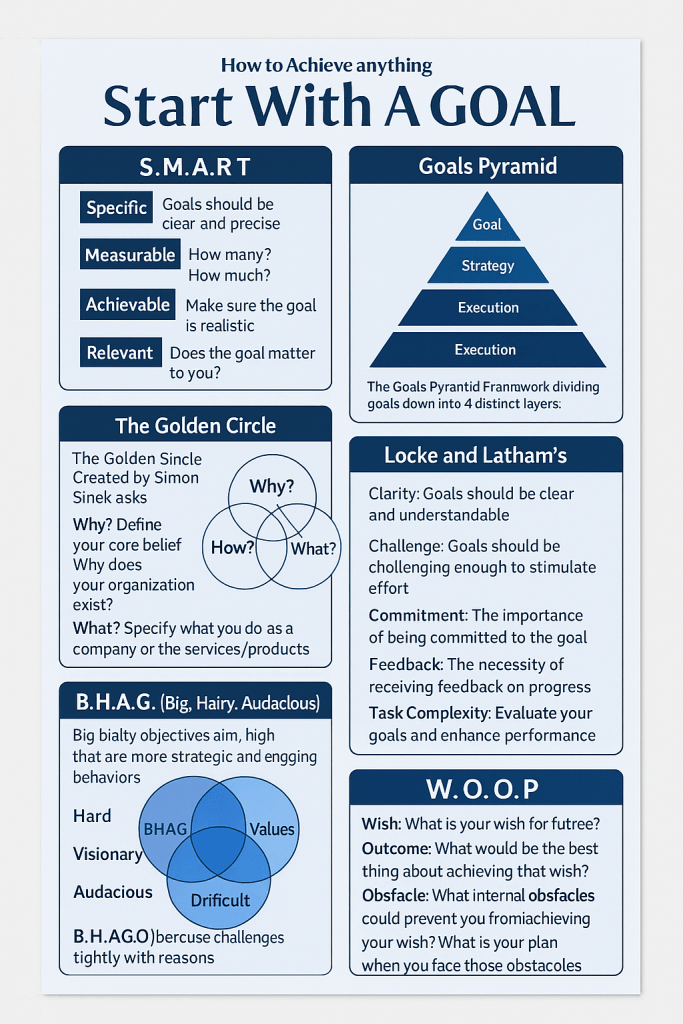
The pursuit of success, whether personal or professional, is a universal human endeavor. From groundbreaking scientific discoveries to everyday personal milestones, the journey towards achievement is often paved with intention, strategy, and relentless effort. At the heart of this journey lies the art and science of goal setting. It’s not merely about wishing for a desired outcome, but about meticulously defining, planning, and executing steps that lead to its realization.
In a world brimming with aspirations, the differentiator between those who merely dream and those who truly achieve often comes down to the frameworks they employ. These structured methodologies provide clarity, focus, and a roadmap, transforming vague desires into tangible accomplishments. This comprehensive guide delves into some of the most powerful and widely recognized goal-setting frameworks, exploring their core principles, practical applications, and how they can be leveraged to unlock your full potential and navigate the path to unparalleled success. By understanding and applying these diverse yet complementary approaches, individuals and organizations alike can cultivate a robust system for turning ambition into reality, fostering sustained growth, and ultimately, mastering the art of achievement.
The Foundation of Success: Setting SMART Goals
In the realm of goal setting, few acronyms are as ubiquitous and impactful as S.M.A.R.T. This framework stands as a cornerstone for anyone serious about translating abstract desires into concrete objectives. Developed to ensure goals are clear, trackable, and attainable, the S.M.A.R.T. methodology provides a robust structure that eliminates ambiguity and fosters a results-oriented mindset. Each letter represents a vital criterion that, when applied, significantly increases the likelihood of success.

S: Specific – Pinpointing Your Target with Precision
The journey to achievement begins with absolute clarity. A “Specific” goal answers the fundamental questions: What exactly do I want to achieve? Who is involved? Where will it happen? When will it happen? Why is this goal important? Without specificity, a goal remains a vague aspiration, difficult to grasp and even harder to pursue.
Consider the difference between “I want to get fit” and “I want to run a 10K race in under 60 minutes by October 31st, 2025, to improve my cardiovascular health and challenge myself.” The latter leaves no room for interpretation. It defines the desired outcome, the key metric, the timeline, and the underlying motivation. This precision allows for focused effort, efficient resource allocation, and a clear understanding of the target. Vague goals, conversely, lead to diffused energy, inconsistent effort, and ultimately, frustration. To make a goal specific, break it down. Instead of “increase sales,” ask: “Which product? By how much? In which region? By when? For what purpose?” The more detailed the answer, the more specific and actionable the goal becomes. This initial step of specificity acts as a powerful lens, sharpening your focus and directing your energy towards a clearly defined endpoint. It’s about moving from a general idea to a vivid, tangible picture of what success looks like.
M: Measurable – Quantifying Progress and Success
If you can’t measure it, you can’t improve it. “Measurable” goals provide concrete criteria for tracking progress and determining when the goal has been achieved. This element introduces objectivity into the goal-setting process, moving beyond subjective feelings of accomplishment to verifiable data. How much? How many? How will I know when it is accomplished? These are the questions a measurable goal answers.
For instance, “improve customer satisfaction” is not measurable. “Increase our Net Promoter Score (NPS) from 30 to 50 within the next six months” is. The latter provides a clear metric (NPS), a starting point (30), a target (50), and a timeframe. Measurability allows for consistent monitoring, enabling individuals and teams to assess their performance accurately. It provides tangible evidence of progress, which in turn boosts motivation and allows for timely adjustments if the current approach isn’t yielding the desired results. Without measurable parameters, it’s impossible to know if you’re on track, falling behind, or have already reached your destination. This component is crucial for accountability and for celebrating genuine achievements. It transforms the abstract concept of progress into a quantifiable reality, making the path to success clear and the destination unmistakable.
A: Achievable – Balancing Ambition with Realism
While ambition is crucial, goals must also be “Achievable.” This doesn’t mean setting easy targets; rather, it means setting goals that are challenging yet realistic given your resources, skills, and constraints. An unachievable goal can quickly lead to demotivation, burnout, and a sense of failure. Conversely, a goal that is too easy won’t inspire growth or significant effort.
The key lies in finding the sweet spot – a goal that stretches your capabilities without breaking them. To assess achievability, consider: Do I have the necessary skills, knowledge, and resources? If not, can I acquire them? Is the timeframe realistic for the scope of the goal? For example, aiming to become a millionaire in a month with no capital is likely unachievable for most, but aiming to increase monthly savings by 10% is often within reach. Achievability requires an honest self-assessment and, sometimes, a willingness to break down a larger, seemingly overwhelming goal into smaller, more manageable steps. It’s about building confidence through incremental wins, ensuring that each step forward feels like a genuine progression rather than an insurmountable hurdle. This principle encourages strategic thinking about capacity and capability, ensuring that your aspirations are grounded in reality while still pushing the boundaries of what you thought possible.
R: Relevant – Aligning with Your Broader Vision
A goal, no matter how specific, measurable, and achievable, loses its power if it’s not “Relevant” to your overarching objectives, values, or long-term vision. Relevance ensures that your efforts are aligned with what truly matters, preventing wasted energy on pursuits that don’t contribute to your ultimate purpose.
For an individual, a relevant goal might align with career aspirations, personal growth, or core values. For a business, it must align with the company’s mission, strategic objectives, and market position. If your long-term vision is to become a leader in sustainable energy, then a goal to develop a new, non-renewable energy source might be achievable and measurable, but it’s not relevant. Relevance provides the “why” behind the “what.” It answers the question: Is this the right goal for me/us right now? Does it contribute to the bigger picture? This alignment is critical for sustained motivation and focus, as it ensures that every step taken is a meaningful contribution towards a larger, more impactful outcome. When goals are relevant, they tap into deeper levels of commitment and passion, transforming tasks into purposeful actions. It ensures that your efforts are not just busywork, but meaningful contributions to your true aspirations.
T: Time-bound – Establishing a Deadline for Action
The final, indispensable component of a S.M.A.R.T. goal is “Time-bound.” Every effective goal must have a deadline. A deadline creates urgency, fosters accountability, and prevents procrastination. Without a defined endpoint, goals tend to drift indefinitely, often losing momentum and eventually fading into forgotten aspirations.
A time-bound goal specifies when the goal needs to be completed. This could be a specific date (e.g., “by December 31st, 2025”), a duration (e.g., “within three months”), or a specific event. The deadline acts as a powerful motivator, prompting action and ensuring that progress is made consistently. It also provides a clear point for evaluation – did you meet the deadline? If not, what were the reasons, and what adjustments are needed for future goals? Deadlines help in prioritizing tasks and managing time effectively. They transform a continuous effort into a project with a defined beginning and end, making the entire process more manageable and focused. Whether it’s a short-term goal to be completed in a week or a long-term objective spanning several years, the presence of a deadline injects a crucial element of discipline and commitment, propelling you towards completion.
Benefits of the S.M.A.R.T. Framework
The widespread adoption of the S.M.A.R.T. framework is a testament to its profound benefits:
- Clarity and Focus: It eliminates ambiguity, providing a crystal-clear understanding of what needs to be achieved.
- Increased Motivation: Specific and measurable progress, coupled with achievable and relevant targets, naturally boosts enthusiasm and commitment.
- Enhanced Accountability: Deadlines and measurable metrics create a strong sense of responsibility.
- Improved Planning: The framework necessitates a thorough consideration of resources, steps, and potential obstacles.
- Better Decision-Making: With clear goals, decisions about priorities and resource allocation become much simpler.
- Efficient Resource Allocation: Understanding what is needed and when, allows for better management of time, money, and personnel.
- Objective Evaluation: Measurable outcomes provide clear benchmarks for assessing success or identifying areas for improvement.
Implementation Tips and Common Pitfalls
To effectively implement S.M.A.R.T. goals, consider these tips:
- Write Them Down: The act of writing solidifies the goal and makes it more tangible.
- Review Regularly: Periodically revisit your goals to track progress, make adjustments, and stay motivated.
- Share with Others: For team goals, ensure everyone understands and buys into the S.M.A.R.T. criteria. For personal goals, sharing with an accountability partner can be beneficial.
- Break Down Large Goals: If a goal feels overwhelming, break it into smaller, S.M.A.R.T. mini-goals.
However, be mindful of common pitfalls:
- Too Rigid: While structure is good, don’t let the framework become so rigid that it stifles flexibility or adaptation to changing circumstances.
- Not Challenging Enough: Ensure “Achievable” doesn’t translate to “easy.” Goals should still push boundaries.
- Ignoring External Factors: While focusing on internal control, remember that external factors can influence goal attainment. Be prepared to adapt.
- Over-reliance on Metrics: While measurable, don’t let the pursuit of numbers overshadow the qualitative aspects or the true purpose of the goal.
The S.M.A.R.T. framework is more than just an acronym; it’s a powerful discipline that transforms intentions into achievements. By meticulously applying each of its principles, individuals and organizations can lay a solid foundation for purposeful action, ensuring that every effort is directed towards a clearly defined, attainable, and ultimately, successful outcome.
The Core Purpose: Understanding The Golden Circle
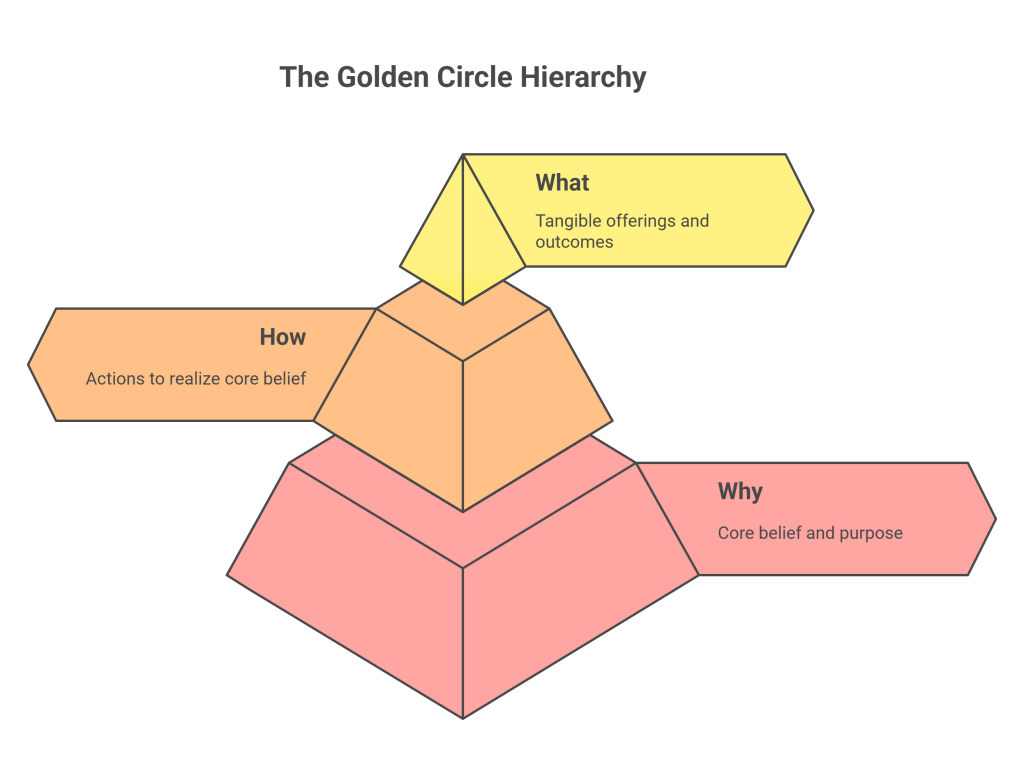
Beyond the mechanics of what to achieve, lies the profound question of why. This is the essence of The Golden Circle framework, a concept that transcends traditional business strategy to touch upon the very heart of inspiration and purpose. Developed to explain why some individuals and organizations are more innovative, influential, and successful than others, this framework posits that true leadership and lasting impact stem from communicating and acting from the inside out: starting with “Why,” then moving to “How,” and finally, to “What.”
Why: Defining Your Core Belief and Purpose
At the innermost core of The Golden Circle is “Why.” This is not about profit or external results; it’s about your purpose, cause, or belief. Why does your organization exist? Why do you get out of bed in the morning? Why should anyone care? This is the emotional driver, the fundamental reason for being. For a company, it’s their mission, their vision, their core values – not just stated, but deeply felt and lived. For an individual, it’s their guiding principles, their passion, their ultimate contribution to the world.
Most people and organizations operate from the “What” outwards, explaining what they do, then perhaps how they do it, and rarely, if ever, why. The Golden Circle flips this on its head. When you start with “Why,” you connect with people on a deeper, emotional level. You inspire trust and loyalty because people don’t buy what you do, they buy why you do it. Think of revolutionary companies that have captured the imagination of millions; their success isn’t just about their products, but about the powerful “Why” that underpins everything they create. Discovering your “Why” requires introspection, a deep dive into your values, beliefs, and the impact you wish to make. It’s about articulating the fundamental reason for your existence or the existence of your venture. This core purpose acts as a compass, guiding all decisions, strategies, and actions. It provides meaning and direction, transforming mundane tasks into purposeful contributions towards a larger cause.
How: Determining the Actions to Realize Your Core Belief
Moving outwards from the “Why” is the “How.” This layer describes the processes, actions, and unique methods you employ to bring your “Why” to life. It’s about your distinctive approach, your values in action, or the principles that guide your operations. The “How” explains how you are different or how you are better than others who might do similar “What.”
For a company, the “How” might involve their innovative design philosophy, their commitment to customer service, their sustainable manufacturing practices, or their collaborative team culture. These are the differentiating factors, the proprietary processes, or the values that define their operational style. For an individual, the “How” could be their disciplined work ethic, their creative problem-solving approach, their empathetic communication style, or their relentless pursuit of learning. The “How” serves as the bridge between your abstract “Why” and your tangible “What.” It outlines the specific steps, systems, or behaviors that are consistent with your core belief and enable you to deliver on your purpose. It’s not just about what you do, but how you do it, reflecting your unique identity and operational philosophy. When the “How” is clearly defined and consistently applied, it reinforces the “Why” and builds credibility, ensuring that your actions are always in alignment with your stated purpose.
What: Specifying Your Tangible Offerings
The outermost layer of The Golden Circle is “What.” This is the easiest part to identify and articulate: the products you sell, the services you offer, the job you perform, or the specific outcomes you deliver. This is the tangible evidence of your “Why” and “How.”
For a company, the “What” might be smartphones, software, consulting services, or educational programs. For an individual, it could be the specific tasks in their job description, the projects they complete, or the skills they apply. While most organizations and individuals start their communication here, The Golden Circle emphasizes that the “What” is merely the result of the “Why” and “How.” It is the manifestation of your purpose and your unique approach. When the “What” is presented as a direct consequence of a compelling “Why” and a distinctive “How,” it gains significantly more meaning and appeal. People are drawn to the purpose and the method, and the product or service becomes a vehicle for them to align with that purpose. The “What” is the proof point, the concrete demonstration that your “Why” is not just a lofty ideal but a tangible reality.
Benefits of The Golden Circle Framework
Adopting The Golden Circle framework offers profound advantages for individuals and organizations:
- Inspiration and Motivation: Starting with “Why” taps into deeper emotional drivers, inspiring not just action but genuine commitment and loyalty.
- Clearer Communication: It provides a compelling narrative that resonates with audiences, fostering stronger connections with customers, employees, and stakeholders.
- Stronger Culture and Identity: A clearly defined “Why” and “How” builds a cohesive internal culture, attracting like-minded individuals and guiding internal decisions.
- Differentiation and Competitive Advantage: In a crowded market, communicating your “Why” allows you to stand out beyond just features or price.
- Innovation and Adaptability: When the “Why” is clear, organizations can adapt their “What” and “How” while remaining true to their core purpose, fostering resilience and continuous innovation.
- Purpose-Driven Decision Making: Every decision can be filtered through the “Why,” ensuring alignment with core beliefs and long-term vision.
Application Across Domains
The Golden Circle is not just for businesses; its principles are equally powerful in personal development, leadership, and even social movements:
- Personal Branding: Understanding your personal “Why” helps you articulate your unique value proposition and career path.
- Leadership: Leaders who communicate from “Why” inspire their teams, fostering engagement and a shared sense of purpose.
- Product Development: Designing products or services with a clear “Why” ensures they meet a genuine need and resonate with target users.
- Marketing and Sales: Shifting focus from features (“What”) to purpose (“Why”) creates more compelling and effective campaigns.
By starting with “Why,” individuals and organizations can transcend mere transactional interactions to build meaningful relationships, foster deep loyalty, and achieve sustained, impactful success. It’s about moving beyond what you do, to articulate the profound reason you do it, thereby unlocking a powerful wellspring of inspiration and influence.
Structured Progression: The Goals Pyramid Framework
While the S.M.A.R.T. framework provides a robust method for defining individual goals, and The Golden Circle illuminates the foundational purpose, the Goals Pyramid offers a hierarchical structure for breaking down complex objectives into actionable, manageable layers. This framework ensures that every effort, from the grand vision to the smallest task, is aligned and contributes directly to the ultimate aim. It provides a clear roadmap, preventing disorganization and ensuring that all necessary components for success are identified and addressed. The Goals Pyramid typically consists of four distinct layers, building from the broadest objective down to the specific support systems required.
Goal: Defining Your Ultimate Objective
At the apex of the Goals Pyramid sits the “Goal.” This is your ultimate, overarching objective, the desired outcome that everything below it serves to achieve. This top-level goal should ideally be a S.M.A.R.T. goal – specific, measurable, achievable, relevant, and time-bound. It represents the summit you are striving to reach.
For example, if the ultimate goal is “To increase market share for our flagship product by 15% within the next fiscal year,” this becomes the singular focus at the top of the pyramid. It’s the destination that dictates all subsequent planning. Without a clearly defined and compelling “Goal” at the top, the entire pyramid lacks direction and purpose. This layer provides the guiding star, ensuring that all subsequent efforts are channeled towards a unified and significant achievement. It’s the ‘what’ you are aiming for, the big picture that gives context to all the detailed work below.
Strategy: Outlining the Approach to Achieve Your Goals
Immediately below the “Goal” is the “Strategy” layer. This level outlines the high-level approaches and methods you will employ to achieve your ultimate goal. It’s about how you plan to tackle the objective, without getting bogged down in the minutiae of daily tasks. Strategies are the broad strokes, the overarching plans that guide your actions.
Continuing the market share example, strategies might include: “Launch an aggressive digital marketing campaign,” “Expand into two new geographical markets,” or “Introduce a new feature set to enhance product competitiveness.” These are not individual tasks, but rather the strategic pillars upon which the execution will be built. This layer requires thoughtful consideration of various pathways to success and selecting the most viable and impactful ones. It’s about making high-level decisions on the direction and methods that will best serve the ultimate goal. A well-defined strategy ensures that the efforts undertaken are not random but part of a cohesive and intelligent plan.
Execution: Detailing Specific Tasks, Timelines, and Milestones
The “Execution” layer is where the rubber meets the road. This level breaks down the strategies into specific, actionable tasks, complete with timelines and defined milestones. It’s the granular detail of what needs to be done, by whom, and by when, to implement the chosen strategies.
For the digital marketing strategy, execution tasks might include: “Develop new ad creatives by end of Q1,” “Optimize landing page conversion rates by 10% by mid-Q2,” “Run A/B tests on email campaigns weekly,” or “Secure partnerships with three key influencers by Q3.” Each of these tasks should ideally be S.M.A.R.T. in themselves, acting as mini-goals that contribute to the larger strategic objective. This layer demands meticulous planning, assigning responsibilities, and setting clear deadlines for each component. Effective execution is about translating strategic intent into tangible progress. It’s the engine that drives the pyramid forward, ensuring that every piece of work contributes directly to the overall success. Without strong execution, even the best strategies remain theoretical.
Resources: Identifying Necessary Support Systems
At the broad base of the Goals Pyramid lies “Resources.” This crucial layer identifies all the necessary support systems needed to hit your goal. It encompasses everything from personnel and funding to tools, technology, information, and even time. Without adequate resources, even the most brilliant strategies and meticulously planned execution can falter.
To achieve the digital marketing execution, necessary resources might include: “Allocating a budget of $X for ad spend,” “Hiring two new digital marketing specialists,” “Subscribing to advanced analytics software,” “Access to market research data,” or “Dedicated time from the product development team for feature enhancements.” This layer requires a comprehensive assessment of what is currently available and what needs to be acquired or developed. It’s about ensuring that the foundation is strong enough to support the entire structure above it. Identifying resources upfront helps in proactive planning, preventing bottlenecks and ensuring that teams have everything they need to perform their tasks effectively. It’s the enabling layer that makes all other layers possible, underscoring the practical realities of goal achievement.
Benefits of the Goals Pyramid Framework
The Goals Pyramid offers several significant advantages for individuals and organizations:
- Clear Roadmap: It provides a visual and logical progression from high-level objectives to daily tasks, making complex goals more manageable.
- Ensures Alignment: Every layer directly supports the one above it, guaranteeing that all efforts are channeled towards the ultimate goal.
- Prevents Overlooking Critical Elements: By systematically considering strategy, execution, and resources, it reduces the risk of neglecting vital components.
- Promotes Systematic Thinking: It encourages a structured approach to planning and problem-solving.
- Facilitates Delegation and Accountability: With clear tasks and resource identification, it becomes easier to assign responsibilities and track progress.
- Adaptability: While providing structure, the pyramid also allows for adjustments at any level if circumstances change, without losing sight of the ultimate goal.
Application and Interrelation
The Goals Pyramid is highly versatile and can be applied to a wide range of scenarios, from personal projects to large-scale corporate initiatives. It inherently integrates with other frameworks:
- The “Goal” at the top is often a S.M.A.R.T. goal.
- The “Strategy” and “Execution” layers can be informed by the “How” and “What” of The Golden Circle, ensuring that the methods and tasks align with the core purpose.
- Identifying “Obstacles” in the W.O.O.P. framework might reveal resource gaps in the “Resources” layer of the pyramid.
By systematically breaking down goals into these interconnected layers, the Goals Pyramid transforms daunting objectives into a series of logical, achievable steps. It provides the clarity, structure, and foresight necessary to navigate the complexities of goal attainment, ensuring that every effort contributes meaningfully to the desired outcome. This framework is invaluable for anyone seeking to move beyond mere aspiration to consistent, structured achievement.
Driving Performance: Locke and Latham’s 5 Principles of Goal Setting
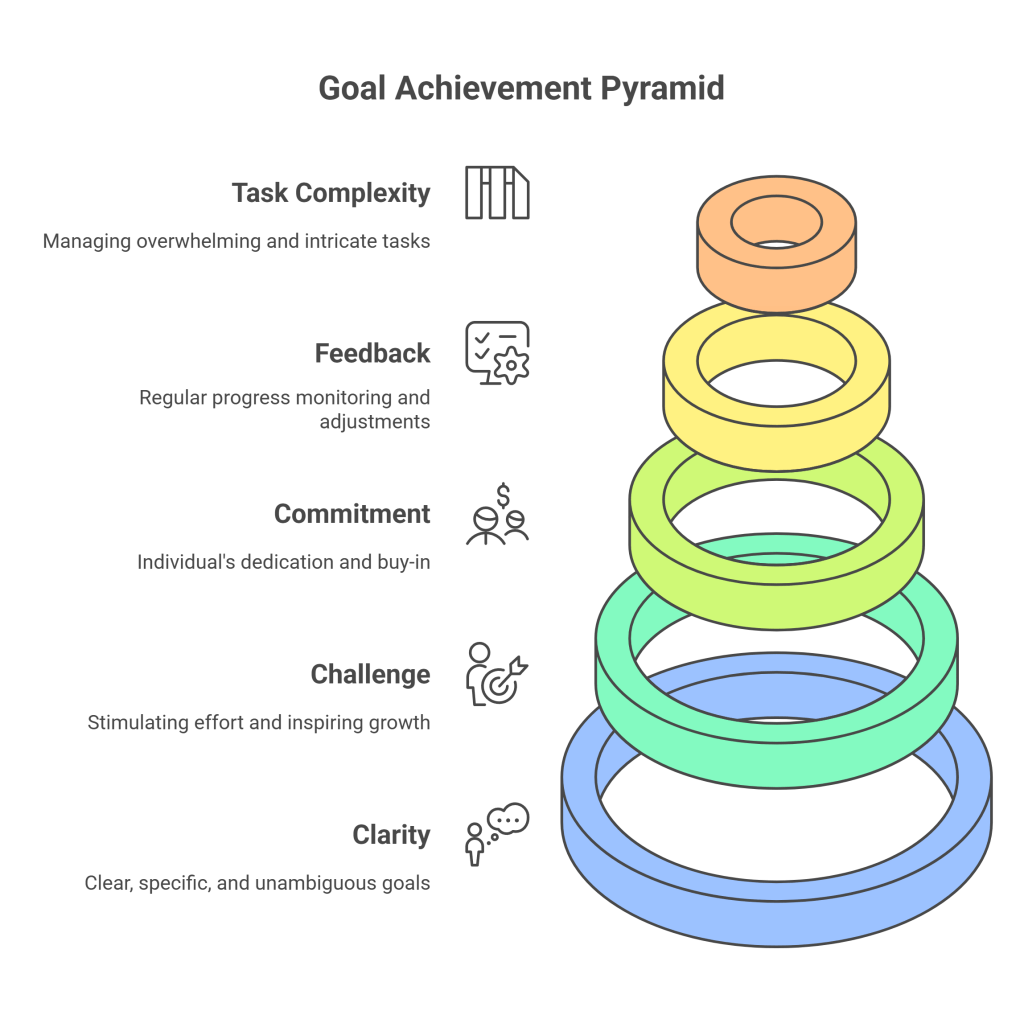
While frameworks like S.M.A.R.T. and the Goals Pyramid provide structural guidance for goal definition and breakdown, the work of Edwin Locke and Gary Latham delves into the psychological underpinnings of effective goal setting, outlining five essential principles that directly enhance performance. Their extensive research highlights how the characteristics of goals themselves, combined with crucial supporting elements, can significantly impact motivation, effort, and ultimately, success. These principles are not just about setting goals, but about setting effective goals that truly drive individuals and teams forward.
1. Clarity: The Foundation of Understanding
The first principle, “Clarity,” emphasizes that goals must be clear, specific, and unambiguous. This echoes the “Specific” component of S.M.A.R.T. goals but extends to the broader understanding and interpretation of the goal by all involved parties. A clear goal leaves no room for misinterpretation regarding what needs to be achieved, by when, and what constitutes success.
Ambiguity is the enemy of action. If a goal is vague, individuals may interpret it differently, leading to misaligned efforts, wasted resources, and frustration. For instance, “Improve team communication” is unclear. “Implement a weekly 15-minute stand-up meeting for all project team members to discuss progress and blockers, starting next Monday” is clear. Clear goals provide a precise target, allowing individuals to focus their efforts effectively. They also make it easier to measure progress and provide feedback. When everyone involved has a shared, crystal-clear understanding of the objective, it fosters cohesion, reduces errors, and accelerates progress. This principle underscores that the initial articulation of a goal is paramount; it must be easily digestible and universally understood to serve as an effective guide for action.
2. Challenge: Stimulating Effort and Growth
The second principle, “Challenge,” asserts that goals should be difficult enough to stimulate effort and inspire growth, but not so challenging that they become perceived as impossible. This aligns with the “Achievable” aspect of S.M.A.R.T. goals, but with a strong emphasis on the motivational aspect of stretch targets.
Easy goals offer little satisfaction upon completion and don’t push individuals to develop new skills or exert maximum effort. Conversely, goals that are perceived as unattainable can lead to demotivation and disengagement. The optimal goal is one that requires a significant stretch, pushing individuals beyond their comfort zones, but remains within the realm of possibility. For example, if a salesperson consistently hits 10 sales per month, a challenging goal might be 13, not 50. This “stretch” factor activates a person’s drive, encourages the development of new strategies, and enhances feelings of competence upon achievement. Challenging goals foster resilience, creativity, and a sense of accomplishment that fuels future endeavors. They transform routine tasks into opportunities for significant personal and professional development.
3. Commitment: The Importance of Buy-in
“Commitment” refers to the individual’s dedication and buy-in to the goal. For a goal to be truly effective, the person pursuing it must be committed to its achievement. This principle highlights that simply assigning a goal is not enough; genuine acceptance and a desire to achieve it are crucial.
Commitment can be fostered in several ways. One powerful method is through participation: allowing individuals to have a say in setting their own goals or contributing to the goal-setting process. Goals that are self-set or jointly set are often more strongly embraced than those imposed externally. Additionally, aligning goals with an individual’s values, providing recognition for progress, and offering support can strengthen commitment. When individuals feel a sense of ownership over their goals, they are more likely to persevere through obstacles, invest greater effort, and take initiative. A lack of commitment, on the other hand, can lead to half-hearted efforts, excuses, and ultimately, failure to achieve the objective. This principle underscores the human element in goal setting, recognizing that intrinsic motivation and personal investment are powerful drivers of performance.
4. Feedback: The Necessity of Progress Monitoring
The fourth principle, “Feedback,” emphasizes the critical role of receiving information on progress towards the goal. Without regular feedback, individuals cannot assess their performance, identify areas for improvement, or adjust their strategies. Feedback acts as a navigational tool, confirming whether one is on the right course or needs to make corrections.
Feedback should be timely, specific, and constructive. It can come from various sources: self-monitoring, peer reviews, managerial evaluations, or automated systems. For example, a student studying for an exam needs to know how they performed on practice tests to identify weak areas. A sales team needs regular updates on their sales figures to see if they are hitting targets. Consistent feedback loops allow individuals to understand their current standing relative to their goal, celebrate small wins, and learn from mistakes. It reinforces positive behaviors and provides necessary insights for course correction, maintaining motivation and ensuring that efforts remain aligned with the desired outcome. This principle transforms goal pursuit from a blind journey into an informed, adaptive process.
5. Task Complexity: Managing Overwhelm
The final principle, “Task Complexity,” acknowledges that highly complex goals can be overwhelming and may require additional consideration. It emphasizes ensuring sufficient time, resources, and support for individuals tackling intricate objectives.
When a goal is particularly complex, it’s essential to break it down into smaller, more manageable sub-goals (as seen in the Goals Pyramid framework). This makes the overall task less daunting and provides opportunities for incremental wins. Additionally, providing adequate training, necessary tools, and intellectual resources is crucial. For instance, developing a new software system is a highly complex task; it requires breaking down into modules, assigning specialized teams, and providing sophisticated development tools and ample time. If a task is too complex and not properly managed, it can lead to confusion, errors, and a sense of being overwhelmed, ultimately hindering progress. This principle highlights the importance of strategic planning and support for challenging endeavors, ensuring that complexity doesn’t become a barrier to achievement.
Benefits of Locke and Latham’s Principles
Applying these five principles leads to significant benefits:
- Increased Motivation and Effort: Clear, challenging, and committed goals, coupled with feedback, inherently drive individuals to work harder and smarter.
- Higher Performance: Research consistently shows that individuals who set and adhere to these principles achieve higher levels of performance.
- Improved Focus and Direction: Clarity ensures that all efforts are channeled effectively.
- Enhanced Self-Regulation: Regular feedback allows individuals to monitor and adjust their own behavior and strategies.
- Greater Job Satisfaction: Achieving challenging goals fosters a sense of accomplishment and competence.
- Effective Learning and Development: Tackling challenging tasks and receiving feedback promotes skill acquisition and personal growth.
Locke and Latham’s principles provide a powerful lens through which to evaluate and refine goal-setting practices. By consciously incorporating clarity, challenge, commitment, feedback, and appropriate management of task complexity, individuals and organizations can create an environment where goals are not just set, but consistently achieved, driving continuous improvement and sustained success.
Visionary Ambition: B.H.A.G. (Big, Hairy, Audacious Goals)
While S.M.A.R.T. goals provide tactical clarity and Locke and Latham’s principles refine the execution, there’s a need for something larger, something that truly inspires and unites an organization or an individual’s life for the long haul. This is where the concept of B.H.A.G.s—Big, Hairy, Audacious Goals—comes into play. A BHAG is not just a goal; it’s a visionary, strategic, and emotionally compelling objective that transcends the everyday and drives significant, long-term transformation. Typically set for a 10-to-30-year timeframe, a BHAG is a clear, compelling, and often risky commitment to a bold future. It’s about aiming for something so grand that it forces a fundamental shift in thinking and action.
Characteristics of a BHAG
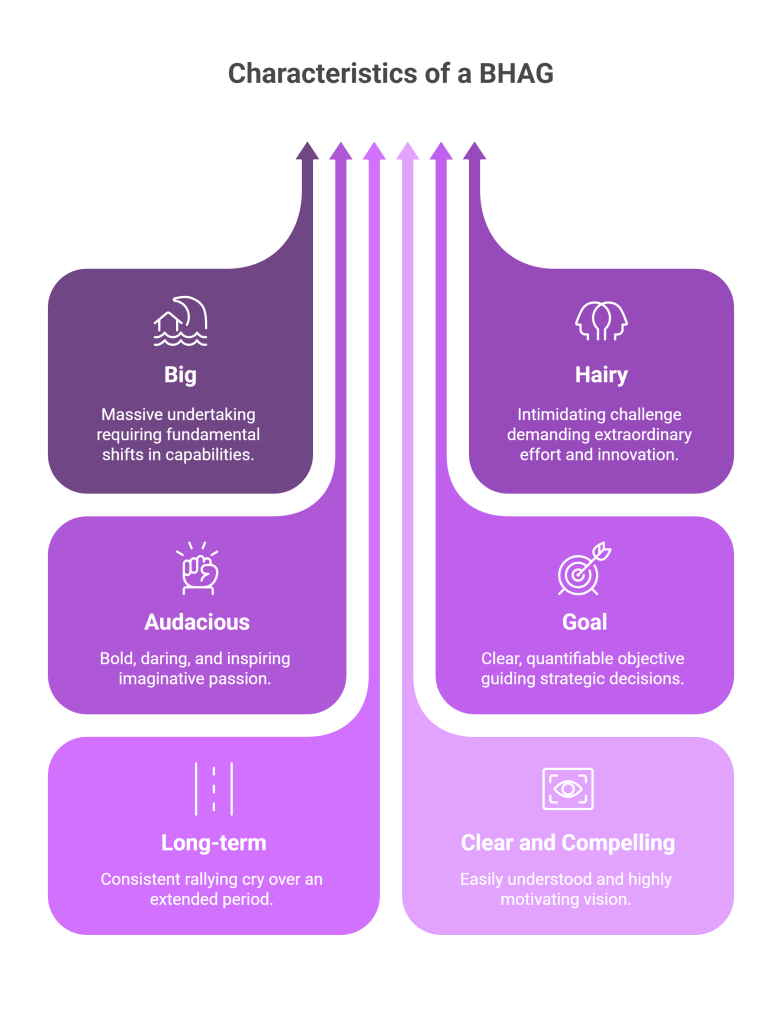
A true BHAG possesses several defining characteristics:
- Big: It must be a massive undertaking, far beyond the scope of typical annual goals. It should feel almost impossible, requiring a fundamental shift in capabilities and thinking.
- Hairy: It should be slightly intimidating, even a little scary. It evokes a sense of challenge and demands extraordinary effort and innovation.
- Audacious: It’s bold, daring, and perhaps even a bit outrageous. It captures the imagination and inspires passion.
- Goal: Despite its visionary nature, it must still be a clear, quantifiable objective, though the path to achieve it may be uncertain at the outset.
- Long-term: BHAGs typically have a 10-to-30-year horizon, providing a consistent rallying cry over an extended period.
- Clear and Compelling: It must be easily understood and highly motivating, inspiring people to commit to its pursuit.
- Non-negotiable: Once set, a BHAG becomes a fixed star, guiding all major strategic decisions.
Types of BHAGs
The image highlights four common categories of BHAGs, each with a distinct focus:
- Target-Oriented BHAGs: These are specific and quantifiable, often revolving around a clear numerical target. They aim for a definitive, measurable outcome that signifies unparalleled success.
- Example: “Become the dominant player in the electric vehicle market by 2030.” (This implies specific market share, production volume, etc.)
- Impact: Provides a clear finish line and galvanizes efforts towards a singular, measurable achievement.
- Competitive BHAGs: These are designed to outperform or even “crush” a specific rival or set of competitors. They are inherently aggressive and focus on market dominance relative to others.
- Example: “Displace [Major Competitor X] as the industry leader in customer satisfaction within 15 years.”
- Impact: Fosters a strong competitive spirit, driving innovation and strategic maneuvering to gain an edge.
- Role Model BHAGs: These aim to establish the organization or individual as the ultimate standard or benchmark within their industry or field. The goal is to be universally recognized as the best or the definitive example.
- Example: “Become the ‘Google’ of sustainable agriculture.” (This implies becoming synonymous with innovation and leadership in that sector).
- Impact: Inspires a relentless pursuit of excellence and sets a high bar for quality, innovation, and ethical practice.
- Internal Transformation BHAGs: These focus on driving significant, fundamental change within the organization itself, often involving a complete overhaul of culture, processes, or core business model.
- Example: “Transform from a traditional brick-and-mortar retailer to a fully integrated omnichannel powerhouse within a decade.”
- Impact: Forces deep introspection, strategic restructuring, and a profound shift in organizational identity and capabilities.
The BHAG Triangle: Passion, Skill, Drive
The image also illustrates a powerful conceptual triangle that underpins the successful pursuit of a BHAG: Passion, Skill, and Drive. These three elements are interdependent and crucial for navigating the long, challenging journey towards an audacious goal.
- Passion: This is the emotional fuel. A BHAG must ignite a deep, intrinsic passion within those pursuing it. If there’s no genuine excitement or belief in the “Why” behind the BHAG, the sheer difficulty of the goal will quickly lead to burnout. Passion provides the resilience to overcome setbacks and the unwavering commitment needed for a multi-decade endeavor. It’s the heart of the BHAG, ensuring that the journey is meaningful and inspiring.
- Skill: While a BHAG is about stretching beyond current capabilities, it must still be grounded in a realistic assessment of existing skills and the potential to acquire new ones. This refers to the collective expertise, knowledge, and talent required to even conceive of, let alone pursue, such a grand objective. It’s about leveraging current strengths and identifying areas where new skills must be developed or acquired. Skill provides the intellectual and practical foundation for tackling the “Hairy” aspects of the goal.
- Drive: This is the sustained effort, the relentless determination, and the sheer willpower to keep pushing forward, year after year, despite challenges and plateaus. Drive translates passion and skill into consistent action. It’s the discipline to execute, to learn from failures, and to maintain momentum over the long haul. Drive is the engine that propels the BHAG from a dream to a reality.
The interplay of these three elements is critical. Passion without skill or drive leads to well-intentioned but ineffective efforts. Skill without passion lacks the motivation to persist. Drive without skill or passion can lead to misguided or unsustainable efforts. When all three are present and aligned, the pursuit of a BHAG becomes a powerful, transformative force.
Benefits of Setting BHAGs
The advantages of embracing BHAGs are far-reaching:
- Inspires Action and Innovation: The sheer scale of a BHAG forces creative thinking and pushes boundaries, leading to breakthrough innovations.
- Creates a Sense of Urgency and Focus: It provides a clear, long-term target that galvanizes efforts and helps prioritize strategic initiatives.
- Unites an Organization: A compelling BHAG can rally employees around a shared vision, fostering a strong sense of purpose and collective identity.
- Attracts Talent: Ambitious goals attract ambitious people who want to be part of something truly significant.
- Provides a Guiding Star: It acts as a consistent beacon, helping to navigate short-term decisions and ensuring they align with the long-term vision.
- Drives Fundamental Change: By definition, a BHAG requires significant transformation, pushing organizations to evolve and adapt.
Distinction from S.M.A.R.T. Goals
It’s important to understand that BHAGs are not a replacement for S.M.A.R.T. goals; rather, they are complementary. A BHAG is the overarching, long-term, visionary summit. S.M.A.R.T. goals are the shorter-term, tactical steps, milestones, and projects that lead towards the BHAG. For example, if the BHAG is “To put a man on the moon and return him safely to the Earth by the end of the decade,” then the S.M.A.R.T. goals would be the specific stages of rocket development, astronaut training, mission control setup, etc., each with its own clear, measurable, achievable, relevant, and time-bound criteria.
BHAGs provide the ultimate destination and the compelling “Why” that drives everything. S.M.A.R.T. goals provide the actionable “What” and “How” for the journey. By combining the visionary power of BHAGs with the practical discipline of S.M.A.R.T. goal setting, individuals and organizations can create a powerful synergy that propels them towards extraordinary achievements.
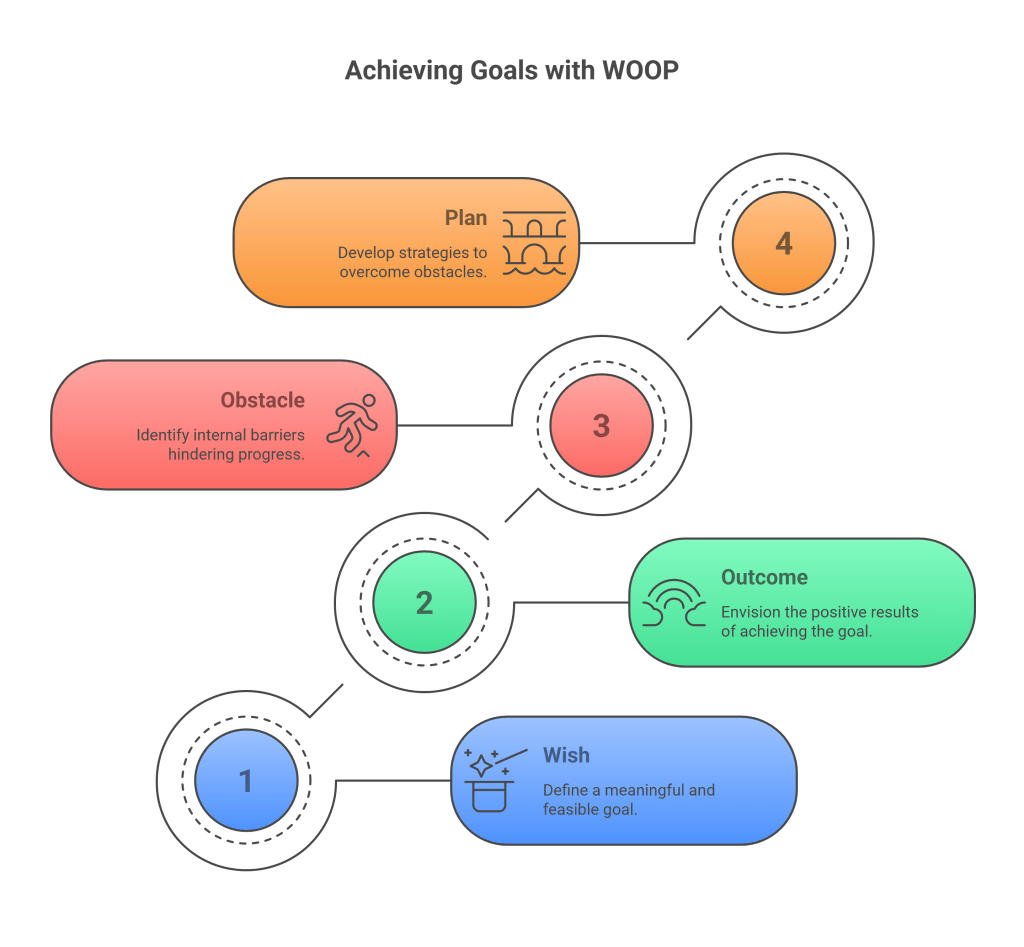
Overcoming Obstacles: W.O.O.P. (Wish, Outcome, Obstacle, Plan)
While setting ambitious goals and understanding their underlying purpose is crucial, the path to achievement is rarely linear. Obstacles, both internal and external, inevitably arise. The W.O.O.P. framework, a science-based mental strategy developed by Gabriele Oettingen, provides a powerful tool for navigating these challenges by fostering a deeper sense of purpose and realism. Unlike other frameworks that primarily focus on goal definition, W.O.O.P. specifically addresses the crucial step of anticipating and planning for potential roadblocks, significantly increasing the likelihood of goal attainment. It’s a four-step process that encourages mental contrasting – pairing positive fantasies about achieving a goal with realistic considerations of the obstacles that might impede progress.
W: Wish – Defining Your Meaningful Desire
The first step in W.O.O.P. is to identify a “Wish.” This is your goal, a meaningful, challenging, and feasible desire that you genuinely want to achieve. It should be something that excites you and that you are committed to pursuing. This “Wish” can be a personal aspiration, a professional objective, or a habit you want to cultivate.
For instance, your wish might be: “To start exercising regularly,” “To complete my novel,” or “To get a promotion at work.” The key here is that the wish should be something you truly desire and believe is attainable, even if it requires effort. It’s about clearly articulating what you want to accomplish, setting the stage for the subsequent steps of mental contrasting. This initial step aligns with the “Goal” aspect of other frameworks, establishing the target before delving into the complexities of its pursuit.
O: Outcome – Envisioning the Most Favorable Result
Once you have your “Wish,” the next step is to vividly imagine the “Outcome” – the most favorable result that could occur if your wish were to come true. This involves mentally simulating the positive feelings, benefits, and sensations associated with achieving your goal. It’s about tapping into the emotional reward of success.
For the wish “To start exercising regularly,” the outcome might be: “I will feel energized, healthier, and more confident. I’ll have more stamina throughout the day, and my clothes will fit better. I’ll feel proud of my discipline.” This mental visualization serves a crucial psychological purpose: it highlights the intrinsic rewards of the goal, boosting motivation and reinforcing the desire to achieve it. However, unlike mere positive thinking, W.O.O.P. doesn’t stop here. It uses this positive fantasy as a contrast to the next step, which is where the realism comes in. This vivid mental picture creates a strong pull towards the desired future, making the effort required seem worthwhile.
O: Obstacle – Identifying Internal Roadblocks
This is arguably the most critical and distinctive step of the W.O.O.P. framework: identifying the “Obstacle.” Here, you shift from positive fantasy to realistic assessment. You need to pinpoint the internal obstacles that stand in the way of achieving your wish. These are not external circumstances (like bad weather or a difficult economy), but rather your own habits, emotions, limiting beliefs, or ingrained behaviors that might derail your efforts.
For the wish “To start exercising regularly,” common internal obstacles might be: “I feel too tired after work,” “I procrastinate and find excuses,” “I lack self-discipline,” or “I get easily distracted by my phone.” The focus on internal obstacles is key because these are the ones you have direct control over. By acknowledging them explicitly, you bring them into conscious awareness, allowing you to develop strategies to overcome them. This step prevents naive optimism and replaces it with a grounded understanding of the challenges ahead. It’s about being honest with yourself about what truly holds you back, rather than blaming external factors. This realistic assessment is what makes W.O.O.P. so effective; it prepares you for the inevitable difficulties.
P: Plan – Developing an “If-Then” Strategy
The final step is to create a “Plan” – specifically, an “if-then” plan to address the identified obstacles. This involves formulating concrete actions you will take if a specific obstacle arises. This pre-planning helps to automate your response to challenges, making it easier to stick to your goals even when faced with adversity.
Continuing the exercise example:
- If I feel too tired after work, then I will put on my workout clothes immediately upon arriving home.
- If I procrastinate and find excuses, then I will set a timer for 10 minutes and just start with a short warm-up.
- If I get easily distracted by my phone, then I will put my phone in another room before starting my workout.
These “if-then” statements create strong mental links between a specific situation (the obstacle) and a pre-determined, effective response. This type of planning, also known as “implementation intentions,” has been scientifically proven to significantly increase the likelihood of goal achievement. It bypasses the need for conscious willpower in the moment of temptation or difficulty, as the response is already decided. The plan is not just a general intention; it’s a specific, actionable strategy for overcoming your personal hurdles.
Benefits of the W.O.O.P. Framework
W.O.O.P. offers several powerful benefits:
- Increased Likelihood of Goal Achievement: By proactively addressing obstacles, individuals are better prepared to overcome them, leading to higher success rates.
- Realistic Outlook: It balances positive thinking with a pragmatic understanding of challenges, fostering resilience rather than naive optimism.
- Enhanced Motivation: The vivid outcome visualization provides a strong pull, while the obstacle planning reduces anxiety about potential failures.
- Proactive Problem-Solving: It encourages individuals to think ahead and devise solutions before problems even arise.
- Reduced Procrastination: Having a clear “if-then” plan makes it easier to initiate action even when faced with internal resistance.
- Improved Self-Regulation: It strengthens the ability to manage one’s own thoughts, emotions, and behaviors in pursuit of a goal.
- Applicable to Various Goals: From habit formation to academic pursuits and professional projects, W.O.O.P. is highly versatile.
Psychological Basis
W.O.O.P. is rooted in two key psychological concepts:
- Mental Contrasting: This involves contrasting a desired future with the present reality, specifically highlighting the obstacles that stand in the way. This process clarifies the effort required and strengthens commitment.
- Implementation Intentions: These are specific “if-then” plans that link a critical situation (e.g., an obstacle) to a goal-directed response. They automate behavior, making it more likely that individuals will act on their intentions.
By guiding individuals through these four simple yet profound steps, W.O.O.P. empowers them to not only dream big but also to realistically prepare for the journey, transforming wishes into tangible realities by systematically dismantling the barriers that often stand in the way. It’s a testament to the power of structured thinking in the pursuit of personal and professional excellence.
Integrating Frameworks for Holistic Achievement
Having explored the individual strengths of S.M.A.R.T. Goals, The Golden Circle, the Goals Pyramid, Locke and Latham’s 5 Principles, B.H.A.G.s, and W.O.O.P., it becomes clear that these frameworks are not mutually exclusive. Instead, they offer complementary lenses through which to approach the complex process of achievement. The most effective strategy often involves integrating elements from multiple frameworks, creating a holistic and robust system for turning aspirations into reality.
Imagine building a magnificent structure. You wouldn’t rely on just one blueprint or one set of tools. Similarly, mastering achievement requires a multi-faceted approach, leveraging the unique contributions of each methodology.
The Synergy of Purpose and Action
The journey ideally begins with the profound introspection offered by The Golden Circle. Understanding your “Why” provides the ultimate purpose, the core belief that fuels all subsequent efforts. This “Why” becomes the emotional anchor, ensuring that all goals, strategies, and actions are deeply relevant and intrinsically motivating. Without a clear “Why,” even perfectly executed S.M.A.R.T. goals can feel hollow or lead to a sense of misalignment.
Once the “Why” is established, it can inspire the creation of a B.H.A.G. – a Big, Hairy, Audacious Goal. This visionary objective, stretching 10-30 years into the future, becomes the grand destination, the ultimate manifestation of your “Why.” It provides a long-term rallying cry, fostering innovation and uniting efforts towards a truly transformative outcome. The BHAG, fueled by passion, skill, and drive, sets the overarching direction.
From Vision to Structure
With the “Why” and the BHAG in place, the next step is to translate this grand vision into a structured, actionable plan. This is where the Goals Pyramid proves invaluable. The BHAG can sit at the very top of the pyramid as the ultimate “Goal.” Below it, strategic pathways are outlined, leading to specific execution tasks. Crucially, the base of the pyramid identifies all necessary resources, ensuring that the ambitious vision is grounded in practical realities. This hierarchical breakdown prevents overwhelm and provides a clear roadmap from the abstract to the concrete.
Within this pyramid, each individual “Goal” and “Execution” task can be meticulously crafted using the S.M.A.R.T. Goals framework. Every milestone, every project, and every daily activity should be Specific, Measurable, Achievable, Relevant (to the larger strategy and BHAG), and Time-bound. This ensures that every step taken is precise, trackable, and contributes directly to the overall progress. S.M.A.R.T. goals become the tactical engines driving the strategic vehicle.
Optimizing Performance and Overcoming Challenges
To ensure that individuals and teams are performing at their peak while pursuing these structured goals, Locke and Latham’s 5 Principles come into play. As S.M.A.R.T. goals are set and tasks are assigned within the Goals Pyramid, ensure they embody:
- Clarity: Everyone involved understands precisely what is expected.
- Challenge: Goals are designed to stretch capabilities and foster growth.
- Commitment: Individuals have buy-in and feel a sense of ownership.
- Feedback: Regular progress updates are provided, allowing for adjustments and motivation.
- Task Complexity: Complex tasks are appropriately managed with sufficient time and resources.
These principles act as a quality control mechanism, ensuring that the goals themselves are designed for optimal human performance and engagement.
Finally, recognizing that the path to achievement is rarely smooth, the W.O.O.P. framework provides a powerful mental strategy for navigating inevitable obstacles. As individuals work through their S.M.A.R.T. goals and execute tasks within the Goals Pyramid, they can apply W.O.O.P. to specific challenges.
- Wish: The immediate sub-goal or task.
- Outcome: The positive feeling of completing that task.
- Obstacle: Identifying the internal barrier (procrastination, self-doubt, fatigue).
- Plan: Creating an “if-then” statement to proactively counter that obstacle.
W.O.O.P. equips individuals with the psychological resilience and practical strategies to overcome internal resistance, ensuring that even when faced with difficulties, they remain on track towards their larger objectives.
A Holistic Approach to Unlocking Potential
By integrating these frameworks, a powerful, multi-layered system for achievement emerges:
- Start with Purpose (Golden Circle): Define the fundamental “Why.”
- Envision the Future (BHAG): Set a bold, long-term, inspiring goal aligned with your “Why.”
- Structure the Journey (Goals Pyramid): Break down the BHAG into strategies, execution steps, and resource requirements.
- Define Tactical Steps (S.M.A.R.T. Goals): Ensure each step within the pyramid is clear, measurable, achievable, relevant, and time-bound.
- Optimize Human Performance (Locke and Latham): Apply principles of clarity, challenge, commitment, feedback, and task complexity to all goals.
- Prepare for Obstacles (W.O.O.P.): Proactively identify internal barriers and create “if-then” plans to overcome them.
This integrated approach provides both the visionary inspiration and the practical discipline needed for sustained success. It moves beyond simply setting goals to cultivating a mindset and a methodology for consistent, purposeful achievement. Whether applied to personal aspirations, team projects, or organizational transformations, this synergistic use of frameworks empowers individuals and entities to not only reach their desired destinations but to truly master the art of achievement. The journey to success is complex, but with these powerful tools, it becomes a navigable, inspiring, and ultimately rewarding endeavor.
The Continuous Cycle of Refinement and Growth
Achievement is not a one-time event but a continuous cycle of setting, pursuing, evaluating, and refining goals. Each framework contributes to this ongoing process, ensuring adaptability and resilience in the face of evolving circumstances.
For instance, as you gather feedback (Locke and Latham) on your S.M.A.R.T. goals, you might realize that a particular strategy within your Goals Pyramid needs adjustment. This could, in turn, lead to a re-evaluation of specific execution tasks or resource allocations. Similarly, successfully overcoming an obstacle using W.O.O.P. strengthens your capability and confidence, potentially influencing the perceived “Achievability” of future S.M.A.R.T. goals or even inspiring a more audacious BHAG.
The “Why” from the Golden Circle remains the constant, providing the unwavering north star. However, the “How” and “What” can evolve as you learn and grow through the pursuit of your goals. This dynamic interplay ensures that your goal-setting system remains vibrant, responsive, and aligned with your deepest purpose, even as the landscape around you changes.
Cultivating a Culture of Achievement
For organizations, integrating these frameworks fosters a powerful culture of achievement. When everyone understands the overarching BHAG, the strategic pathways (Goals Pyramid), their specific S.M.A.R.T. contributions, the principles guiding their performance (Locke and Latham), and how to overcome individual challenges (W.O.O.P.), it creates a highly aligned, motivated, and resilient workforce.
- Shared Understanding: All employees grasp the “Why” and the BHAG, creating a unified vision.
- Empowerment: Individuals feel empowered to set and pursue their S.M.A.R.T. goals, knowing how they contribute to the larger picture.
- Accountability: Clear metrics and feedback mechanisms foster a culture of responsibility.
- Resilience: The W.O.O.P. approach equips teams to proactively address setbacks, turning challenges into opportunities for growth.
- Continuous Improvement: Regular evaluation and adaptation of strategies lead to ongoing learning and refinement.
This holistic approach transforms goal setting from a bureaucratic exercise into a dynamic, inspiring force that propels individuals and organizations towards their highest potential. It’s about building a system where ambition is not just encouraged but systematically supported, where every effort is purposeful, and where achievement becomes a consistent, celebrated outcome.
Conclusion: The Art and Science of Purposeful Pursuit
The journey to achieving anything significant is rarely a matter of chance or sheer willpower alone. It is, instead, a deliberate and structured process, an intricate dance between visionary thinking and meticulous execution. The frameworks explored in this guide—S.M.A.R.T. Goals, The Golden Circle, the Goals Pyramid, Locke and Latham’s 5 Principles, B.H.A.G.s, and W.O.O.P.—each offer a unique yet complementary lens through which to approach this journey.
From the foundational clarity and measurability of S.M.A.R.T. goals, which provide the tactical precision for daily action, to the profound purpose articulated by The Golden Circle, which imbues every effort with meaning, these methodologies serve as indispensable tools. The Goals Pyramid offers a hierarchical roadmap, breaking down grand visions into manageable steps, while Locke and Latham’s principles optimize human performance by focusing on goal characteristics that drive motivation and commitment. For those daring to dream big, B.H.A.G.s provide the audacious, long-term vision that inspires transformative change. And finally, W.O.O.P. equips individuals with the psychological resilience to confront and overcome the inevitable internal obstacles that arise on any path to success.
The true power lies not in adhering rigidly to a single framework, but in understanding their synergy and integrating them into a personalized, adaptive system. By starting with a clear sense of purpose, defining a compelling long-term vision, structuring the journey into actionable steps, optimizing for peak performance, and proactively preparing for challenges, individuals and organizations can unlock an unparalleled capacity for achievement.
Ultimately, mastering achievement is about cultivating a mindset of intentionality, a commitment to continuous learning, and the courage to pursue what truly matters. These frameworks provide the scaffolding, the blueprints, and the practical strategies to build a future defined not by unfulfilled aspirations, but by tangible, impactful accomplishments. Embrace these principles, apply them diligently, and embark on a purposeful pursuit that transforms your biggest dreams into your greatest realities. The power to achieve anything resides in the strategic clarity and unwavering commitment you bring to your goals.
Discover more from SkillWisor
Subscribe to get the latest posts sent to your email.
 SkillWisor