

In the professional world, your salary is more than just a number; it’s a reflection of your value, your skills, and your contribution to an organization. Yet, for many, the prospect of negotiating their salary can be daunting, filled with anxiety and uncertainty. We often accept the initial offer, fearing rejection or damaging the relationship with a potential employer. However, mastering the art and science of salary negotiation is a critical skill that can significantly impact your financial well-being and career trajectory.
This article, inspired by key principles of effective negotiation, delves deep into how you can confidently and successfully ask for what you’re truly worth. We will explore the essential mindset shifts required, effective communication strategies, the traits that define strong negotiators, and even provide word-for-word examples of what to say. By understanding and applying these principles, you can transform the negotiation process from a source of dread into an opportunity to advocate for yourself and secure compensation that aligns with your market value and the results you deliver.
Mindset That Wins More: Building a Foundation for Success
Successful salary negotiation begins long before you utter a single word about compensation. It starts with cultivating the right mindset – a perspective that empowers you to approach the conversation with confidence and clarity. The image highlights four crucial elements of a winning mindset:
1. Know What You’re Worth: Use Market Data, Not Guesses
One of the most common pitfalls in salary negotiation is operating based on assumptions or arbitrary figures. Guessing your worth is a sure way to undersell yourself. Instead, your negotiation stance must be grounded in solid data.
Why Market Data is King:
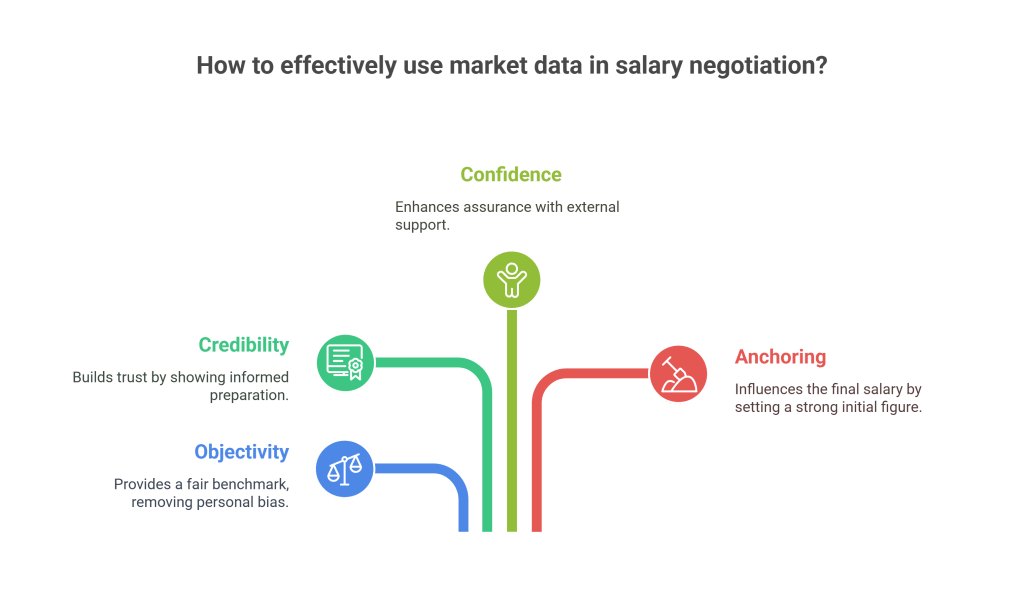
- Objectivity: Market data provides an objective benchmark for what professionals with similar skills, experience, education, and in similar geographic locations are earning. It removes personal bias and emotional reasoning from the equation.
- Credibility: When you can back up your salary request with data from reputable sources, you build credibility and demonstrate that you’ve done your homework. This shows you are serious and informed.
- Confidence: Armed with market data, you can approach the negotiation with significantly more confidence. You know your request is reasonable and supported by external evidence.
- Anchoring: Researching market rates allows you to establish a strong “anchor” – the initial figure you have in mind or propose. A well-researched anchor can significantly influence the final negotiated salary.
How to Gather Market Data:
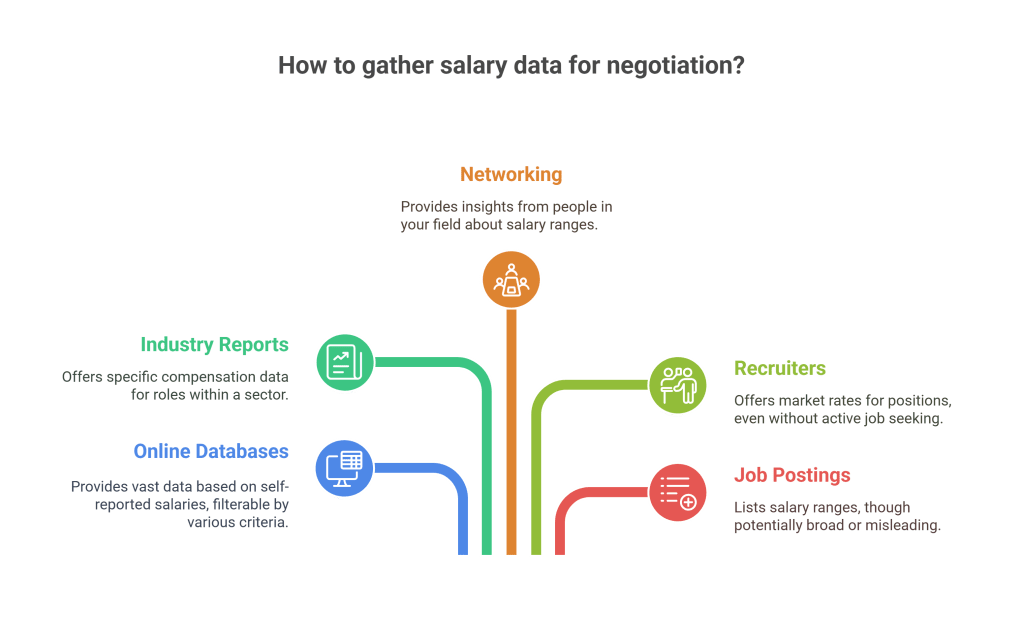
- Online Salary Databases: Websites like Glassdoor, Payscale, Salary.com, and LinkedIn Salary provide vast amounts of data based on self-reported salaries. Filter your searches by job title, location, years of experience, industry, and company size for the most accurate results. Be sure to look at data points like median salary, salary ranges, and reported bonuses or benefits.
- Industry Reports: Many industries publish annual compensation reports. These can be excellent sources for specific roles within a particular sector. Professional associations often provide this type of data to their members.
- Networking: Talk to people in your field, both within and outside your current company. Discreetly inquire about typical salary ranges for roles similar to yours. Be mindful of privacy, but informational interviews can be a valuable source of insight.
- Recruiters: Recruiters often have a pulse on market rates for various positions. Building relationships with recruiters in your industry can provide valuable information, even if you’re not actively seeking a new job through them at the moment.
- Job Postings: Pay attention to salary ranges listed in job descriptions, although be aware that these can sometimes be broad or even misleading. However, they can offer a general idea of what companies are willing to pay.
Analyzing the Data:
Once you’ve gathered data, don’t just look at a single number. Understand the range. Where do you fall within that range based on your specific skills, achievements, and the value you bring? Consider factors like specialized certifications, unique expertise, or a proven track record of exceeding expectations. Your goal is to identify a target salary range that is both competitive based on the market and reflective of your individual value.
2. Show Results, Not Hours: Tie Your Value to Outcomes, Not Effort
Employers pay for value delivered, not for the amount of time you spend at your desk. Focusing on hours worked during a salary negotiation is a weak position. Instead, you must articulate your value in terms of the results and outcomes you have achieved.
Why Results Matter More Than Effort:
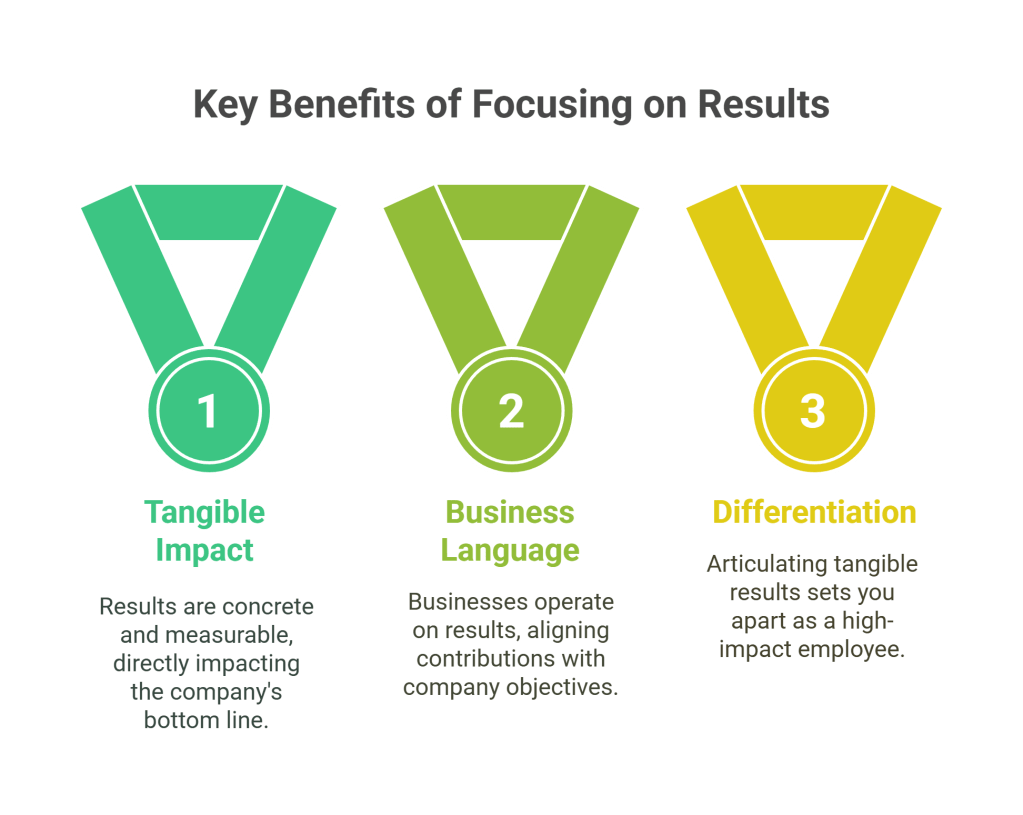
- Tangible Impact: Results are concrete and measurable. They demonstrate the direct impact you’ve had on the company’s bottom line, efficiency, or goals.
- Business Language: Businesses operate on results. Speaking in terms of outcomes aligns your contribution with the company’s objectives and priorities.
- Differentiation: Many people put in effort. Fewer can clearly articulate the tangible results of that effort. Focusing on outcomes differentiates you as a high-impact employee.
- Justification for Higher Pay: When you can show how your work has saved money, generated revenue, improved processes, or contributed to other key metrics, you provide a compelling justification for a higher salary.
How to Quantify Your Results:

- Think in Numbers: Whenever possible, quantify your achievements. Did you increase sales by a certain percentage? Did you reduce costs by a specific amount? Did you improve efficiency, leading to a reduction in time spent on a task?
- Focus on Impact: How did your actions benefit the company? Did you solve a critical problem? Did you launch a successful project? Did you improve customer satisfaction?
- Use the STAR Method: The STAR method (Situation, Task, Action, Result) is a useful framework for structuring examples of your achievements. Describe the situation, the task you needed to complete, the action you took, and the positive result of your action.
- Keep a “Win List”: Throughout the year, maintain a running list of your accomplishments. Note the situation, your action, and the quantifiable result. This makes it much easier to recall and articulate your achievements during performance reviews and salary negotiations.
- Align with Company Goals: Understand the key performance indicators (KPIs) and strategic goals of your team and the company. Frame your results in the context of how you contributed to achieving those goals.
Examples of Result-Oriented Statements:
- Instead of: “I worked hard on the new marketing campaign.”
- Try: “I implemented a new digital marketing strategy that resulted in a 15% increase in qualified leads within the first quarter.”
- Instead of: “I spent a lot of time improving the reporting process.”
- Try: “I streamlined the monthly reporting process, reducing the time required by 10 hours per month and improving data accuracy by 5%.”
By consistently focusing on the results you deliver, you shift the conversation from a discussion about the time you put in to a recognition of the tangible value you create for the organization.
3. Expect Pushback: “No” is Normal, Don’t Panic
Negotiation, by its very nature, involves a back-and-forth. It’s a discussion where two parties are trying to reach an agreement that is mutually beneficial. Therefore, it is completely normal and expected to encounter pushback or an initial “no” to your salary request. The key is not to panic when this happens.
Why Pushback is Part of the Process:
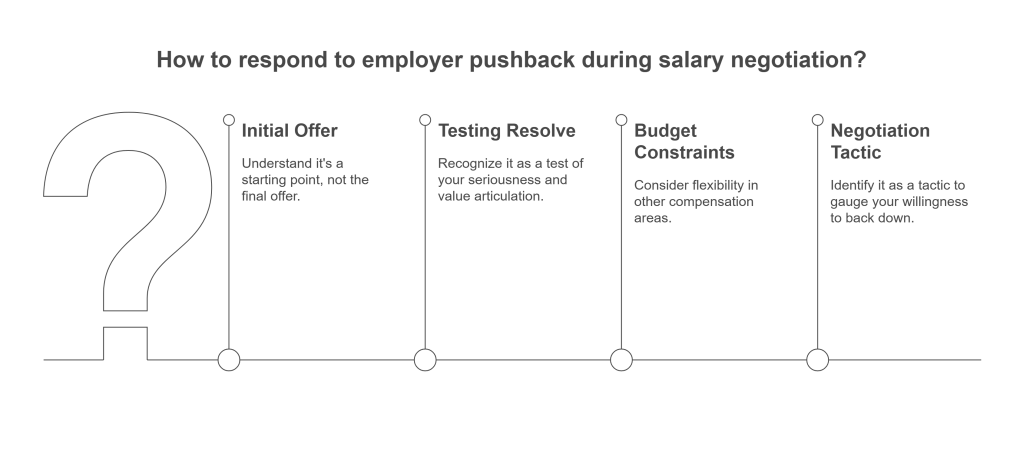
- Starting Point: The initial offer or response from the employer is often just a starting point. They may have a budget range in mind, and their first offer might be at the lower end of that range.
- Testing the Waters: Employers want to see how serious you are about your request and how well you can articulate your value. Pushback can be a way of testing your resolve and your justification.
- Budget Constraints: Sometimes, there are genuine budget limitations. However, even in these cases, there may be flexibility in other areas of the compensation package.
- Negotiation Tactic: Pushback can simply be a negotiation tactic to see if you will immediately back down.
How to Handle Pushback Without Panicking:
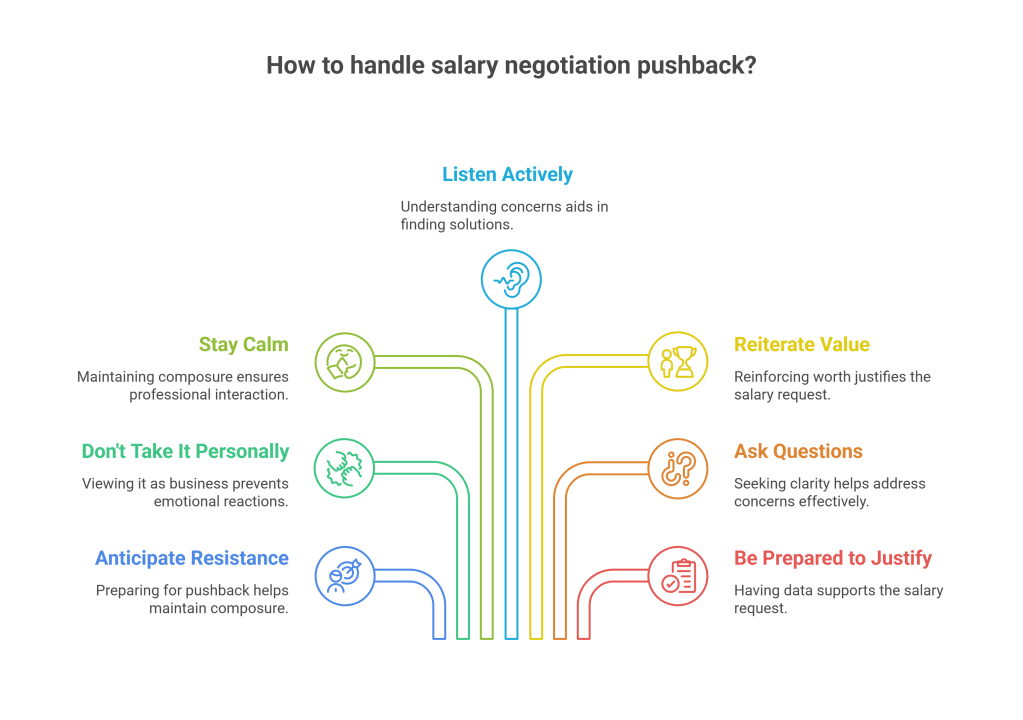
- Anticipate It: Go into the negotiation expecting that your initial request might not be immediately accepted. This preparation helps you stay calm if you encounter resistance.
- Don’t Take It Personally: Remember that the negotiation is a business conversation, not a personal rejection. Their response is about the numbers and the budget, not about your worth as a person.
- Stay Calm and Composed: If you receive pushback, take a breath. Avoid getting defensive or emotional. Maintain a calm and professional demeanor.
- Listen Actively: Pay close attention to why they are pushing back. Are there specific concerns about the budget? Do they need more information about your value? Understanding their perspective is crucial for finding a solution.
- Reiterate Your Value: Calmly reiterate the key reasons why you believe your requested salary is fair, referencing your market research and, most importantly, the results you’ve delivered.
- Ask Questions: Instead of just restating your position, ask open-ended questions to understand their constraints or concerns better. For example, “I understand there might be budget considerations. Could you help me understand the factors influencing the salary range for this role?” or “Based on the results I’ve shared, what would be a more realistic salary figure from your perspective?”
- Be Prepared to Justify: Have your data and examples of your results readily available to support your request.
Pushback is not the end of the negotiation; it’s an invitation to continue the conversation and explore possibilities. By expecting it and remaining calm and prepared, you can navigate it effectively.
4. Know When to Walk: Power Comes from Real Options
The ultimate leverage in any negotiation comes from having alternatives. In salary negotiation, this means having other potential job opportunities or being in a financial position where you are not desperate to accept any offer. Knowing when you are willing to walk away from an offer is a powerful component of your negotiation strategy.
Why Having Options Gives You Power:
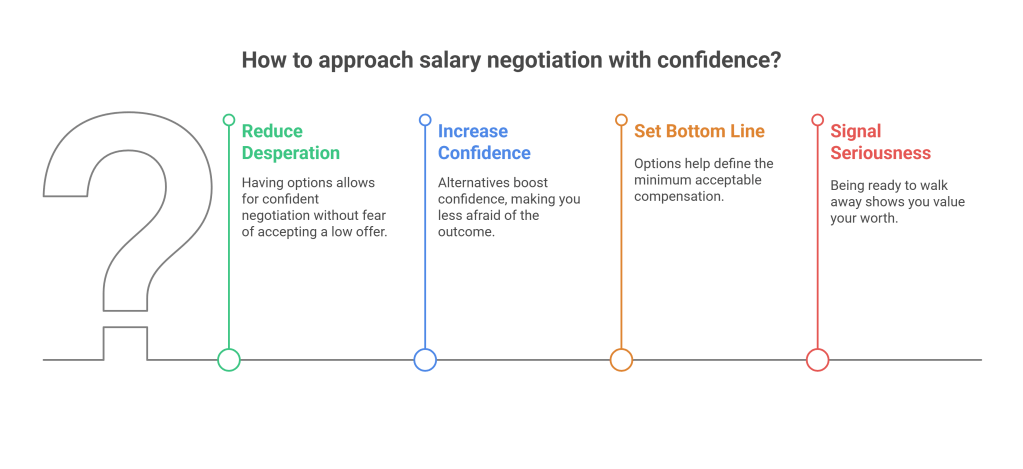
- Reduces Desperation: When you have other options, you are not negotiating from a position of desperation. This allows you to be more confident and less likely to accept an offer that is significantly below your worth.
- Increases Confidence: Knowing you have alternatives boosts your confidence during the negotiation. You are less afraid of the outcome because you have a safety net.
- Sets Your Bottom Line: Having other options helps you clearly define your “walk-away point” – the minimum compensation and terms you are willing to accept.
- Signals Seriousness: If you are prepared to walk away from an offer that doesn’t meet your needs, it signals to the employer that you are serious about your value and not just trying to get a few extra dollars.
How to Develop Real Options:
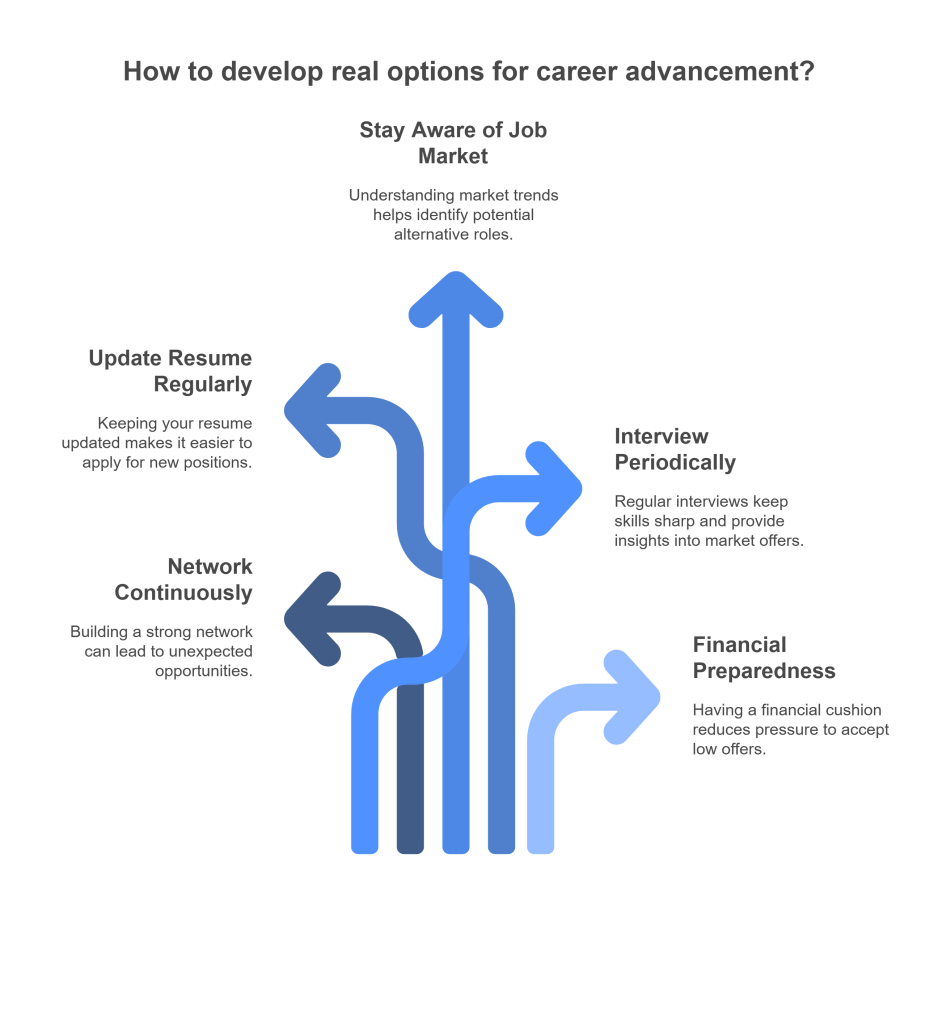
- Network Continuously: Don’t just network when you’re looking for a job. Build and maintain professional relationships throughout your career. A strong network can lead to unexpected opportunities.
- Keep Your Resume Updated: Regularly update your resume with your latest accomplishments and skills. This makes it easier to apply for other positions if needed.
- Stay Aware of the Job Market: Even when you’re not actively looking, keep an eye on job postings and industry trends. This helps you understand the demand for your skills and potential alternative roles.
- Interview Periodically: Consider interviewing for other positions even if you’re not planning to leave your current job immediately. This helps you stay sharp with your interview skills and provides insights into what other companies are offering.
- Financial Preparedness: Having a financial cushion or emergency fund can reduce the pressure to accept a low offer out of necessity.
Using Your Options (Carefully):
While having options is crucial, you don’t necessarily need to explicitly mention other offers unless it’s strategic. Sometimes, simply knowing you have alternatives is enough to give you the confidence you need. If you do mention another offer, do so professionally and factually, focusing on how the current opportunity compares and what it would take to make it the right choice for you. Avoid using other offers as a blunt instrument or making ultimatums.
Knowing when to walk away is not about being demanding or unreasonable; it’s about having a clear understanding of your value and being prepared to hold out for an offer that truly reflects it.
Communication Strategies: Speaking with Impact
Beyond having the right mindset, effective communication is paramount in salary negotiation. The way you articulate your request and engage in the conversation can significantly influence the outcome. The image highlights three key communication strategies:
Speak With Confidence: Ask Clearly, Then Pause
Confidence in your voice and demeanor is contagious. When you speak with confidence, you project an image of competence and conviction in your value. This isn’t about being arrogant, but rather about being self-assured and clear in your communication.
Why Confidence Matters in Negotiation:

- Credibility: Confident communication makes your statements more believable and persuasive.
- Control: Speaking clearly and deliberately helps you maintain control of the conversation’s pace and direction.
- Respect: Projecting confidence earns you respect from the other party.
- Reduces Doubt: Hesitation or uncertainty in your voice can signal to the employer that you are unsure of your own value, potentially leading them to question your request.
How to Speak With Confidence:
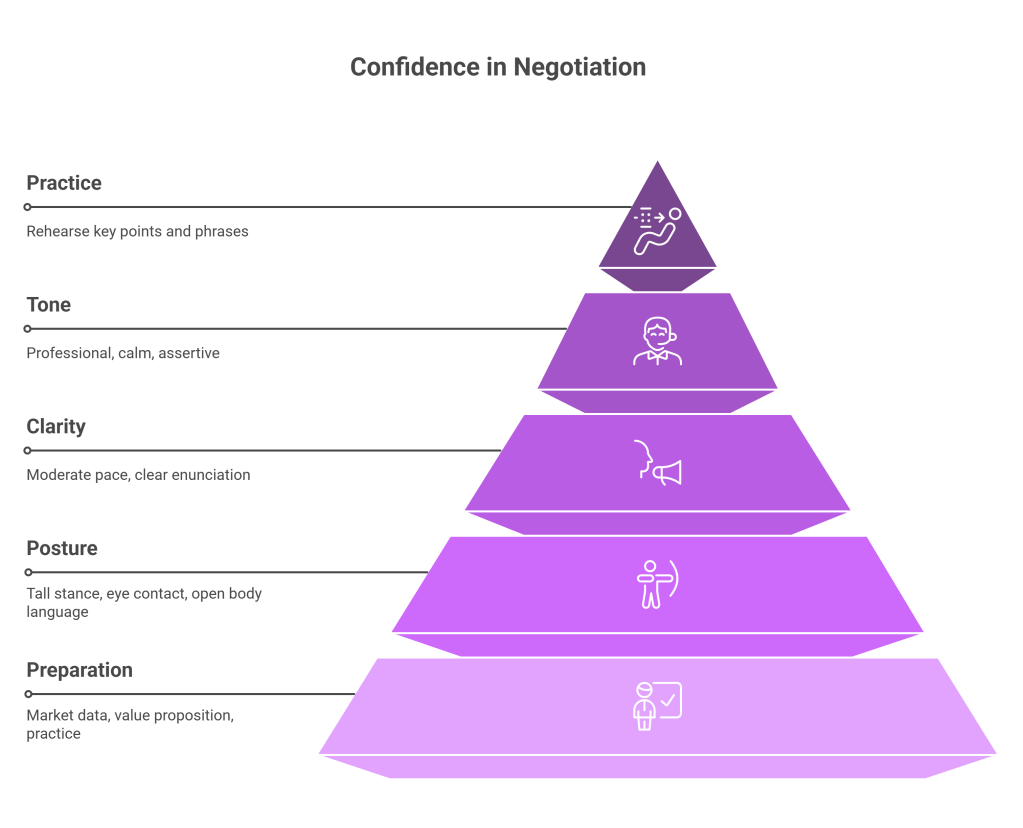
- Preparation is Key: Knowing your market data, your value proposition, and having practiced what you want to say are the foundations of confidence.
- Maintain Good Posture: Sit or stand tall, make eye contact, and use open body language. These physical cues can influence how you feel and how you are perceived.
- Speak Clearly and Deliberately: Avoid mumbling or rushing your words. Speak at a moderate pace, enunciating clearly.
- Control Your Tone: Keep your tone professional, calm, and assertive, not aggressive or demanding.
- Practice Out Loud: Rehearse your key points and phrases before the negotiation. Practice speaking them out loud to get comfortable with the wording and your delivery.
The Power of the Pause:
After stating your salary request or a key point, resist the urge to fill the silence. Pause. This allows the other person to process what you’ve said and gives you an opportunity to observe their reaction. Filling the silence can sometimes lead you to ramble, backtrack, or weaken your position. The pause is a powerful tool that demonstrates confidence and control.
Ask Without Apology: It’s a Business Conversation, Not a Favor
Many people approach salary negotiation as if they are asking for a favor. This mindset is detrimental. Negotiating your salary is a standard business practice, a conversation about the terms of your employment and the value exchange between you and the company. You are not asking for charity; you are discussing fair compensation for the skills and results you will provide.
Why You Shouldn’t Apologize for Asking:
- Undermines Your Value: Apologizing for asking for a higher salary or better terms signals that you believe your request is unreasonable or that you are not truly worth what you are asking for.
- Shifts the Dynamic: It frames the conversation as one where you are beholden to the employer, rather than an equal discussion between two parties entering into a mutually beneficial agreement.
- Reduces Your Leverage: An apologetic tone weakens your position and makes it easier for the employer to dismiss your request.
How to Ask Without Apology:
- Frame it as a Discussion: Use language that emphasizes collaboration and finding a mutually agreeable solution. For example, “I’d like to discuss the compensation for this role” or “Could we explore the potential salary range for this position?”
- Focus on Value: Continuously tie your salary request back to the value you bring and the results you will deliver.
- Use Confident Language: Avoid hesitant phrases like “I was just wondering if…” or “Would it be possible to maybe…” Instead, use direct and clear language like “I am seeking a salary in the range of…” or “Based on my experience and the market data, I am looking for…”
- Remember it’s Standard Practice: Remind yourself that salary negotiation is a normal part of the hiring process. Employers expect candidates to negotiate.
By approaching the conversation as a professional business discussion about value and compensation, you empower yourself to ask confidently and without feeling the need to apologize.
Ask Bigger Questions: “What Else Can We Explore Beyond Salary?”
While salary is a primary focus, compensation packages often include much more than just the base salary. A strong negotiator understands the value of the total compensation package and is willing to explore other elements beyond the hourly or annual wage. Asking “bigger questions” opens the door to negotiating these other valuable components.
Why Explore Beyond Base Salary:
- Total Compensation: The true value of a job offer lies in the total compensation package, which can include bonuses, stock options, health insurance, retirement plans, paid time off, professional development opportunities, flexible work arrangements, and more.
- Flexibility: If there is limited flexibility on the base salary, there might be more room to negotiate other benefits that are important to you.
- Long-Term Value: Some benefits, like retirement contributions or stock options, can have significant long-term financial value.
- Work-Life Balance: Benefits like flexible hours or remote work options can significantly impact your quality of life.
Examples of “Bigger Questions”:
- “Beyond the base salary, could we discuss the potential for a signing bonus?”
- “I’m also interested in understanding the bonus structure and performance incentives.”
- “Could we explore the possibility of stock options or equity in the company?”
- “What is the company’s policy on professional development and training? Are there opportunities for tuition reimbursement or conference attendance?”
- “I’m interested in understanding the health insurance and retirement plan benefits.”
- “Is there flexibility regarding the start date or potential for remote work?”
- “What is the policy on paid time off and vacation?”
- “Could we discuss the potential for a review and salary increase after a certain period, say six months?”
By asking these broader questions, you demonstrate your understanding of the full value of the compensation package and your willingness to be flexible in how that value is delivered. This can lead to a more favorable overall offer, even if the base salary is not exactly what you initially hoped for.
Traits of Strong Negotiators: Cultivating Inner Strength
Effective negotiation is not just about what you say; it’s also about who you are in the conversation. Certain traits and qualities contribute significantly to your ability to negotiate successfully. The image highlights five key traits of strong negotiators:
Perspective: See the Whole Package, Not Just the Number
As mentioned earlier, a strong negotiator understands that the offer is more than just the base salary. They have the perspective to see the entire compensation package and evaluate its overall value.
Cultivating Perspective:
- Prioritize Your Needs: Before entering negotiations, identify which aspects of compensation are most important to you (e.g., base salary, health benefits, work-life balance, growth opportunities).
- Understand the Value of Each Component: Research the monetary value of different benefits. For example, what would it cost you to purchase comparable health insurance on your own?
- Think Long-Term: Consider the long-term implications of the offer. Will this role provide opportunities for growth and future salary increases?
- Compare Offers Holistically: If you are comparing multiple offers, evaluate each one based on the total compensation package, not just the base salary.
Clarity: Know Your Ask – and Why It Matters
A strong negotiator is crystal clear about what they are asking for and, more importantly, why it matters. This clarity stems from thorough preparation and a deep understanding of their value.
Developing Clarity:
- Define Your Target Range: Based on your market research and assessment of your value, establish a clear target salary range.
- Know Your Walk-Away Point: Determine the minimum acceptable compensation and terms.
- Articulate Your Value Proposition: Be able to clearly and concisely explain the specific skills, experience, and results you bring that justify your request.
- Anticipate Questions: Think about the questions the employer might ask and prepare clear, concise answers.
Composure: Stay Calm – Even If They Don’t
Negotiations can sometimes be stressful, and the other party might exhibit signs of frustration or pressure. A strong negotiator maintains their composure throughout the process, regardless of the other party’s demeanor.
Maintaining Composure:
- Practice Mindfulness: Techniques like deep breathing can help you stay calm under pressure.
- Focus on the Goal: Keep your focus on achieving a mutually beneficial agreement, rather than getting caught up in the emotional aspects of the conversation.
- Don’t React Impulsively: If you receive an unexpected response or pushback, take a moment to process it before responding.
- Remember It’s Business: Detach your emotions from the business transaction.
Confidence: Speak Slow, Don’t Fill Silence
Confidence, as discussed earlier, is a key trait. In the context of composure, speaking slowly and deliberately, and being comfortable with silence, are hallmarks of a confident negotiator.
Demonstrating Confidence Through Delivery:
- Pace Yourself: Avoid rushing your words. A slower pace conveys thoughtfulness and control.
- Embrace the Pause: As mentioned before, don’t feel the need to fill every silence. Allow pauses for processing and reflection.
- Maintain Eye Contact: This shows you are engaged and confident in your communication.
Evidence: Bring Metrics, Wins, and Offers
Strong negotiators don’t just make claims; they provide evidence to support their requests. This evidence comes in the form of quantifiable results, examples of their achievements (“wins”), and, when appropriate, other job offers.
Gathering and Presenting Evidence:
- Quantifiable Results: Have your “win list” ready with specific numbers and impacts.
- STAR Method Stories: Prepare concise stories using the STAR method to illustrate your key achievements.
- Market Data: Be prepared to reference the market research you’ve conducted.
- Other Offers (Use Strategically): If you have other offers, use them as leverage, but do so professionally and focus on how the current opportunity compares.
By cultivating these traits, you build your inner strength and enhance your ability to navigate the negotiation process effectively.
What to Say Word-for-Word: Practical Phrases for Negotiation
Knowing what to say and how to say it can make a significant difference in your salary negotiation. The image provides six practical phrases that can be used at different stages of the conversation. Let’s break down each one:
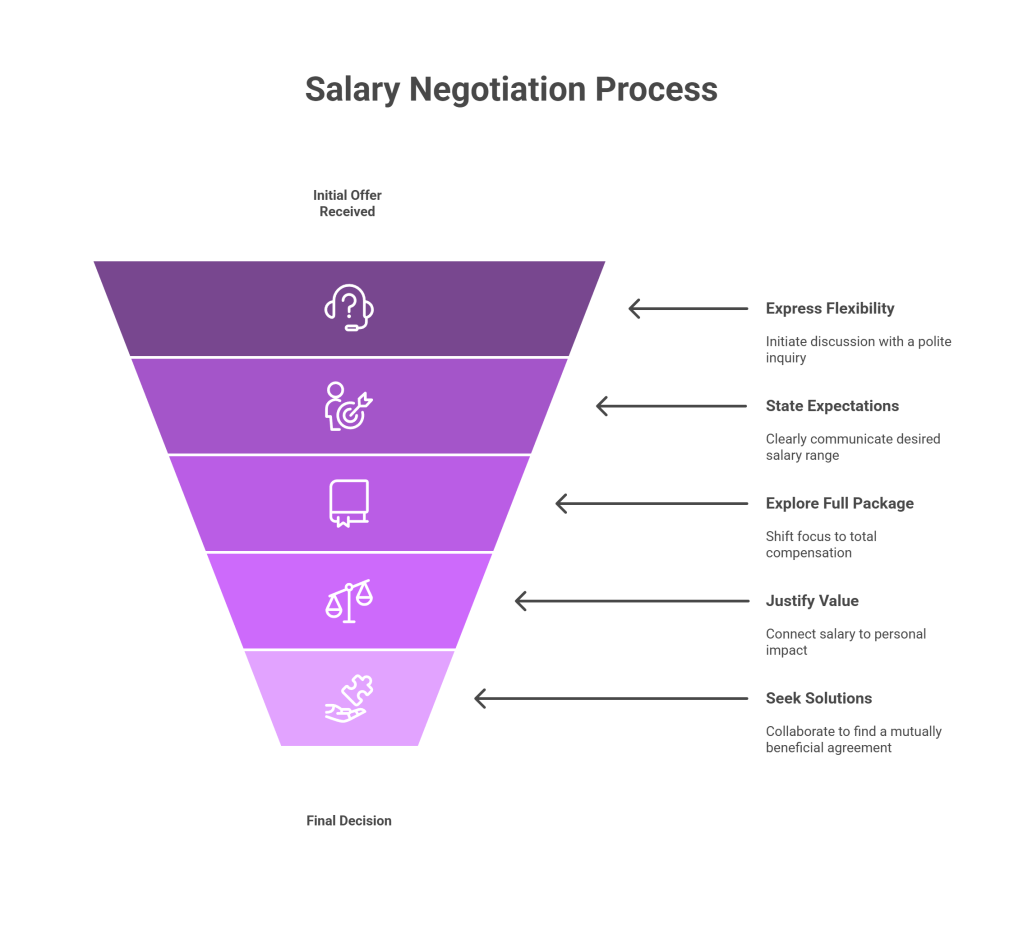
1. “Thanks – Is there any flexibility here?”
- Context: This is a polite and open-ended way to initiate the negotiation after receiving an initial offer. It’s non-confrontational and opens the door for further discussion without putting immediate pressure on the employer.
- Why it Works: It acknowledges their offer while gently probing for potential movement. It signals that you are interested but would like to explore the possibility of a higher salary.
- Variations: “Thank you for the offer. I’m excited about this opportunity. Regarding the salary, is there any room for negotiation?” or “I appreciate the offer. I’d like to discuss the compensation further. Is there flexibility in the proposed salary?”
2. “I was expecting something closer to…”
- Context: This phrase is used to introduce your desired salary range after they have presented their initial offer. It’s a polite way to anchor the negotiation closer to your target figure.
- Why it Works: It clearly states your expectation based on your research and value. By mentioning a higher figure, you set a new anchor point for the discussion.
- Variations: “Based on my research and the value I believe I can bring, I was anticipating a salary in the range of [Your Target Range].” or “Considering my experience and the market rate for this type of role, I was looking for something closer to [Your Target Figure].”
3. “Can we look at the full package?”
- Context: This phrase is used to shift the focus beyond just the base salary and explore other components of the total compensation package.
- Why it Works: It demonstrates your understanding of the full value of the offer and your willingness to be flexible in how that value is delivered. It opens the door to negotiating benefits, bonuses, or other perks.
- Variations: “I’d also like to discuss the other aspects of the compensation package, such as benefits, bonuses, and potential for growth.” or “Could we review the entire offer, including health insurance, retirement plans, and paid time off?”
4. “Based on my impact, I’d feel good at…”
- Context: This phrase directly connects your desired salary to the value and results you have delivered or will deliver. It’s a powerful way to justify your request.
- Why it Works: It anchors your salary expectation to your tangible contributions, making your request more compelling and less arbitrary. It shifts the focus from your needs to the value you provide to the company.
- Variations: “Considering the results I’ve achieved in [Previous Role/Project] and the impact I believe I can make here, I would be comfortable with a salary of [Your Target Figure].” or “Based on my track record of [Specific Accomplishment] and the value I bring to this role, I’m looking for a salary of [Your Target Figure].”
5. “What would it take to get there?”
- Context: This is a collaborative and solution-focused question to ask if there is a gap between your desired salary and the employer’s offer. It invites the employer to work with you to find a solution.
- Why it Works: It shows that you are not just making demands but are genuinely interested in finding a way to reach an agreement. It encourages the employer to think creatively about how they might be able to meet your needs, either through salary or other components of the package.
- Variations: “I understand there might be limitations on the base salary. What other aspects of the compensation package could we explore to get closer to my desired total compensation?” or “If [Your Target Salary] is not possible at this time, what steps or milestones would be required to reach that level in the future?”
6. “I’d like to think it over.”
- Context: This phrase is used to buy yourself time to consider the offer, especially if it’s complex or if you need to compare it with other opportunities. It also allows you to maintain control of the process.
- Why it Works: It prevents you from making a hasty decision under pressure. It gives you time to evaluate the offer thoroughly, consult with others if needed, and formulate your response. It also subtly signals that you are not desperate and are carefully considering your options.
- Variations: “Thank you for the updated offer. I’d like to take some time to review it carefully and will get back to you by [Specific Date/Time].” or “I appreciate you walking me through the offer. I need a little time to process everything and will follow up with you soon.”
These phrases are tools to help you navigate the conversation. Remember to deliver them with confidence, clarity, and a focus on your value.
Expanding on Key Themes: Building a Comprehensive Negotiation Strategy
To create a truly detailed article and provide a comprehensive guide to salary negotiation, let’s expand on some key themes and add additional layers to the strategies discussed so far.
Researching Market Value in Depth: Beyond the Basics
While online salary databases are a good starting point, a truly in-depth understanding of market value requires going deeper.
Advanced Market Research Techniques:
- Geographic Nuances: Salary ranges can vary significantly even within the same country or state. Research data specific to the metropolitan area or region where the job is located.
- Industry-Specific Data: Compensation for similar roles can differ between industries. For example, a software engineer in the tech industry might earn more than a software engineer in a non-profit organization.
- Company Size and Type: Larger companies often have more structured compensation bands and may offer higher salaries and more comprehensive benefits than smaller startups or non-profits. Public companies may also have different compensation structures than private ones.
- Specific Skill Sets: Are there specialized skills or certifications you possess that are in high demand? Research how these specific skills impact salary ranges in your field.
- Negotiation Trends: Stay informed about current negotiation trends in your industry and the broader job market. Are salaries increasing or decreasing? What are common benefits being offered?
By conducting thorough and nuanced market research, you can arrive at a highly accurate and defensible target salary range that reflects your true market value.
Practicing Your Negotiation: Rehearsal for Success
You wouldn’t go into a major presentation or performance without rehearsing, and salary negotiation is no different. Practicing your negotiation can significantly boost your confidence and improve your delivery.
Effective Practice Methods:
- Role-Playing: Practice with a friend, mentor, or career coach. Have them play the role of the hiring manager or recruiter and go through the negotiation conversation. This allows you to practice your responses to potential questions and pushback.
- Record Yourself: Record yourself practicing your key points and phrases. Listen back to identify areas where you can improve your tone, pace, and clarity.
- Anticipate Objections: Think about the potential objections or questions the employer might raise and practice how you will respond.
- Practice Your Opening and Closing: Rehearse how you will initiate the negotiation and how you will conclude the conversation.
The more you practice, the more comfortable and confident you will feel when the actual negotiation takes place.
Handling Different Scenarios: Navigating the Negotiation Process
Salary negotiation isn’t always a single conversation. It can involve multiple interactions and different scenarios. Being prepared for these variations is key.
Common Negotiation Scenarios:
- The Initial Offer: This is often the starting point. Be prepared to respond politely, express your enthusiasm for the role, and initiate the negotiation regarding compensation.
- The Counter-Offer: If you receive a counter-offer from your current employer after accepting a new position, carefully evaluate if it truly meets your needs and long-term goals. Don’t accept a counter-offer solely based on a higher salary if the underlying reasons for wanting to leave haven’t changed.
- Negotiating Benefits: If there’s limited flexibility on the base salary, be prepared to negotiate other aspects of the compensation package, such as vacation time, signing bonuses, professional development budgets, or flexible work arrangements.
- Negotiating a Promotion or Raise in Your Current Role: The principles of negotiation still apply. Research internal salary bands, highlight your recent accomplishments and their impact, and clearly articulate your desired salary increase.
- Negotiating a Job Offer with No Stated Salary Range: In this situation, you’ll need to be prepared to state your desired salary range first, based on your market research. Be confident in your anchor.
Being adaptable and prepared for different scenarios will allow you to navigate the negotiation process more effectively.
The Psychology of Negotiation: Understanding the Dynamics
Understanding some basic principles of negotiation psychology can give you an edge.
Psychological Principles in Negotiation:
- Anchoring: The first number mentioned in a negotiation can act as an “anchor” that influences the subsequent discussion. This is why it’s important to have a well-researched target salary in mind and, in some cases, be prepared to state it first.
- Framing: How you frame your request can impact how it is received. Framing your desired salary in terms of the value you bring is more effective than framing it in terms of your personal needs.
- Reciprocity: People are often inclined to reciprocate favors or concessions. If you are flexible on certain aspects of the package, the employer might be more willing to be flexible on others.
- Loss Aversion: People are generally more motivated to avoid a loss than to gain something of equal value. Framing the negotiation in terms of what the company might “lose” by not hiring you (e.g., lost productivity, missed opportunities) can be persuasive.
- Building Rapport: Establishing a positive and professional relationship with the hiring manager or recruiter can create a more collaborative negotiation environment.
While you don’t need to be a psychology expert, being aware of these principles can help you approach the negotiation strategically.
Long-Term Career Negotiation: It Doesn’t End Here
Salary negotiation is not a one-time event. It’s an ongoing process throughout your career. Regularly assessing your market value, tracking your accomplishments, and being prepared to negotiate for raises and promotions are essential for long-term financial growth.
Ongoing Negotiation Strategies:
- Regular Performance Reviews: Use performance reviews as an opportunity to discuss your accomplishments and their impact, and to advocate for a salary increase.
- Stay Informed About Market Trends: Continuously monitor salary trends in your field to ensure your compensation remains competitive.
- Seek Opportunities for Growth: Taking on new challenges, acquiring new skills, and seeking promotions can increase your value and your earning potential.
- Be Prepared to Re-Negotiate: If your responsibilities increase significantly or you achieve a major milestone, don’t be afraid to initiate a conversation about a salary adjustment outside of the regular review cycle.
By viewing salary negotiation as a continuous process, you can proactively manage your career and ensure your compensation keeps pace with your growing value.
Conclusion: Empowering Yourself to Ask for What You’re Worth
Salary negotiation is a critical skill that can have a profound impact on your financial well-being and career success. It’s not about being greedy or demanding; it’s about understanding your value, advocating for yourself, and securing compensation that is fair and reflective of your contributions.
By adopting a winning mindset, practicing effective communication strategies, cultivating the traits of strong negotiators, and being prepared with data and evidence, you can approach salary negotiation with confidence and increase your chances of success. Remember that negotiation is a conversation, a process of finding a mutually beneficial agreement. Be prepared for pushback, know when to explore options beyond base salary, and always be ready to walk away if the offer doesn’t meet your needs and value.
Don’t leave money on the table. Invest the time and effort to prepare for your salary negotiations. The skills you develop will serve you throughout your career, empowering you to ask for what you’re truly worth and build the financial future you deserve.
Discover more from SkillWisor
Subscribe to get the latest posts sent to your email.
 SkillWisor