
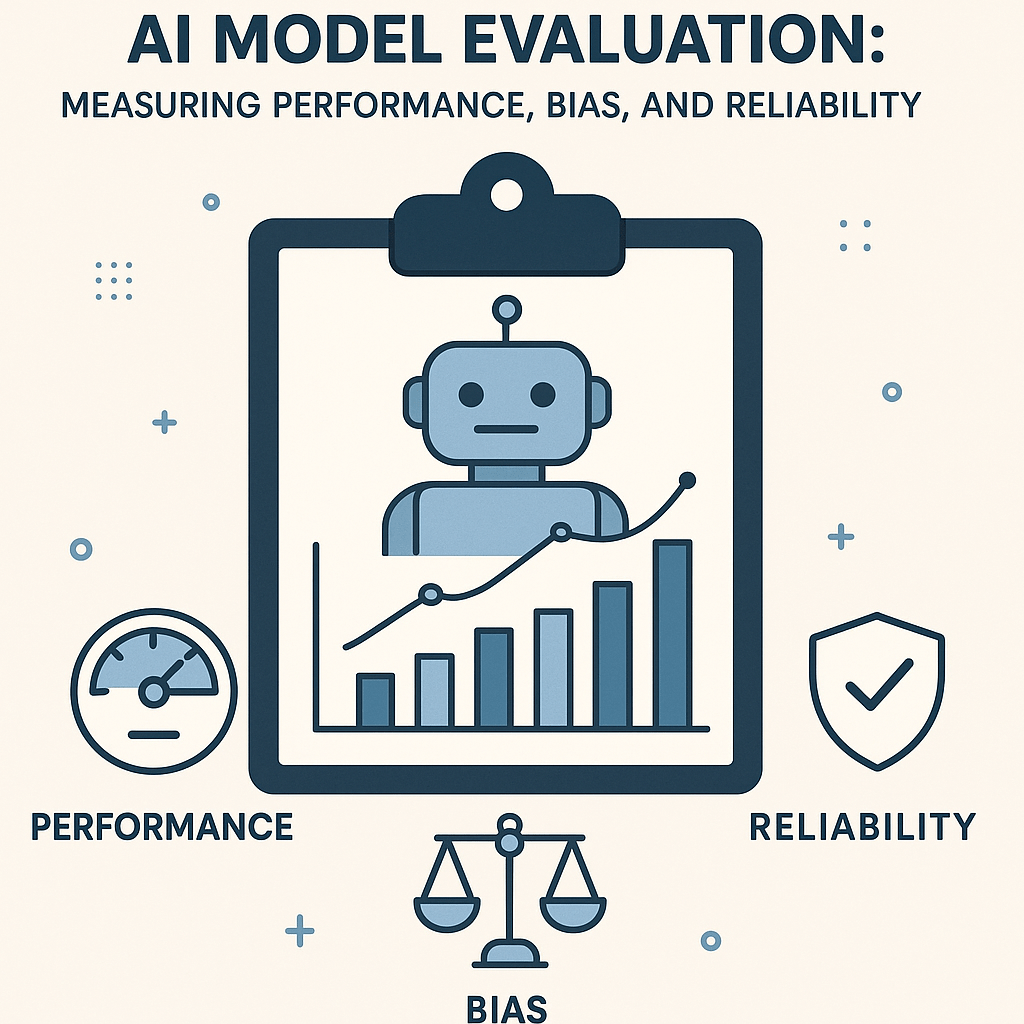
Building an AI model is only half the battle; rigorously evaluating it is what separates a proof-of-concept from a production-ready, trustworthy system. Effective evaluation isn’t a single score but a holistic understanding of a model’s capabilities and limitations. This involves looking beyond simple accuracy to assess its real-world performance, its fairness towards different groups, and its reliability under stress.
This guide explores the essential metrics across these three critical pillars of AI model evaluation.
1. Measuring Core Performance
Performance metrics are the most common form of evaluation. They measure how “correct” a model’s predictions are. The right metric depends entirely on the type of task the model is designed for.
A. Metrics for Classification Models
Classification models predict a category or class (e.g., spam vs. not spam, cat vs. dog, approved vs. denied).
The Confusion Matrix
This is the bedrock of most classification metrics. It’s a table that visualizes the performance of a model by comparing its predictions to the actual ground truth.
| Predicted Positive | Predicted Negative | |
| Actual Positive | True Positive (TP) | False Negative (FN) |
| Actual Negative | False Positive (FP) | True Negative (TN) |
- True Positive (TP): The model correctly predicted a positive class. (e.g., correctly identified spam).
- True Negative (TN): The model correctly predicted a negative class. (e.g., correctly identified a non-spam email).
- False Positive (FP): The model incorrectly predicted a positive class. (e.g., a legitimate email was marked as spam). Also known as a Type I Error.
- False Negative (FN): The model incorrectly predicted a negative class. (e.g., a spam email was missed and went to the inbox). Also known as a Type II Error.
Based on the confusion matrix, we derive several key metrics:

Accuracy
- What it is: The percentage of total predictions that were correct.
- Formula:
(TP + TN) / (TP + TN + FP + FN) - When to use it: When the classes in your dataset are well-balanced.
- Limitation: Accuracy can be highly misleading for imbalanced datasets. For example, if a model is 99% accurate at detecting a rare disease that only affects 1% of the population, it might simply be predicting “no disease” every time.
Precision
- What it is: Of all the times the model predicted “positive,” what percentage was actually correct? It measures the quality of the positive predictions.
- Formula:
TP / (TP + FP) - When to use it: When the cost of a False Positive is high. For example, in spam detection, you don’t want to incorrectly mark an important email as spam. High precision is key.
Recall (Sensitivity or True Positive Rate)
- What it is: Of all the actual positive cases, what percentage did the model correctly identify? It measures the model’s ability to “find” all the positive samples.
- Formula:
TP / (TP + FN) - When to use it: When the cost of a False Negative is high. For example, in medical screening for a serious disease, you want to find every person who actually has the disease, even if it means some healthy people are flagged for more tests. High recall is critical.
F1-Score
- What it is: The harmonic mean of Precision and Recall. It provides a single score that balances both concerns.
- Formula:
2 * (Precision * Recall) / (Precision + Recall) - When to use it: When you need a balance between Precision and Recall, and when you have an imbalanced dataset.
AUC – ROC Curve
- What it is: The Area Under the Receiver Operating Characteristic Curve. The ROC curve plots the True Positive Rate (Recall) against the False Positive Rate at various classification thresholds.
- Interpretation: AUC represents the likelihood that the model will rank a randomly chosen positive instance higher than a randomly chosen negative one.
- Scale: Ranges from 0 to 1. An AUC of 0.5 is equivalent to random guessing, while an AUC of 1.0 is a perfect classifier. It is a great aggregate measure for comparing different models.
B. Metrics for Regression Models
Regression models predict a continuous numerical value (e.g., house price, temperature, sales forecast).

- Mean Absolute Error (MAE): The average of the absolute differences between the predicted and actual values. It’s easy to interpret as it’s in the same units as the output variable.
- Mean Squared Error (MSE): The average of the squared differences between predicted and actual values. It penalizes larger errors more heavily than MAE due to the squaring.
- Root Mean Squared Error (RMSE): The square root of the MSE. This is often preferred over MSE because its units are the same as the output variable, making it more interpretable.
- R-Squared (R² or Coefficient of Determination): Measures the proportion of the variance in the dependent variable that is predictable from the independent variable(s). An R² of 0.8 means that 80% of the variation in the output can be explained by the model’s inputs.
2. Measuring Fairness and Bias
A model that is highly accurate can still be unfair, producing systematically worse outcomes for certain demographic groups. Measuring fairness is essential for building responsible AI.
Key Concept: Protected Attributes
These are the variables that define the groups you want to ensure are treated fairly, such as race, gender, age, or religion.
Common Fairness Metrics

- Demographic Parity (or Statistical Parity): This metric checks if the likelihood of receiving a positive outcome is the same for all groups, regardless of their protected attribute. For a loan application model, it would mean that the percentage of applicants approved from Group A is the same as the percentage approved from Group B.
- Equal Opportunity: This metric ensures that the model correctly identifies positive outcomes at an equal rate for all groups. It means the True Positive Rate (Recall) should be the same across groups. For a loan model, this would mean that of all the people who can repay a loan, the model approves them at the same rate, regardless of group.
- Equalized Odds: This is a stricter metric that combines the previous two. It requires that both the True Positive Rate and the False Positive Rate are equal across all protected groups.
- Disparate Impact: A legal and regulatory concept, often defined as the ratio of selection rates (positive outcomes) for a protected group compared to the majority group. A common threshold for fairness is ensuring this ratio is above 80%.
3. Measuring Reliability and Robustness
A model’s performance on a clean test set doesn’t guarantee its reliability in the real world, where data can be noisy, unpredictable, or even malicious.
A. Robustness to Perturbations
- What it is: How well does the model maintain its performance when the input data is slightly altered?
- How to test it:
- Stress Testing: Introduce noise, missing values, or synthetic data (e.g., images with added blur, text with typos) to see how much it degrades performance.
- Adversarial Attacks: Intentionally craft inputs that are nearly imperceptible to humans but are designed to fool the model. A robust model should be resistant to such attacks.
B. Calibration
- What it is: Does the model’s predicted confidence align with its actual accuracy? A well-calibrated model that predicts something with 90% confidence should be correct 90% of the time.
- Why it matters: Overconfident and incorrect predictions can be dangerous. In a medical setting, a model that is “99% confident” in a wrong diagnosis is more harmful than one that is “60% confident.”
- How to measure it: Calibration plots and metrics like Expected Calibration Error (ECE) can be used to quantify how well-calibrated a model is.
C. Explainability and Interpretability (XAI)
- What it is: While not a single metric, explainability is a key component of reliability. It involves using techniques to understand why a model made a specific prediction.
- Why it matters: If you can’t explain a model’s decision, it’s difficult to trust it, debug it, or be sure it hasn’t learned a spurious correlation.
- Common Tools: Methods like SHAP (SHapley Additive exPlanations) and LIME (Local Interpretable Model-agnostic Explanations) help identify which input features were most influential in a given prediction.
Conclusion: A Holistic Approach
Evaluating an AI model is not a single step but a continuous process. A truly successful model is one that is not only performant on its core task but is also proven to be fair in its outcomes and reliable in a complex, ever-changing world. By moving beyond a single accuracy score and embracing this multi-dimensional framework, we can build AI systems that are not just powerful, but also responsible and trustworthy.
Discover more from SkillWisor
Subscribe to get the latest posts sent to your email.
 SkillWisor