
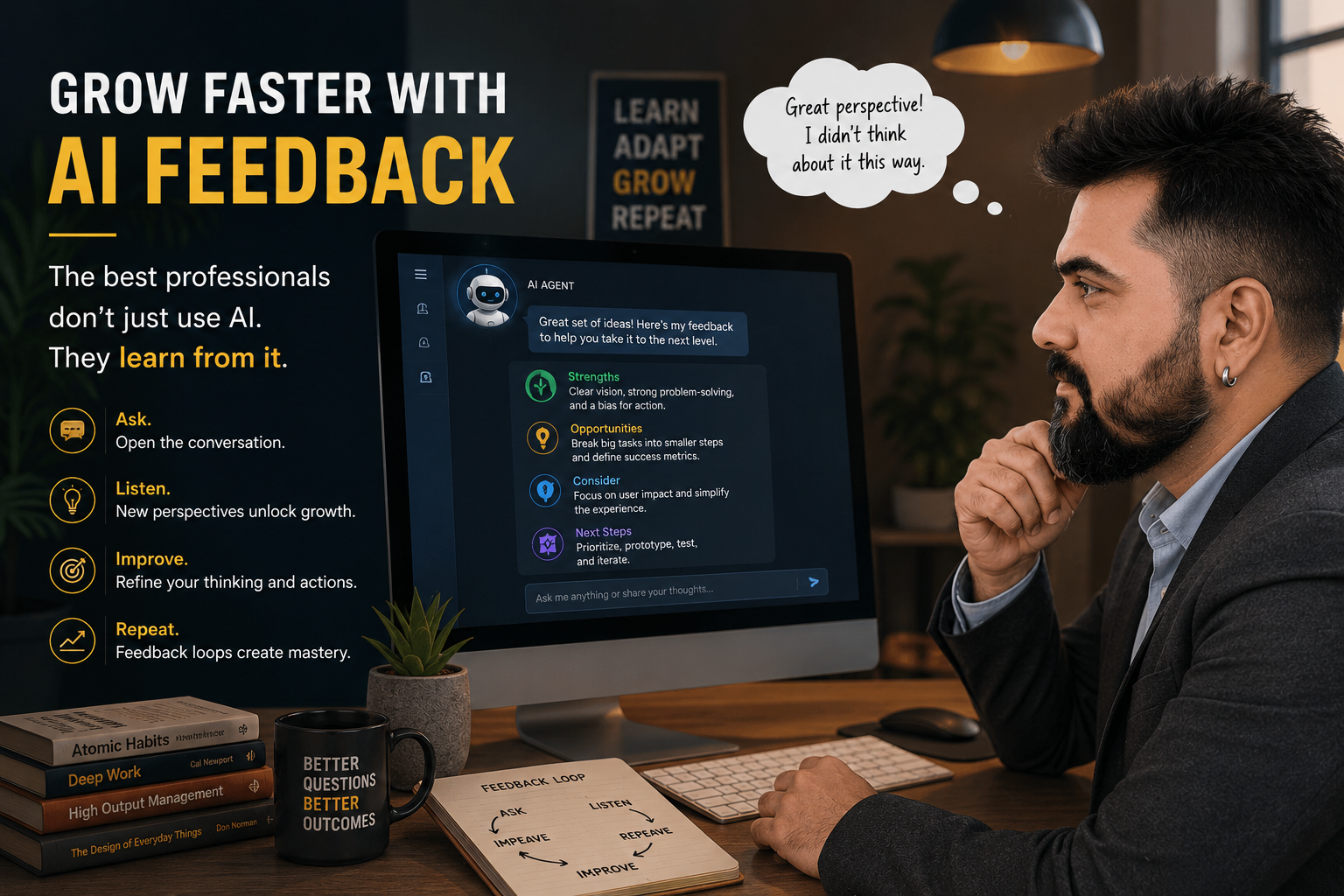
You are staring at your screen, jaw clenched. For the third time in ten minutes, your AI assistant has handed you a sprawling, generic mess of an answer.
“The models are getting lazier,” you mutter to yourself, hitting the backspace key aggressively. “It completely missed the point.”
But here is the uncomfortable, unspoken truth of the generative AI era: the machine is not getting lazier. It is simply holding up a high-definition mirror to your own communication flaws.
Every serious professional has a feedback routine.
You ask your manager: How can I improve?
You ask your peers: How am I doing?
You ask your customers: What’s working? What isn’t?
Feedback is the engine of professional growth. We understand this instinctively. We spend millions of dollars on executive coaching and 360-degree surveys to uncover our professional blind spots.
Yet, there is one collaborator that most of us now work with for hours every day—and almost nobody thinks to ask it for feedback.
Think about your daily workflow. You likely spend hours every week interacting with ChatGPT, Claude, Gemini, or Copilot. You are engaged in a continuous, high-volume loop of communication. You are assigning work, reviewing outputs, defining parameters, and making decisions. For a modern knowledge worker, this happens dozens, sometimes hundreds, of times before lunch.
But your AI? Your AI sees your raw, unfiltered, rushed thoughts. It sees your fragmented logic, your missing context, and your tendency to demand solutions without defining the problem. It observes your cognitive micro-habits with perfect recall. It has quietly become your most observant, available, and intimately knowledgeable collaborator.
It is time to stop blaming the algorithm for bad outputs. It is time to build a continuous feedback loop with the intelligence that knows your communication habits better than anyone else.
The Psychology of the Prompt: Why We Fail the Mirror Test
When a prompt returns a hallucinated or useless result, the instinctive human reaction is to blame the technology. Sometimes, that blame is warranted; the technology absolutely has limitations. But much more often, the AI’s output is simply a perfect reflection of your own muddled thought process.
Humans are uniquely prone to a psychological phenomenon called the “Curse of Knowledge.” Once we know something, we find it incredibly difficult to imagine what it is like not to know it. We carry decades of lived experience, months of complex project history, implicit company culture, and hours of recent meeting context in our working memory.
When we turn to an AI to draft an email, write code, or analyze data, we unconsciously assume the machine shares a fraction of that invisible context. We type, “Write an update to the client about the delay,” completely forgetting that the AI doesn’t know the client is notoriously impatient, that the delay was caused by a vendor, or that the tone needs to be apologetic but firm regarding costs.
When the AI returns a confused output, the mirror is reflecting back your own cognitive biases:
- Unclear objectives: You asked for a “report” without defining the ultimate business decision the report is meant to inform.
- Overloaded cognitive limits: You asked the AI to execute five complex, disparate tasks in a single breathless paragraph.
- Stranded context: Critical background information was left buried in a Slack channel and never explicitly written down.
These are not inherently AI problems. They are foundational human communication problems.
And the harsh reality is this: if you are making these errors with an AI, they almost certainly show up in your human interactions, too. They are lurking in your rushed emails, your ambiguous Slack messages, your poorly scoped Jira tickets, and your rambling stakeholder presentations.
A human colleague will nod, attempt to decode your ambiguity, and likely suffer in silence or produce sub-par work to avoid the social friction of saying, “I have absolutely no idea what you are asking me to do.”
The AI has no such social anxiety. It simply executes the confused, contradictory instructions it was given, handing you back the exact chaos you handed it. That is not a bug. That is a profound, career-altering feature.
Deconstructing the Four Cardinal Sins of AI Communication
After reviewing and analyzing large volumes of AI interaction logs across various organizations, the divide between “power users” and “frustrated users” rarely comes down to technical prowess. It comes down to communication hygiene. To use AI as a tool for continuous self-improvement, you must first learn to recognize your own failures.
Here are the four cardinal sins of prompt formulation, how they manifest, and how to fix them.
1. Command Stacking (The Multithreading Fallacy)
The Mistake: “Fix the bug in the authentication flow, update the database architecture to support the new user roles, review the caching strategy, optimize the frontend performance, and draft an email to the QA team letting them know it’s ready for testing.”
This is five distinct tasks. One message. Multiple levels of abstraction spanning backend engineering to team communication. Every single one of these tasks is competing for the model’s attention span (and token limit).
In human management, this is akin to dropping by an employee’s desk, rattling off five complex projects in 30 seconds, dropping a sticky note, and walking away. It guarantees failure.
The Fix: AI—like any capable human professional—does its best work on clearly defined, single-outcome requests. The solution is an approach called “Chaining.” You must require the discipline of yourself to separate these into sequential prompts where one outcome informs the next. Start with the bug. Verify the fix. Then move to the database. Verify the schema. One outcome per request.
2. Hidden Context (The Iceberg Illusion)
The Mistake: “Write a blog post announcing our new analytics dashboard.”
This is the most common sin of the modern marketer or product manager. Experienced professionals carry an enormous “iceberg” of context beneath the surface of their daily work. You know that your competitors just launched a similar feature, so your messaging needs to highlight your unique integration speed. You know your brand voice is authoritative but approachable. You know the primary audience is mid-level data engineers, not CMOs.
None of that exists in the chat window. What reads as “obviously it should be handled this way” to you is a blank slate to the AI.
The Fix: Explicit context always outperforms implicit assumptions. Before making a request, force yourself to write a “State of the Union” preamble.
Who is this for? What happened previously? What are the political sensitivities? What must we avoid saying?
A stronger prompt looks like this: “We are launching a new analytics dashboard. Our target audience is mid-level data engineers who are highly skeptical of marketing fluff. The core differentiator is our integration speed (under 5 minutes). Draft a 500-word announcement post. The tone must be technical, direct, and avoid words like ‘synergy’ or ‘revolutionary’.”
3. Solution-First Thinking (The XY Problem)
The Mistake: “Write a Python script to scrape our competitor’s pricing page every 10 minutes and save it to a CSV.”
Many requests begin with a prescribed solution before the actual problem is defined. In software engineering, this is known as the “XY Problem”—you want to solve problem X, you think Y is the solution, so you ask for help with Y, even though Y is a terrible, inefficient way to solve X.
By prescribing the solution immediately (a scraper and a CSV), you bypass the AI’s greatest strength: its ability to reason across vast amounts of information to find optimal, alternative paths. You are micromanaging the machine.
The Fix: Great communicators define outcomes; weaker communicators prescribe implementation. You must learn to separate the what from the how.
A stronger approach is: “Here is the business problem I am trying to solve: our competitor changes prices dynamically and we are losing margin by reacting too slowly. What are the most resilient, scalable technical approaches to monitor their pricing in real-time, considering we want to avoid getting our IP banned? Give me three options ranging from low-effort to high-effort.”
4. Scope Drift (The Contaminated Context Window)
The Mistake: You start a conversation to ask a quick question about an Excel formula. It goes well. Ten prompts later, in the exact same thread, you are asking it to draft a Q3 marketing strategy, analyze a competitor’s SEC filing, and write a polite rejection letter to a job candidate.
The result is a contaminated context window. The model begins hallucinating Excel terminology into your marketing strategy and referencing SEC regulations in your rejection letter because the conversation has lost all boundaries.
The Fix: Focus is not a limitation of AI—it is a prerequisite for quality output. Treat conversational threads like physical meeting rooms. When the topic changes entirely, leave the room. Start a new chat. This forces you to be disciplined about the scope of your current cognitive task.
The AI Communication Maturity Model
As you begin to recognize these sins, you will notice yourself moving through distinct phases of capability. Most modern knowledge workers currently sit at Level 1 or 2. The gap between Level 2 and Level 4 is where the most significant professional leverage—and career acceleration—lives today.
Level 1: The Prompt User
- Mindset: Treats AI like a Google search bar or a magic 8-ball.
- Behavior: Writes short, isolated, fragmented prompts. Constantly searches for “magic words” or secret prompt templates online, believing the flaw is in the syntax.
- Outcome: Judges the AI’s utility entirely by individual, one-off outputs. Experiences frequent frustration when the AI “doesn’t get it,” leading to abandonment of the tool.
Level 2: The Context Provider
- Mindset: Treats AI like an eager, but highly literal, junior intern.
- Behavior: Understands that garbage-in equals garbage-out. Begins adding background requirements, target audiences, and desired objectives to prompts.
- Outcome: Sees a marked improvement in results, but still relies on a transactional “request and receive” dynamic rather than true collaboration.
Level 3: The Collaborator
- Mindset: Treats AI as a thinking partner and a sounding board.
- Behavior: Uses iteration intentionally. Never accepts the first output. Explores alternatives (“Give me three completely different ways to solve this”). Challenges the AI’s assumptions (“Why did you choose that framework? Defend your reasoning against X alternative”).
- Outcome: The AI becomes a tool for refining the user’s own thoughts, not just generating text or code. The user realizes the conversation is the product.
Level 4: The Architect
- Mindset: Treats AI as a sophisticated system to be managed and orchestrated.
- Behavior: Designs conversations with deep intention. Separates strategic brainstorming threads from tactical execution threads. Structures information meticulously (using markdown, XML tags, or clear headers) before delivering it to the model to reduce the machine’s cognitive load.
- Outcome: Consistently high-quality, predictable outputs. The user is now effectively managing a digital intelligence and scaling their own output exponentially.
Level 5: The System Thinker
- Mindset: Treats communication as a masterable craft spanning human and machine ecosystems.
- Behavior: Takes the lessons learned from AI interactions and systematically applies them to human communication. They rewrite team onboarding docs to include missing context discovered via AI. They restructure meetings based on the principles of single-threading. They clarify email communication to eliminate the XY problem.
- Outcome: Exponential productivity gains, fewer team misunderstandings, and recognized leadership in organizational clarity.
The A.I.R. Framework: Assess, Improve, Repeat
How do you transition from reading about these mistakes to actively eliminating them from your daily workflow? By implementing a continuous, automated feedback loop.
I propose a three-step, repeating cycle: Assess → Improve → Repeat (A.I.R.).
Phase 1: Assess (The Brutal Audit)
You must ask the AI to evaluate your communication patterns. Most professionals never do this, completely ignoring the fact that the data required for a comprehensive communication audit is sitting right there in the chat history.
Open a long-running, complex thread you’ve had with an AI recently. (The longer the thread, the better the data). You must instruct the AI to drop its default “helpful and polite” persona, or it will flatter you.
Ask it questions like:
- Based strictly on my prompts in this thread, where do I consistently create ambiguity?
- What specific context did I regularly forget to provide until you made a mistake and I had to correct you?
- Did I ever exhibit “Command Stacking” by giving you too many disparate instructions at once? Cite specific examples.
The observations it surfaces are often startlingly accurate. They are exactly the things your human team members notice but never have the courage to say.
Phase 2: Improve (The Targeted Intervention)
Once your patterns are visible, you must work on specific, targeted interventions. “Communicate better” is a wish, not a strategy. You need actionable before-and-after frameworks.
Improving Constraints:
- Before: “Optimize this database query so it runs faster.”
- After: “Refactor this Postgres query. The constraint is that we cannot add any new indexes to the database, and we cannot change the schema. Reduce the execution time to under 500ms while strictly maintaining the current JSON output format.”
Improving Success Criteria:
- Before: “Design a better onboarding flow for the app.”
- After: “Design a 3-step onboarding flow. Success for this prompt means the user understands the core value proposition without needing to read more than 50 words total, and the final step results in them connecting their email account. Do not suggest any flow that requires watching a video.”
The difference in output quality between these pairs is monumental. But more importantly, the discipline required to write the “After” prompt forces you to become a better, clearer thinker.
Phase 3: Repeat (The Compounding Habit)
Communication is a compounding skill. A single improvement session is an interesting intellectual exercise; a sustained practice is career-altering. Track your communication growth the exact same way you track sales quotas, sprint points, or any other professional metric. Make it visible. Make it a routine.
Establishing the Continuous Feedback Habit
To operationalize this, you don’t need a formal review cycle. You just need a habit. Block off 10 minutes on Friday afternoons. Select the AI chat thread from that week where you did your most complex, challenging, or frustrating work.
Paste the Continuous Feedback Prompt (provided at the bottom of this article) into that thread.
Read the feedback. You don’t need to save it to a formal HR file; just digest it. Look for trends. Are you getting better at providing constraints upfront? Are you still struggling with scope drift?
Done consistently, this becomes the most rigorous, private coaching you will ever receive. It is grounded in empirical evidence (your actual keystrokes), delivered by a system with zero political incentive to soften the blow or flatter your ego, and is available to anyone, at any hour.
Why This Matters Beyond the Algorithm
It is incredibly easy to dismiss prompt engineering as a niche, highly technical skill that will become obsolete as AI models get smarter and more intuitive.
This is a dangerous, fundamental misconception.
The skills that make you an exceptional AI communicator—clarity of thought, precision in defining requirements, explicit context-sharing, outcome orientation, and iterative problem solving—are not technical skills.
They are the foundational skills of human leadership.
Think about your human team. The exact same lack of context that causes ChatGPT to write a useless, generic marketing email is what causes a newly hired junior marketer to feel alienated, confused, and unproductive. The exact same command-stacking that breaks a coding copilot is what causes engineering teams to burn out and miss deadlines under poor management.
AI is simply a low-friction, high-fidelity practice environment. It is a flight simulator for leadership communication. It gives you immediate, consequence-free feedback on the quality of your thoughts, without the awkwardness of asking a subordinate to critique your Slack messages or project briefs.
The professionals who will command the highest premiums over the next decade are not necessarily the ones who know the most about transformer architecture, vector databases, or machine learning infrastructure.
The most valuable professionals will be those who can translate vast human complexity into clear, actionable communication. They will be fluent in translating reality for both machines and people.
A Final Thought
We spend our careers endlessly seeking feedback. We ask our managers for time, we seek out industry mentors, we survey our peers, and we listen to our customers. We have built entire industries around 360-assessments and coaching programs.
We now spend hours every single week communicating intimately with highly observant AI systems. They know our habits. They see our unstructured thoughts. They witness our communication breakdowns in real-time.
And almost nobody thinks to ask them what they see.
That is a staggering missed opportunity. Not because AI is infallible. It isn’t. But because it observes your habits with perfect, uncompromising recall. It possesses no political agenda. It doesn’t care about your job title, your tenure, or your ego. It will tell you exactly what it sees if you simply have the courage to ask.
The next time you get a terrible output from an AI, before you close the window in frustration, pause.
Sometimes, the fastest way to improve your output is not by upgrading to the newest AI model, or buying a new prompt engineering course.
It is taking a hard look in the digital mirror, and improving the person typing the words.
The Continuous Feedback Prompt
Ready to see what your AI thinks of your communication habits? Copy the prompt below and paste it into any long, complex conversation thread you’ve recently had with your AI. The more interaction history it has to analyze, the more specific and brutal (and useful) the feedback will be.
“Act as an expert, highly critical executive communication coach. I want you to review the entire history of this specific conversation thread and critically evaluate my communication skills, prompt engineering, and clarity of thought. Drop your default polite persona; I need candid, objective feedback to improve.
Please provide a direct critique based strictly on my inputs in this thread, structured exactly as follows:
1. The Blind Spots: Identify 2 recurring communication weaknesses you noticed in my prompts. Do I create ambiguity? Do I ‘stack’ too many commands? Do I assume hidden context? Quote my actual text where I failed.
2. The ‘XY Problem’ Check: Did I ever jump straight to demanding a technical/tactical solution without properly defining the underlying problem first? Give examples.
3. Clarity Score: Give me a harsh, objective ‘Clarity Score’ out of 10 for my overall communication in this thread. (Do not inflate this).
4. The Next Immediate Step: Give me ONE highly actionable, specific habit to practice in our conversations next week to improve my clarity.”

Leave a Reply