
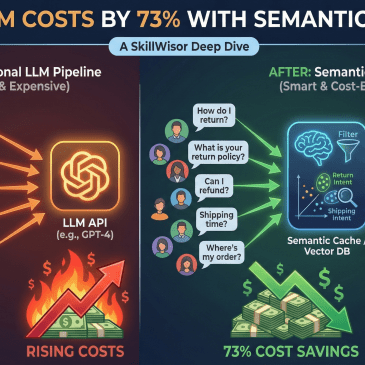
How Semantic Caching Can Slash Your LLM Costs by 73%: A Complete Implementation Guide
Most teams don’t overspend on LLMs because the model is expensive — they overspend because they answer the same question repeatedly.
In real production systems, nearly 65% of user queries are either exact duplicates or semantically similar to questions already answered before. Traditional caching captures only exact matches, leaving the biggest opportunity untouched.
This is where semantic caching changes the game.
By storing and retrieving responses based on meaning similarity (vector embeddings) instead of exact text, semantic caching can reduce LLM API calls by up to 73% — without sacrificing response quality.
In this article, we break down:
The real-world 18% / 47% / 35% query distribution
How vector similarity + cosine similarity actually work
A production-ready Python implementation
Why semantic caching is now mandatory infrastructure for LLM products
If you’re running LLMs in production, this is no longer an optimization — it’s survival. … More How Semantic Caching Can Slash Your LLM Costs by 73%: A Complete Implementation Guide















 SkillWisor