
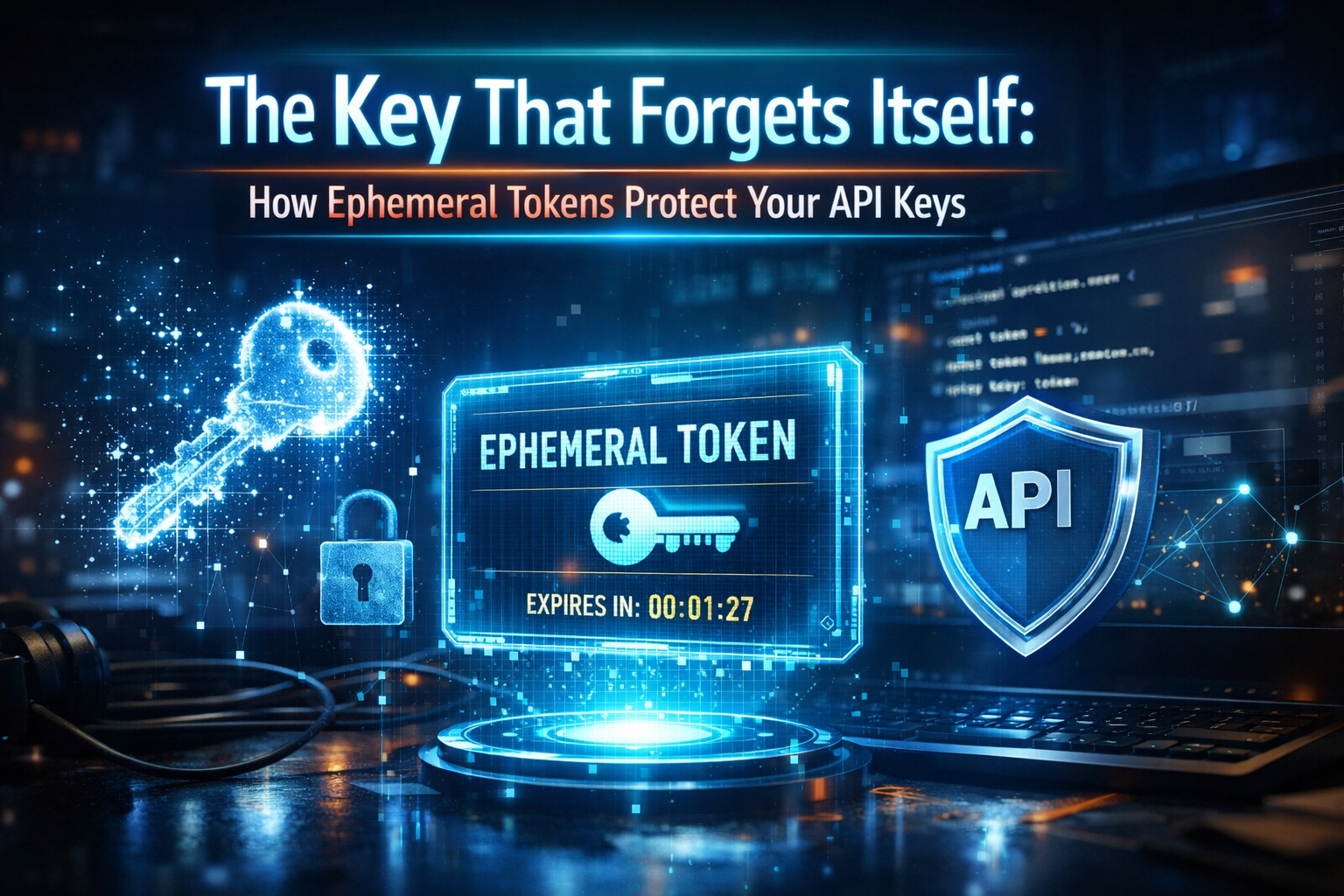
Every developer hits the same wall eventually — you need your frontend to call a powerful API directly, but your API key is a long-lived master credential. Putting it in client-side code is like leaving the keys to your house under the doormat. Ephemeral tokens solve this elegantly.
The Problem: Your Frontend Knows Too Much
When building real-time applications — live voice AI, streaming video analysis, sub-100ms audio responses — routing every API call through your backend adds too much latency. You need the client to connect directly. But if you put your real API key in the frontend, anyone who opens DevTools can steal it and rack up charges on your account indefinitely.
The naive fix is a backend proxy. But for latency-sensitive apps, that round-trip kills the experience. You need the frontend to connect directly without holding a credential that can be stolen and abused.
That’s exactly what ephemeral tokens are designed for.
The mental model: Give the frontend a valet key — it opens the car, starts the engine for one ride, then expires. The key to the vault never leaves your hands.
How It Works: The Three-Party Handshake
Ephemeral token issuance always involves three parties: your backend (the trusted authority), the token issuer (the API’s auth server), and the frontend (the untrusted client).
Step 1 — Your backend authenticates using your real API key. This is the only place the real key ever lives.
Step 2 — The auth server generates a fresh, independent token. This is the critical step. The server does NOT encrypt or encode your API key into the token. It generates a completely random string, stores a mapping on its own servers (token → scoped permissions), and hands that token out.
Step 3 — The frontend uses the token directly. It can now connect to the API with no backend proxy — but it only holds a short-lived, limited credential that reveals nothing about your real key.
What This Looks Like in Code (Google Gemini Live API)
On your backend (Node.js):
// Your real API key lives ONLY here — never sent to the clientconst client = new GoogleGenAI({ apiKey: process.env.GEMINI_API_KEY });app.get('/api/get-token', async (req, res) => { ensureUserIsAuthenticated(req); // your own auth check const tokenResponse = await client.auth_tokens.create({ model: 'gemini-2.0-flash-live-001', uses: 1, // single-use ttl: '60s' // expires in 60 seconds }); // Only the opaque token goes to the client res.json({ token: tokenResponse.name });});On your frontend (browser):
// Fetch the short-lived token from YOUR backendconst { token } = await fetch('/api/get-token').then(r => r.json());// Use the token instead of the real API keyconst ai = new GoogleGenAI({ apiKey: token });const session = await ai.live.connect({ model: 'gemini-2.0-flash-live-001' });// ✅ Direct WebSocket to Google — real API key never touched the browserWhy You Cannot Reverse-Engineer the API Key
This is not security through obscurity. There is a fundamental mathematical reason why the ephemeral token reveals nothing about the API key that created it.
When your backend calls auth_tokens.create(), here is what actually happens on the auth server:
token_id = CSPRNG(128 bits) ← cryptographically secure random numbertoken_str = base64url(token_id) ← this is what you receiveserver stores: token_str → { api_key_hash : HMAC_SHA256(master_secret, api_key), permissions : ["live-api-v1alpha"], uses_left : 1, expires_at : now() + 90 seconds }Notice two things. First, the token string is a random number — it was not derived from or encrypted from your API key. Second, even the server only stores a hash of your API key, not the key itself.
When the frontend uses the token, Google’s server looks it up in its own database, checks permissions, and decrements the use count. Your real API key is never reconstructed during this process.
There is simply no mathematical function that can convert the token back to the API key, because the token was never mathematically derived from the key in the first place. It is a random coat-check ticket. The coat-check staff know what ticket 4471 maps to — but the ticket itself contains no information about its contents.
This is different from a JWT (JSON Web Token), where the token actually contains a readable payload (just base64-encoded, not encrypted). An ephemeral opaque token contains nothing.
Is “Ephemeral Token” a Google Thing?
No. This is one of the most widely-used patterns in the entire tech industry. Google’s implementation for the Gemini Live API follows the same architecture that every major cloud provider uses.
OAuth 2.0 Access Tokens — The grandfather of the pattern, formalized in RFC 6749 (2012). Any app that uses “Sign in with Google/GitHub/Microsoft” is using this exact model. Short-lived bearer tokens that grant scoped access without exposing the underlying credentials.
AWS Security Token Service (STS) — aws sts get-session-token returns temporary IAM credentials that expire in 15 minutes to 36 hours. Used extensively for cross-account roles and federated access in enterprise AWS environments.
Twilio Access Tokens — Exactly the same pattern for browser-based WebRTC calls. Your backend generates a short-lived token; the browser connects to Twilio’s voice infrastructure directly without holding your Account SID or Auth Token.
Agora RTC Tokens — Real-time audio/video SDK used in many live streaming and video conferencing apps. Backend generates tokens per channel session; clients join directly.
Firebase App Check — Attests that requests come from a legitimate app instance. Short-lived attestation tokens replace API keys in client-side calls to Firebase services.
Supabase (anon key + Row Level Security) — The public anon key combined with database-level security policies acts as a scoped credential — limited by design rather than by secrecy.
The common thread in all of these: a trusted backend exchanges a long-lived master credential for a short-lived, scoped, opaque token that the untrusted frontend can safely hold.
What If Someone Intercepts The Token?
Ephemeral tokens don’t make you invincible — they dramatically shrink the blast radius of a compromise.
If someone steals your real API key:
- It works until you manually revoke it (could be days or weeks before you notice)
- It grants full access to all API capabilities in your project
- It can incur unlimited billing charges
- It requires emergency incident response to contain
If someone intercepts an ephemeral token:
- It expires in 90 seconds if not yet used to start a session
- It only works with the Live API — nothing else in your project
- It allows at most one session, lasting 30 minutes maximum
- It cannot be used to derive your real API key
- It self-destructs automatically — no action needed from you
In practice, an attacker who grabs your ephemeral token from the browser’s Network tab gets a 90-second window to start one Live API session. After that, worthless. This is the same security model as hotel key cards: they expire at checkout, and a found key card doesn’t tell you anything about the hotel’s master key system.
What This Pattern Actually Buys You
Zero credential exposure. Your real API key never reaches client memory, the browser’s network traffic, or DevTools. It physically cannot be found in the frontend.
Direct client connections without proxying. The frontend’s WebSocket or WebRTC connection goes straight to the API provider — no backend hop. For real-time AI applications, this can be the difference between a 50ms and a 250ms response.
Automatic damage control. Any stolen token self-destructs in minutes. No manual revocation, no incident response, no 3am alerts.
Scoped permissions. The token only unlocks the specific capability you configured — in Google’s case, only the Live API. A stolen token cannot be used to make regular Gemini API calls, access your other Google Cloud resources, or create new tokens.
Per-user issuance. Your backend controls who gets a token. Unauthenticated users never receive one. You can rate-limit token issuance, log every request, and revoke access per user — none of which is possible when everyone shares the same API key.
Summary
Ephemeral tokens work because they are genuinely random — not derived from or encrypted from your API key. There is no mathematical relationship between the token and the credential that created it. The token is merely a lookup key into the issuing server’s database.
This is an industry-standard pattern used by OAuth, AWS, Twilio, Agora, Firebase, and dozens of other platforms. Google’s implementation for the Gemini Live API is a textbook example of it, specifically designed to enable low-latency direct client connections in production.
The paradigm shift: instead of trying to protect a secret on the frontend (impossible), you issue time-limited vouchers. Even if they end up in the wrong hands, they contain nothing of value and expire before they can cause real damage.


Leave a Reply