

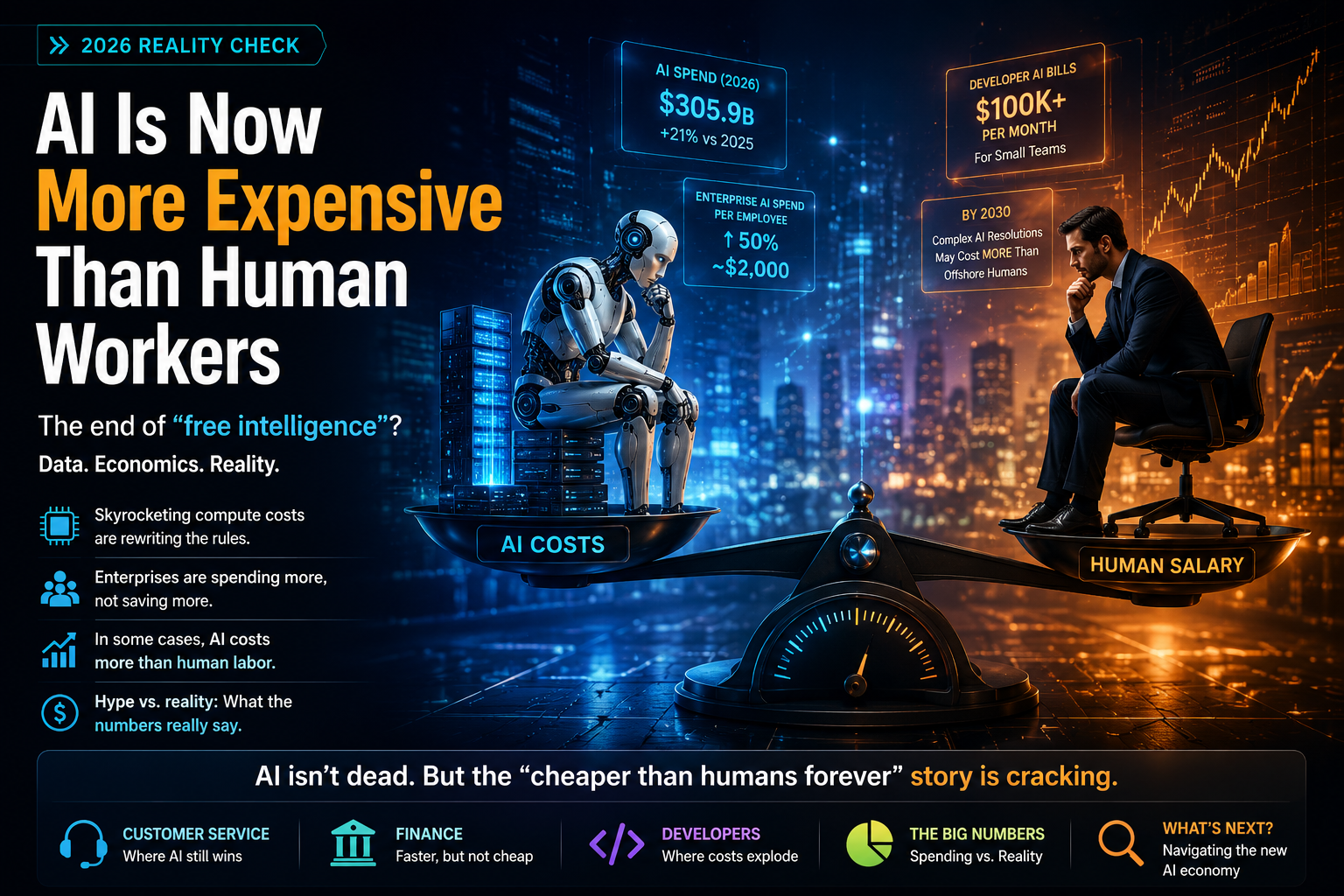

The hype promised cheaper, unlimited intelligence. The 2026 reality is far more complicated — and expensive.
For three years, the world was sold a simple, seductive narrative: Artificial Intelligence would replace expensive human labor. Investors believed it. Startups built billion-dollar pitches around it. Executives rushed into “AI-first” strategies. And employees feared for their jobs.
But 2026 is revealing something the market dramatically underestimated. AI is not cheap.
In fact, for many organizations, AI is now becoming more expensive than the humans it was supposed to replace. The operating costs behind large-scale AI adoption — GPU infrastructure, token usage, inference expenses, model retraining, hallucination monitoring, human oversight teams, compliance layers, and multi-model orchestration — are quietly shocking executives across every industry.
📊 The Big Numbers: What $305.9 Billion Looks Like
Global AI spending in 2026 is projected to reach $305.9 billion — a 21% increase over 2025. Enterprise AI spend per employee has risen 50% year-over-year to approximately $2,000 per person. Small developer teams are now regularly hitting $100K+ monthly AI bills.
⚡ NVIDIA’s Warning That Shook the Industry
One of the most jarring moments in the AI economics debate came straight from the company powering the boom. An NVIDIA VP publicly acknowledged:
“For my team, the cost of compute is far beyond the cost of employees.”
— NVIDIA VP, 2026
That single statement shattered one of the strongest market assumptions of our time. If NVIDIA — the very company whose GPUs underpin OpenAI, Anthropic, Google DeepMind, Meta, and thousands of startups — is admitting that compute costs are overtaking human labor costs, the problem is no longer theoretical.
Around the same time, Uber’s CTO revealed that his team burned through the entire 2026 AI budget in just the first four months — primarily on Claude coding agents. These are not isolated incidents. They are symptoms of a much larger economic shift.
🤖 Why Agentic AI Is Driving Costs Through the Roof
Earlier AI systems were relatively lightweight. You sent a prompt. The model returned an answer. Done.
Modern agentic AI systems are a completely different animal. Today’s agents think through multiple steps, call external tools, query databases, search documents, write and execute code, retry failed tasks, run background reasoning chains, maintain memory, and interact with APIs repeatedly — all in a single workflow.
JiEvery one of those actions burns tokens. Every token costs compute. Every compute cycle inflates infrastructure expenses. A single AI coding agent can generate hundreds of millions of tokens per month per developer. Multiply that across thousands of employees and the costs become staggering.
📞 Customer Service: The One Area Where AI Still Clearly Wins
To be fair, AI absolutely dominates in certain use cases — and customer support is the clearest winner.
- AI cost per interaction: $0.07 – $0.40 per minute
- Human agent cost: $7 – $12 per minute
- Gartner projected savings in 2026: $80 billion in labor costs
For repetitive, predictable tasks — password resets, order tracking, FAQ handling, appointment scheduling — AI is extraordinary. The economics are genuinely compelling.
The problem starts when complexity increases. Once conversations require emotional intelligence, context retention, policy interpretation, multi-step reasoning, escalation judgment, or regulatory compliance — human oversight becomes essential again. Organizations then discover a second cost layer: AI supervisors. Humans monitoring hallucinations, auditing responses, correcting mistakes, and maintaining compliance.
Many companies are not eliminating support teams. They are adding AI infrastructure on top of existing teams. Costs rise before savings appear.
🏦 Finance: Faster, But Not Cheaper
Finance is one of the most aggressive AI adopters — and the results are genuinely impressive in specific areas. AI systems now accelerate fraud detection, market forecasting, expense categorization, risk analysis, and automated reporting by 30–50%.
But enterprise AI budgets in finance are ballooning. Organizations are now paying simultaneously for AI licenses, custom integrations, private model hosting, security layers, compliance frameworks, dedicated AI teams, AI governance offices, vendor subscriptions, and internal tooling — all while paying the same human salaries.
The finance analyst was not replaced. The analyst now works alongside expensive AI infrastructure. The spreadsheet didn’t shrink. It just changed columns.
💻 Software Engineering: The Most Expensive AI Battleground
Software development may be the most revealing AI use case of all — because it is simultaneously where the productivity gains are most dramatic and where the cost surprises are most brutal.
Coding assistants are undeniably powerful. Developers generate boilerplate instantly, debug faster, write tests automatically, and build prototypes in hours. The productivity gains are real.
But coding tasks are uniquely expensive for AI models. Unlike simple text generation, software engineering requires long context windows, multi-file understanding, iterative reasoning, retry loops, tool calling, continuous execution, validation checks, and compilation cycles. A coding agent may generate, execute, fail, retry, debug, and regenerate code dozens of times for a single task. Each iteration burns additional tokens.
| Role | Human Salary (Est.) | AI Tools + Compute Cost (High Usage) |
|---|---|---|
| Customer Support | $8.50/month equiv. | $0.40/month |
| Finance Analyst | $7,000/month | $2,000/month |
| Software Developer | $8,000–12,000/month | $12,000+/month |
| Data Analyst | $4,500/month | $6,500/month |
The narrative was: “AI will replace expensive engineers.” Instead, companies are discovering: “AI may require expensive engineers plus expensive infrastructure.”
💥 Are We in an AI Bubble? The Numbers Are Hard to Ignore
Every major technology revolution follows a familiar arc: breakthrough → hype → investment → unrealistic expectations → economic reality check → market correction → sustainable adoption. We saw it with the dot-com boom, crypto cycles, EVs, the metaverse, and SaaS expansion.

AI may now be approaching its reality-check phase. Hundreds of billions are being invested in data centers, GPUs, model training, and acquisitions — while profits remain small relative to total expenditure. Many AI startups still rely heavily on investor funding rather than sustainable business economics.
$400B+ in capex. Tiny revenue. OpenAI warning publicly on compute bills. Michael Burry-level shorts incoming?
This does not mean AI is fake or collapsing. It simply means the market may have underestimated the cost of scaling intelligence.
🧠 The Most Important Truth: AI Still Needs Humans
The biggest misconception of the AI era was the belief that humans would disappear from workflows entirely. That hasn’t happened.
The strongest teams today are neither AI alone nor humans alone — but humans working with AI. The future belongs to smaller high-performance teams, AI-augmented employees, technical operators with AI leverage, and human judgment layered on top of machine output.
This is not the extinction of labor. It is the transformation of labor. Some jobs will disappear. New jobs will emerge. Certain industries will automate aggressively. Others will discover that humans remain cheaper and more reliable.
🎯 The Real Question: Can AI Replace Humans Profitably?
A system can technically automate work while still being economically irrational. That is exactly what some companies are beginning to realize.
2026 may be remembered as the year the AI conversation finally matured. The industry is moving beyond fantasy and into genuine questions of unit economics, profitability, scalability, operational efficiency, sustainable infrastructure, ROI, and enterprise viability.
The winners of the next decade will not simply be the companies with the biggest models. They will be the organizations that figure out how to deploy AI profitably, balance humans and machines efficiently, control compute costs, and build sustainable business models.
🔑 Key Takeaways
- ✅ AI can save money in the right use cases (customer service automation is the clearest win)
- ✅ AI can burn enormous money in the wrong use cases (agentic coding is the clearest risk)
- ✅ Human talent remains irreplaceable for complex, high-context, judgment-heavy work
- ✅ The future belongs to Humans + AI teams, not AI replacing humans entirely
- ✅ The era of “cheap AI forever” is over — the era of AI maturity has begun
The AI revolution is real. But the economics are only beginning to reveal themselves. And that may become the most important business story of the decade.
What is your experience with AI costs in your organization? Is AI saving you money — or adding to the bill? Share your perspective in the comments below.
📌 Follow SkillWisor for weekly AI insights, economics breakdowns, and career intelligence that cuts through the hype.

Leave a Reply