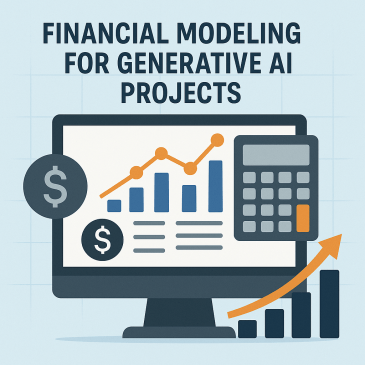
Mastering Gen AI Project Finances: Build, Forecast & Deliver ROI

Mastering the finances of a Generative AI project is not optionalβ€”it’s essential. From managing GPU costs and data acquisition to calculating ROI and TCO, this guide equips Gen AI Project Managers with a detailed financial model to justify investments, control budgets, and deliver real business value. Learn how to break down CAPEX and OPEX, track key performance metrics, and present a compelling case to leadership.

More Mastering Gen AI Project Finances: Build, Forecast & Deliver ROI

The Gen AI Project Manager: A Comprehensive Guide

The rise of Generative AI (Gen AI) is not just a technological revolution; it’s a paradigm shift in how businesses innovate, create, and operate. From crafting human-like text with Large Language Models (LLMs) to generating photorealistic images from simple prompts, Gen AI is unlocking unprecedented capabilities. However, transforming this potential into tangible business value is a complex endeavor. It requires more than just brilliant data scientists and machine learning engineers. It demands a new breed of leader.

Interested in learning more about the crucial role of a Gen AI Project Manager and how they navigate the unique lifecycle of AI projects? Read the full article for a deep dive into each phase, best practices for quality and cost management, and key responsibilities for success. Click here to read the full article! … More The Gen AI Project Manager: A Comprehensive Guide

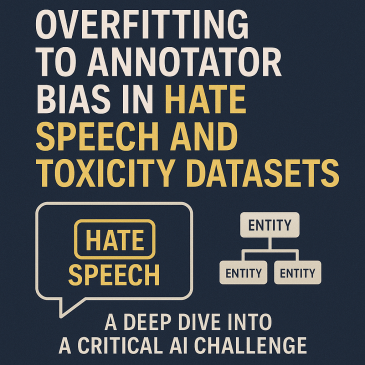
Overfitting to Annotator Bias in Hate Speech and Toxicity Datasets: A Deep Dive into a Critical AI Challenge

Is the AI designed to fight online hate actually making the problem worse?

Our hate speech detection models are learning and amplifying the unconscious biases of their human trainers. This leads to a dangerous paradox: the very systems built to protect vulnerable communities can end up silencing them.

This isn’t just a technical glitch; it’s a critical issue of digital fairness and equity. We’re failing to stop real harm while penalizing innocent conversations, especially from marginalized groups.

How do we fix it?

I wrote a detailed article exploring the deep-rooted problem of overfitting to annotator bias and the innovative strategies being developed to build fairer, more accurate AI.

Read the full article here

#AIforGood #AIEthics #ResponsibleAI #HateSpeech #ContentModeration #MachineLearning #DEI #BiasinAI … More Overfitting to Annotator Bias in Hate Speech and Toxicity Datasets: A Deep Dive into a Critical AI Challenge

Challenges in Annotations: Navigating the Complexity of Nested Entities

πŸ” The Annotation Challenge That’s Breaking AI Systems
When you see “CEO of Apple” in text, your brain instantly recognizes two entities: a job title AND a company. But training AI to do the same?

That’s where things get complicated.
The Problem: Traditional annotation systems treat entities as separate, non-overlapping units. But real language is messy. “CEO of Apple” contains:

A job title (CEO)
A company name (Apple)
A complete professional role (CEO of Apple)

Why This Matters:
β†’ Medical texts: “breast cancer tumor suppressor gene”
β†’ Legal documents: “Delaware corporation breach of contract”
β†’ Financial reports: “Q3 2023 Apple revenue forecast”
Each phrase contains multiple overlapping entities that current systems struggle to capture accurately.
The Impact: Poor annotation quality β†’ Inconsistent training data β†’ Unreliable AI models β†’ Failed real-world applications
The Solution Path:
βœ… Advanced tagging schemes beyond traditional BIO format
βœ… Multi-layer annotation interfaces
βœ… Graph-based entity modeling
βœ… Specialized training for annotators

Are you struggling with nested entity annotation in your NLP projects?

πŸ“– Read the full deep-dive article to discover:

Technical solutions for complex annotation challenges
Domain-specific strategies for biomedical, legal, and financial texts
Quality control frameworks that actually work
Emerging technologies that could solve the annotation bottleneck

πŸ‘‡ What’s your biggest annotation challenge?

Share your experience in the comments – let’s solve this together!

#NLP #MachineLearning #DataAnnotation #AI #ArtificialIntelligence #DataScience #TechChallenges #Innovation … More Challenges in Annotations: Navigating the Complexity of Nested Entities

Sensor Noise & Drift: Labelling in Imperfect Conditions

Sensor Noise & Drift: Labelling in Imperfect Conditions

A comprehensive 3000-word analysis covering:

β†’ 4 Types of Sensor Noise and their impact on data quality
β†’ Advanced Mitigation Strategies including Kalman filtering and ML-based denoising
β†’ Real-World Case Studies from automotive, healthcare, and industrial applications
β†’ Future Technologies including edge computing and quantum sensing
β†’ Practical Implementation guidelines for your next project

Perfect for: ML Engineers, Data Scientists, IoT Architects, and Technical Leaders dealing with sensor-based systems.

Read the full article: … More Sensor Noise & Drift: Labelling in Imperfect Conditions

AI Model Evaluation: Measuring Performance, Bias, and Reliability

AI Model Evaluation: Measuring Performance, Bias, and Reliability

Building an AI model is only half the battle; rigorously evaluating it is what separates a proof-of-concept from a production-ready, trustworthy system.

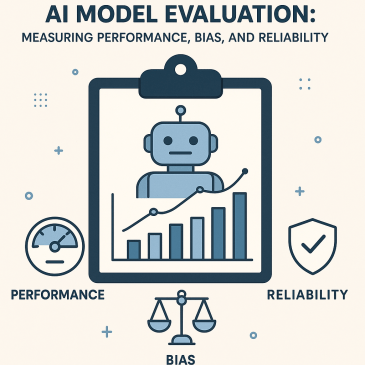
Effective AI evaluation goes far beyond a simple accuracy score. To deploy models responsibly, you must assess how well they perform, how fairly they treat all groups, and how reliably they handle real-world complexities.

This guide explores the three pillars of AI model evaluation:

Performance – How accurate and effective is the model for its intended task?

Bias – Does it produce equitable outcomes across different demographic groups?

Reliability – Can it be trusted under uncertainty, noise, and edge cases?

By embracing a multidimensional evaluation approach, we move closer to building AI systems that are not just intelligentβ€”but also ethical, transparent, and safe. … More AI Model Evaluation: Measuring Performance, Bias, and Reliability

A Comprehensive Guide to Multi-Modal Data Annotation

Beyond Single-Sense AI: Why Multi-Modal Data Annotation is the Future of Intelligent Systems

In today’s AI-driven world, models are no longer confined to understanding information from just one type of data. Imagine an AI that can not only read text but also see images, hear audio, and interpret video simultaneously – this is the power of multi-modal AI. But for these sophisticated systems to truly comprehend and interact with our complex world, they need equally sophisticated training data.

This is where Multi-Modal Data Annotation steps in. It’s the art and science of meticulously labeling and categorizing diverse data formatsβ€”text, images, video, and moreβ€”to teach AI models how to synthesize information just like humans do. From powering self-driving cars that see and understand their surroundings, to revolutionizing healthcare diagnostics that combine patient records with medical imagery, multi-modal annotation is the crucial backbone. Dive into our comprehensive guide to explore the intricate types of annotation, its game-changing applications across industries, and the significant risks of overlooking its quality. Get ready to understand why precise multi-modal data is not just an advantage, but a necessity for building the next generation of intelligent systems. … More A Comprehensive Guide to Multi-Modal Data Annotation

LangChain Deep Dive: Building Complex AI Applications with Chains, Agents, and Memory

LangChain Deep Dive: Building Complex AI Applications with Chains, Agents, and Memory

Discover how LangChain empowers developers to build intelligent, context-aware AI systems by combining modular components like Chains, Agents, and Memory. This deep dive covers everything from sequential workflows and autonomous decision-making to memory architectures and real-world use cases such as customer support automation and data analysis.

πŸ‘‰ If you’re serious about building production-ready AI tools, this is your roadmap.
Read the full article now and start building smarter AI systems. … More LangChain Deep Dive: Building Complex AI Applications with Chains, Agents, and Memory

Fine-tuning vs. Prompt Engineering: A Strategic Guide to AI Model Optimization

When Prompt Engineering Hits Its Ceiling

Most AI teams start with prompt engineeringβ€”and for good reason. It’s fast, flexible, and requires no specialized infrastructure. You can prototype solutions in hours, not weeks. But here’s what I’ve observed across dozens of implementations: there’s always a moment when carefully crafted prompts stop delivering the performance gains you need.
That moment typically arrives when you’re dealing with highly specialized domains, processing thousands of requests daily, or when consistency becomes more important than flexibility. A medical AI system analyzing radiology reports can’t rely on “please be accurate” in its promptsβ€”it needs to internalize medical reasoning patterns through fine-tuning. An e-commerce platform processing customer queries at scale can’t afford the token costs of lengthy, detailed prompts for every interaction.
The breakthrough insight? The most successful AI implementations don’t choose between fine-tuning and prompt engineeringβ€”they orchestrate both strategically.
Consider this hybrid approach: Start with a fine-tuned foundation model trained on your core domain knowledge, then use lightweight prompts to handle variations and edge cases. You get the deep specialization of fine-tuning with the adaptability of prompt engineering, while optimizing both performance and costs.
The organizations winning with AI aren’t just using these toolsβ€”they’re thinking systematically about when and how to combine them. They’re building AI systems that can evolve with their business needs while maintaining the reliability their operations demand. … More Fine-tuning vs. Prompt Engineering: A Strategic Guide to AI Model Optimization

How to Learn Machine Learning from Scratch in 2025

Machine Learning (ML) is no longer a futuristic concept; it’s an integral part of our present, shaping industries from healthcare and finance to entertainment and transportation. In 2025, the field continues its explosive growth, driven by advancements in data availability, computational power, and innovative algorithms. If you’re looking to enter this dynamic domain, whether for a career change, skill enhancement, or pure intellectual curiosity, learning Machine Learning from scratch might seem daunting. However, with a structured approach, dedication, and the right resources, it’s an achievable and incredibly rewarding endeavor.

This comprehensive guide will walk you through everything you need to know to begin your machine learning journey in 2025, from foundational prerequisites to advanced concepts, practical application, and staying ahead of the curve. The ML landscape in 2025 is defined by powerful trends like Generative AI, Multimodal AI Systems, and the growing importance of Explainable and Ethical AI. A successful learning path starts with building a strong foundation in mathematics (linear algebra, calculus, probability, and statistics) and programming (Python and its essential libraries like NumPy, Pandas, Matplotlib, and Scikit-learn). From there, you’ll delve into core concepts of supervised and unsupervised learning, deep learning fundamentals, and even explore reinforcement learning. Crucially, the journey culminates in hands-on projects and portfolio building, transforming theoretical knowledge into practical skills for real-world applications. … More How to Learn Machine Learning from Scratch in 2025

Edge AI Architecture for Smartphones: Revolutionizing Mobile Intelligence

The AI Revolution is Happening in Your Pocket – And Most People Don’t Even Know It
Your smartphone just got exponentially smarter, but the biggest breakthrough isn’t happening in the cloud – it’s happening right in your hand. Edge AI architecture is silently revolutionizing how mobile devices think, learn, and respond, bringing artificial intelligence directly to your fingertips without ever sending your personal data to remote servers.

Imagine AI that responds instantly, protects your privacy completely, and works even when you’re offline. That’s not a future promise – it’s happening right now with Neural Processing Units, optimized software stacks, and breakthrough model deployment strategies that are reshaping the mobile landscape.

The companies that understand edge AI architecture today will dominate tomorrow’s mobile market. While competitors struggle with cloud latency and privacy concerns, early adopters are building lightning-fast, privacy-first applications that users can’t live without.

But here’s the challenge: implementing edge AI isn’t just about having better hardware. It requires mastering complex optimization techniques, navigating resource constraints, and balancing performance with power efficiency. The technical knowledge gap is real, and it’s growing every day.

Don’t let your competition get ahead while you’re still thinking cloud-first. The edge AI transformation is accelerating, and the window for gaining a competitive advantage is closing fast.

Ready to unlock the full potential of edge AI architecture? The future of mobile intelligence is in your hands – literally. … More Edge AI Architecture for Smartphones: Revolutionizing Mobile Intelligence

Edge AI Revolution: How Advanced Mobile Processors Enable On-Device Intelligence

Edge AI Revolution: The Future is in Your Pocket – Don’t Get Left Behind
The mobile technology landscape is experiencing a seismic shift as artificial intelligence capabilities migrate from distant cloud servers directly to our smartphones.

This evolution toward edge AI isn’t just about faster processingβ€”it’s fundamentally redefining what’s possible with mobile intelligence while addressing critical privacy concerns that have limited AI adoption.

Here’s what you need to know RIGHT NOW:
Unlike traditional cloud-based AI that requires constant connectivity and raises privacy questions, edge AI processes everything locally on your device. Samsung’s Galaxy AI system, powered by Qualcomm’s award-winning Snapdragon Elite processors, exemplifies this transformation. With specialized Neural Processing Units delivering sophisticated AI capabilitiesβ€”from real-time translation across 40+ languages to advanced photo editingβ€”all without your personal data ever leaving your device.
The Snapdragon 8 Elite, recognized as 2024’s Best Edge AI Processor, demonstrates how dedicated AI hardware can deliver cloud-level intelligence with smartphone efficiency. Its multi-modal processing capabilities enable simultaneous understanding of voice, text, and images, creating truly intuitive user experiences that work offline and respond instantly.

As AI smartphones are projected to capture over 30% of the market by 2025, edge AI represents more than technological advancementβ€”it’s the foundation for a new era of mobile computing where privacy, performance, and intelligence converge seamlessly in devices we carry every day.

The window to understand and leverage this technology is closing fast. Read the full article now to discover how edge AI will impact your industry, your privacy, and your daily life. … More Edge AI Revolution: How Advanced Mobile Processors Enable On-Device Intelligence

Machine Learning and Deep Learning Algorithms: A Comprehensive Guide

Machine Learning is no longer just a buzzwordβ€”it’s the engine powering today’s smartest systems. In this post, we break down the most important ML algorithmsβ€”from classics like Linear and Logistic Regression to advanced architectures like LSTM and Transformers. Whether you’re a beginner or brushing up your skills, this guide gives you clarity, use-cases, and the intuition behind each technique.

Learn how to pick the right algorithm for your projectβ€”with examples and practical tips. … More Machine Learning and Deep Learning Algorithms: A Comprehensive Guide

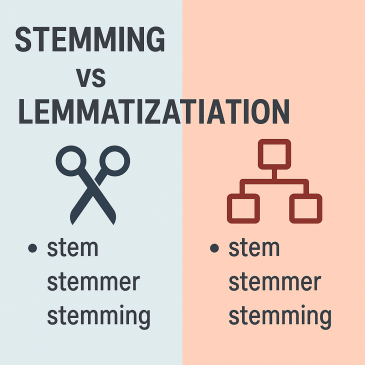
Stemming vs Lemmatization: Which One Should You Use?

The Decision That Could Make or Break Your NLP Project
Picture this: You’ve built what seems like the perfect text analysis model, but it’s either crawling at a snail’s pace or producing results that make no sense. The culprit? You chose the wrong text preprocessing technique.
In natural language processing, the choice between stemming and lemmatization isn’t just a technical detailβ€”it’s a strategic decision that impacts everything from processing speed to accuracy. While stemming can process 10,000 words in 0.1 seconds, lemmatization takes 2-5 seconds but delivers 85-95% accuracy compared to stemming’s 60-80%.
Here’s the reality most developers face: Stemming gives you speed but produces non-words like “bett” from “better,” while lemmatization correctly identifies “better” as “good” but demands significant computational resources.
The stakes are high. Choose stemming for your sentiment analysis system, and you might miss crucial emotional nuances. Pick lemmatization for your large-scale search engine, and users will abandon your slow platform.
But what if you could make this decision with confidence, knowing exactly when each technique shines and when it fails?
Ready to master the art of choosing between stemming and lemmatization? Our comprehensive guide reveals the decision framework that top NLP engineers use, complete with real-world examples, performance benchmarks, and hybrid approaches that give you the best of both worlds. … More Stemming vs Lemmatization: Which One Should You Use?

Named Entity Recognition (NER): What, Why, and How

Named Entity Recognition is a fundamental task in natural language processing that involves identifying and classifying named entities within text. These entities represent real-world objects such as people, organizations, locations, dates, monetary values, and other specific items that carry semantic meaning. As one of the core components of information extraction, NER serves as a bridge between unstructured text and structured data, making it invaluable for numerous applications in the modern digital landscape. … More Named Entity Recognition (NER): What, Why, and How

The Complete Guide to Machine Learning Algorithm Selection: A Practical Framework for Data Scientists

Struggling to choose the right ML algorithm for your project?

You’re not alone. With dozens of algorithms available, selecting the optimal approach often feels like navigating a maze blindfolded.

The difference between a successful ML project and a failed one often comes down to this crucial decision.

Most data scientists fall into the trap of either defaulting to familiar algorithms or jumping to the most complex solutions. But here’s the truth: the best algorithm isn’t always the most sophisticated one – it’s the one that perfectly matches your problem constraints, data characteristics, and business requirements.

Our comprehensive framework breaks down algorithm selection into six core problem types, each with specific algorithmic recommendations. From knowing when logistic regression beats XGBoost, to understanding why K-means might fail where DBSCAN succeeds, this guide provides the systematic approach you need to make confident decisions.

Whether you’re building your first model or optimizing production systems, having a structured decision framework eliminates guesswork and accelerates your path to successful ML deployments. … More The Complete Guide to Machine Learning Algorithm Selection: A Practical Framework for Data Scientists

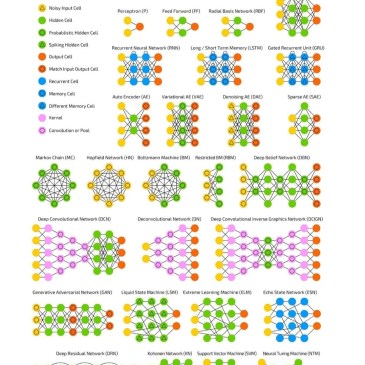
The Neural Networks Zoo: A Comprehensive Guide to Architectures and Applications

Ready to truly master the fascinating world of Artificial Neural Networks? Our comprehensive guide, “The Neural Networks Zoo,” meticulously breaks down each architecture, from the foundational Perceptron to cutting-edge GANs and NTMs.
🌐 Uncover the secrets behind how these powerful models learn, process data, and drive today’s AI revolution. Whether you’re a curious beginner or a seasoned AI enthusiast, this article is your essential roadmap to understanding the diverse landscape of deep learning.

πŸ‘‰ Don’t just observe the zoo – understand it!

Click here to explore the full article and elevate your AI knowledge today! πŸ’‘πŸ“š … More The Neural Networks Zoo: A Comprehensive Guide to Architectures and Applications

The Complete Guide to Activation Functions in Neural Networks: From Simple Concepts to Advanced Applications

Understanding Activation Functions: The Decision Makers of Neural Networks
From “The Complete Guide to Activation Functions in Neural Networks: From Simple Concepts to Advanced Applications”
Imagine you’re teaching a computer to recognize pictures of cats and dogs. At each step, the computer needs to make crucial decisionsβ€””Does this pixel pattern look more like whiskers or floppy ears?” This is where activation functions come into play, serving as the decision-makers in artificial neural networks that help computers process information and make these vital choices.
Activation functions are mathematical equations that determine whether a neuron should be “activated” or not. Think of them as sophisticated light switches that can be completely off, completely on, or dimmed to various levels. Without these functions, even the most complex neural networks would behave like simple linear regression models, severely limiting their ability to solve real-world problems.
From the foundational Sigmoid and ReLU functions to cutting-edge innovations like Mish and Swish, each activation function brings unique properties to the table. ReLU revolutionized deep learning with its simplicityβ€”acting like a one-way valve that passes positive values unchanged while blocking negative ones. Meanwhile, newer functions like Mish combine the best features of multiple activations, creating Swiss Army knife-like versatility that often outperforms traditional options.
The choice between these functions can dramatically impact your model’s performance, training speed, and computational requirements. While beginners should start with ReLU for its simplicity and effectiveness, advanced practitioners might leverage Mish for state-of-the-art performance or Hard Sigmoid for mobile applications where computational efficiency is paramount.
Understanding these mathematical building blocks isn’t just academicβ€”it’s practical knowledge that can make the difference between a model that struggles to learn and one that achieves breakthrough performance… … More The Complete Guide to Activation Functions in Neural Networks: From Simple Concepts to Advanced Applications

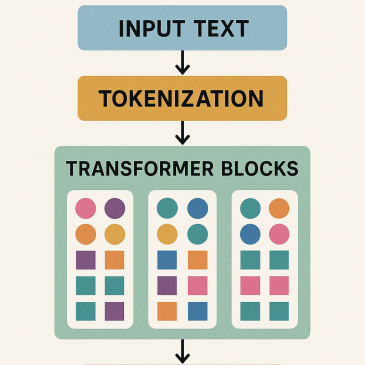
How LLMs Run Locally: A Comprehensive Guide

Large Language Models (LLMs) have transformed AI by enabling powerful natural language understanding and generation. While cloud-based APIs dominate usage, running LLMs locally on personal devices is gaining traction due to benefits like privacy, lower latency, and offline functionality. This guide dives deep into the six key stages of local LLM operationβ€”from user input, model loading and optimization, tokenization, context encoding, decoding responses, to logging and monitoringβ€”highlighting the technical challenges and optimizations needed for efficient deployment. With advances in hardware, software, and model design, local LLMs are poised to democratize AI access by delivering powerful capabilities directly to users without relying on the cloud. … More How LLMs Run Locally: A Comprehensive Guide

Advanced Techniques for Training Large Language Models

The rise of Large Language Models (LLMs) has reshaped the AI landscape, bringing powerful capabilities across NLP, code generation, and automation. But training and deploying these giants comes at a steep costβ€”computationally and financially.

This article explores the critical need for efficient LLM training, diving into the concept of knowledge distillationβ€”a technique where a large “teacher” model guides the learning of a smaller “student” model.

From soft-label distillation, which captures nuanced predictions, to hard-label distillation for simpler implementation, and co-distillation for mutual learningβ€”each method offers a path to scaling LLMs in real-world applications without compromising performance.

If you’re building or optimizing AI models, this deep dive is your go-to guide for unlocking efficiency without losing intelligence. … More Advanced Techniques for Training Large Language Models

GraphRAG: Unlocking Deeper Insights with Knowledge-Powered LLMs

Tired of LLM responses that scratch the surface? Is your RAG system missing the crucial connections in your data?

Traditional Retrieval Augmented Generation (RAG) has revolutionized how Large Language Models access external knowledge, but it often falls short when dealing with complex, interconnected information. If you’re looking to unlock deeper insights, enable sophisticated multi-hop reasoning, and ground your AI in verifiable facts, it’s time to look beyond simple vector search.

Introducing GraphRAG: The next evolution in AI knowledge retrieval. By harnessing the power of knowledge graphs, GraphRAG empowers your LLMs to understand not just what information exists, but how it’s all connected. Imagine AI that can navigate complex relationships, uncover hidden patterns, and provide truly nuanced answers.

Ready to transform your AI’s understanding of the world? Dive into our comprehensive guide on GraphRAG to explore:

The limitations of traditional RAG that GraphRAG overcomes.
Core components: from graph construction to advanced retrieval strategies.
Real-world use cases transforming industries like finance, research, and customer intelligence.
A conceptual roadmap to building your own GraphRAG system.
Don’t just retrieve data, understand its fabric. Read the full article to discover how GraphRAG can elevate your AI capabilities! … More GraphRAG: Unlocking Deeper Insights with Knowledge-Powered LLMs

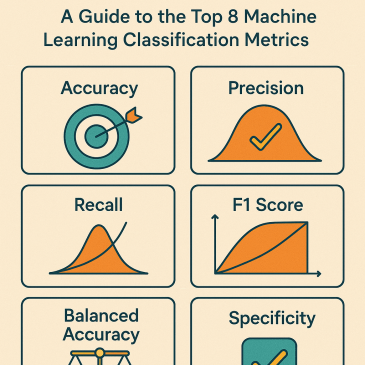
Decoding Model Performance: A Guide to the Top 8 Machine Learning Classification Metrics

When building a machine learning classification model, success isn’t just about making predictionsβ€”it’s about making the right predictions. But how do you measure that? This guide walks you through the Top 8 classification metricsβ€”including Accuracy, Precision, Recall, F1 Score, ROC-AUC, and moreβ€”that every data scientist should understand. Whether you’re detecting spam, diagnosing diseases, or flagging fraud, knowing which metric to use (and when) is critical. Get ready to confidently evaluate your model’s performance and make smarter, data-driven decisions. … More Decoding Model Performance: A Guide to the Top 8 Machine Learning Classification Metrics

Building AI Agents: An Elaborated Learning Roadmap for Beginners to Experts

AI agents are the next frontier in autonomous systems, capable of perceiving environments, processing information, and executing goal‑driven actions. Whether you’re just starting out or aiming to build production‑grade agents, this roadmap walks you through every stage: from mastering Python and TypeScript fundamentals, understanding machine learning paradigms and large language models, to implementing API integrations, prompt engineering, and retrieval‑augmented generation. You’ll then explore advanced architectures, multi‑agent collaboration, and best practices for deployment, evaluation, and ethical alignment. By the end, you’ll have a clear, structured path to go from a novice coder to an expert AI agent developer ready to tackle real‑world challenges.

More Building AI Agents: An Elaborated Learning Roadmap for Beginners to Experts

A Comprehensive Guide to AI Agents: Understanding Their Functionality, Technology, and Applications

In the evolving landscape of Artificial Intelligence, AI agents are becoming the engine behind automation, smart decision-making, and human-AI collaboration.

These autonomous systems perceive their surroundings, process data, make intelligent decisions, and take goal-driven actions β€” all while continuously learning and adapting. From virtual assistants and recommendation engines to autonomous vehicles and industrial robots, AI agents are redefining what machines can do.

This comprehensive guide breaks down how AI agents function, the technology that powers them, and their real-world applications across industries. Whether you’re an AI enthusiast, developer, or business leader, this article equips you with the knowledge to understand β€” and leverage β€” the transformative power of AI agents. … More A Comprehensive Guide to AI Agents: Understanding Their Functionality, Technology, and Applications

The Comprehensive Data Science Life Cycle: From Data to Insights

From defining business goals to deploying machine learning models and communicating insights, the Data Science Life Cycle is more than just crunching numbers. This blog walks you through every critical phase β€” from business understanding, data acquisition, and preparation, to modeling, evaluation, and real-world deployment. You’ll also explore advanced techniques, ethical best practices, and case studies across industries like healthcare, retail, and finance. Plus, get ahead of the curve with emerging trends like AutoML, MLOps, and Federated Learning.

More The Comprehensive Data Science Life Cycle: From Data to Insights

Deconstructing AI: A Deep Dive into the 7 Layers of Model Architecture

Okay, here are the blog excerpt and the LinkedIn post, both crafted with a call-to-action focus.

Blog Excerpt:

Deconstructing AI: A Deep Dive into the 7 Layers of Model Architecture
Have you ever felt like Artificial Intelligence is a bit of a “black box”? We marvel at its capabilities, from recognizing faces to writing code, but understanding how it works beneath the surface can feel daunting. The reality is, complex AI systems aren’t monolithic entities; they are intricate structures built upon distinct, interconnected layers, each serving a critical function.

To truly grasp the power and potential of AI, or even to effectively build, deploy, or debug it, we need to move beyond the surface level. We need to deconstruct it.

In this deep dive, we unveil a framework for understanding AI architecture through 7 fundamental layers. From the physical silicon that powers computation to the final interface users interact with, we’ll peel back the layers one by one. You’ll discover:

The absolute bedrock: The Physical Hardware Layer where electrons flow and tensors multiply.
The essential connective tissue: The Data Link Layer ensuring seamless operation.
The core engine: The Computation Layer where the heavy lifting of inference and processing happens.
And much more, right up to the Application Layer you interact with daily.
Understanding these layers isn’t just academic; it’s empowering. It provides clarity, enables better decision-making, and opens up possibilities for innovation. Ready to demystify the AI black box and build a solid foundational understanding?

Continue reading the full article to explore each of the 7 layers in detail and transform your understanding of AI architecture! … More Deconstructing AI: A Deep Dive into the 7 Layers of Model Architecture

Large Language Model Architecture: A Comprehensive Guide

Dive deep into the world of Large Language Models with this all-in-one guideβ€”covering everything from tokenization to training infrastructure, decoding the magic of attention mechanisms, and even building your own Mini-LLM from scratch. Whether you’re a curious learner or an AI builder, this is your blueprint to mastering modern NLP.

More Large Language Model Architecture: A Comprehensive Guide

The Rise of Agentic RAG: Essential Patterns Transforming AI Systems

🧠 RAG is evolvingβ€”are you keeping up?

In this deep-dive blog, I break down 6 distinct Retrieval-Augmented Generation (RAG) patternsβ€”from Naive RAG to Multi-Agent RAGβ€”and explain when and why to use each.

Whether you’re building GenAI systems or optimizing LLM performance, these insights will help you choose the right architecture for your needs.

βœ… Real-world relevance
βœ… Visual A5 infographic
βœ… Actionable use cases

πŸ‘‰ Read the full breakdown and grab the shareable infographic now.

More The Rise of Agentic RAG: Essential Patterns Transforming AI Systems

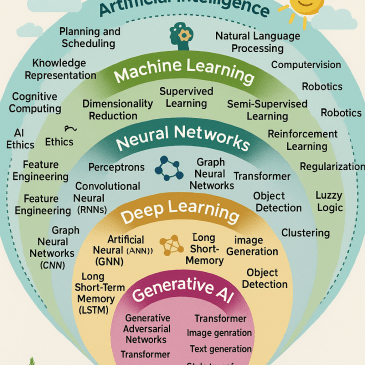
The AI Universe: A Comprehensive Guide to Artificial Intelligence

The AI Universe encompasses a vast array of interconnected disciplines, methodologies, and applications that continue to expand at an unprecedented pace. From the broad concept of Artificial Intelligence to specialized domains like Machine Learning, Neural Networks, Deep Learning, and cutting-edge Generative AI, each layer builds upon the previous one, creating increasingly sophisticated frameworks for machines to perceive, learn, reason, and create.

Consider Natural Language Processing, which enables machines to understand and generate human language. Modern NLP systems leverage deep learning to analyze text and speech data, extract meaning, and generate human-like responses. The development of transformer models has revolutionized this field, enabling unprecedented capabilities in language understanding and generation that power everything from customer service chatbots to sophisticated content creation tools.

Similarly, Computer Vision technologies allow machines to “see” and interpret the visual world, with applications spanning manufacturing quality control, medical imaging diagnostics, autonomous vehicles, and augmented reality experiences. Convolutional Neural Networks have been particularly instrumental in advancing these capabilities, achieving human-level accuracy in many visual recognition tasks.

As we move deeper into the AI Universe, we encounter transformative technologies like Generative AI, which represents perhaps the most visible frontier in artificial intelligence today. These systems can create new contentβ€”from realistic images and coherent text to music and codeβ€”opening new possibilities for creativity, productivity, and human-machine collaboration. … More The AI Universe: A Comprehensive Guide to Artificial Intelligence

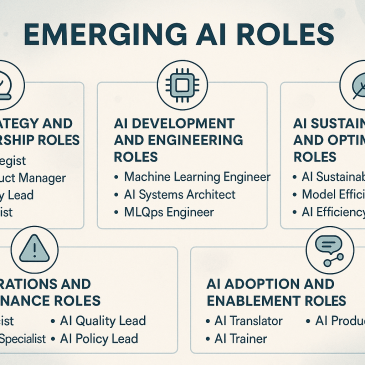
Emerging AI Job Roles: The New Frontier of Artificial Intelligence Careers

Unlocking the Future of Work: Emerging Roles in AI You Need to Know

Artificial Intelligence is no longer a buzzwordβ€”it’s a business imperative.

As organizations race to integrate AI across every facet of operations, a new breed of roles is emerging to meet the demand. From AI Ethicists to Prompt Engineers, the future of work is being reshaped by innovation, governance, and cross-functional expertise.

Whether you’re a business leader planning your AI roadmap or a tech enthusiast eyeing the next big career move, understanding these new roles is your gateway to staying ahead.

πŸ” Ready to discover which AI career path fits your strengths? πŸ“ˆ Want to build a future-proof AI team for your organization?

πŸ‘‰ Dive into the full article and take the first step toward becoming an AI leader of tomorrow.

🧠 Read the full article here : … More Emerging AI Job Roles: The New Frontier of Artificial Intelligence Careers

The Complete Guide to AI Terminology: Understanding Concept Drift, Data Munging, and More

Navigating AI Terminology: One Concept, Many Names

In the world of artificial intelligence, language can be just as complex as the models themselves. A single concept might be known as “model decay” in production environments, “model drift” in data science circles, and “concept drift” in academic papers.

This guide breaks down 15 of the most commonly misunderstood AI terms, revealing their alternative names, subtle nuances, and how they show up in real-world applications. Whether you’re a practitioner, student, or simply AI-curious, this resource is your key to decoding the language of AI with clarity and confidence. … More The Complete Guide to AI Terminology: Understanding Concept Drift, Data Munging, and More

Efficient Token Management and API Cost Optimization for AI SaaS Applications

πŸ”Ή Token Optimization Techniques πŸ”Ή

Understanding and applying the right optimization techniques can significantly enhance model performance. From truncation and dynamic padding to byte pair encoding and prompt engineering β€” mastering these strategies is key to efficient AI development. Here’s a crisp, visual guide to the major techniques every ML enthusiast and practitioner should know!

More Efficient Token Management and API Cost Optimization for AI SaaS Applications

Advanced Embedding Techniques: Powering the Next Generation of AI

Embeddings are the numerical language of AI, representing complex data points as vectors that capture meaning and relationships.

While static embeddings were foundational, the AI landscape is rapidly moving towards dynamic, context-aware, and interconnected representations. As of March 2025, the focus is on advanced techniques like Dynamic Embeddings (capturing meaning based on context), Multimodal Embeddings (bridging information across text, images, etc.), and Graph Embeddings (understanding relationships and structure).

These aren’t just theoretical concepts; they are actively transforming critical AI applications such as advanced search, sophisticated recommendation systems, and the creation and utilization of knowledge graphs.

Delve deeper into this rapidly evolving field to understand how these techniques work, their advantages, challenges, and their profound impact on the future of Artificial Intelligence. Learn how AI’s ability to understand and represent the world is reaching new levels. … More Advanced Embedding Techniques: Powering the Next Generation of AI

AI Safety, Alignment, and Governance: Navigating the Future of Intelligent Systems

As AI systems become increasingly powerful and autonomous, the critical importance of ensuring their safety, alignment with human values, and effective governance has transitioned from theoretical discussion to urgent global priority. By March 2025, conversations around these topics are more nuanced, technical challenges clearer, and the need for robust frameworks more apparent than ever.

This article delves into the interconnected concepts of AI safety, alignment, and governance, exploring technical approaches, regulatory landscapes, the necessity of auditing, and strategies for mitigating potential risks. From the increasing capabilities and autonomy of AI to the complexities of aligning systems with human values and the evolving global regulatory frameworks, we examine the multifaceted challenge of building trustworthy AI.

The deliberate misuse of AI capabilities is also a significant concern, requiring proactive mitigation strategies. Ultimately, navigating this complex terrain is a shared responsibility that demands sustained effort and collaboration for a future where AI serves humanity’s best interests. Read the full article to understand the depth of these challenges and the path forward. … More AI Safety, Alignment, and Governance: Navigating the Future of Intelligent Systems

The AI Implementation Spectrum: From Automation to Agentic AI

The AI Revolution: A Glimpse into Our Future

Imagine a world where machines can think and learn like humans. Welcome to the era of artificial intelligence (AI), where this once-futuristic concept is now a reality. From self-driving cars to virtual assistants, AI is transforming industries and reshaping our daily lives. But with great power comes great responsibility. As AI systems become more advanced, we must grapple with ethical questions and potential risks. How do we ensure that AI benefits humanity while minimizing harm? Join us as we explore the fascinating world of AI and its profound implications for our future. … More The AI Implementation Spectrum: From Automation to Agentic AI